Posts tagged as:

I’ve spent a great deal of time here defending “techno-optimism” or “Internet optimism” against various attacks through the years, so I was interested to see Cory Doctorow, a novelist and Net activist, take on the issue in a new essay at Locus Online.  I summarized my own views on this issue in two recent book chapters. Both chapters appear in The Next Digital Decade and are labeled “The Case for Internet Optimism.” Part 1 is sub-titled “Saving the Net From Its Detractors” and Part 2 is called “Saving the Net From Its Supporters.” More on my own thoughts in a moment. But let’s begin with Doctorow’s conception of the term.

Doctorow defines “techno-optimism” as follows:

In order to be an activist, you have to be… pessimistic enough to believe that things will get worse if left unchecked, optimistic enough to believe that if you take action, the worst can be prevented. […] Techno-optimism is an ideology that embodies the pessimism and the optimism above: the concern that technology could be used to make the world worse, the hope that it can be steered to make the world better.

What this definition suggests is that Doctorow has a very clear vision of what constitutes “good” vs. “bad” technology or technological developments. He turns to that dichotomy next as he seeks to essentially marry “techno-optimism” to a devotion to the free/open software movement and a rejection of “proprietary technology”: Continue reading →

Here’s the first of two essays I’ve recently penned making “The Case for Internet Optimism.” This essay was included in the book, The Next Digital Decade: Essays on the Future of the Internet (2011), which was edited by Berin Szoka and Adam Marcus of TechFreedom.  In these essays, I identify two schools of Internet pessimism: (1) “Net Skeptics,” who are pessimistic about the Internet improving the lot of mankind; and (2) “Net Lovers,” who appreciate the benefits the Net brings society but who fear those benefits are disappearing, or that the Net or openness are dying.  (Regular readers of this blog will be familiar with these themes since I sketched them out in previous essays here such as, “Are You an Internet Optimist or Pessimist?” and “Two Schools of Internet Pessimism.”) The second essay is here.

This essay focuses on the first variant of Internet pessimism, which is rooted in general skepticism about the supposed benefits of cyberspace, digital technologies, and information abundance. The proponents of this pessimistic view often wax nostalgic about some supposed “good ‘ol days” when life was much better (although they can’t seem to agree when those were). At a minimum, they want us to slow down and think twice about life in the Information Age and how it’s personally affecting each of us.  Occasionally, however, this pessimism borders on neo-Ludditism, with some proponents recommending steps to curtail what they feel is the destructive impact of the Net or digital technologies on culture or the economy.  I identify the leading exponents of this view of Internet pessimism and their major works. I trace their technological pessimism back to Plato but argue that their pessimism is largely unwarranted. Humans are more resilient than pessimists care to admit and we learn how to adapt to technological change and assimilate new tools into our lives over time. Moreover, were we really better off in the scarcity era when we were collectively suffering from information poverty?  Generally speaking, despite the challenges it presents society, information abundance is a better dilemma to be facing than information poverty.  Nonetheless, I argue, we should not underestimate or belittle the disruptive impacts associated with the Information Revolution.  But we need to find ways to better cope with turbulent change in a dynamist fashion instead of attempting to roll back the clock on progress or recapture “the good ‘ol days,” which actually weren’t all that good.

Down below, I have embedded the entire chapter in a Scribd reader, but the essay can also be found on the TechFreedom website for the book as well as on SSRN.  I have also includes two updated tables that appeared in my old “optimists vs. pessimists” essay.  The first lists some of the leading Internet optimists and pessimists and their books. The second table outlines some of the major lines of disagreement between these two camps and I divided those disagreements into (1) Cultural / Social beliefs vs. (2) Economic / Business beliefs.

Continue reading →

[I’ve been working on an outline for a book I hope to write surveying technological skepticism throughout history. I first started thinking about this topic two years when I noticed that a great number of recent books about Internet policy could generally be grouped into one of two camps: Internet optimists vs. Internet pessimists. I subsequently penned an essay on the subject that generated a fair bit of attention. So, I figured I must be on to something, and the more Net policy books I read, the more I realized that the divisions between these two camps were growing wider and increasingly heated. Thus, I thought I would share this very rough draft (much of it still in outline form) of the opening chapter of that book I want to write about this great intellectual war over the impact of technology on society. I invite reader input. Update Jan. 2011: I finally published a full-length essay on this topic. You can find it here. ]

__________

The impact of technological change on culture, learning, and morality has long been the subject of intense debate, and every technological revolution brings out a fresh crop of both pessimists and pollyannas. Indeed, a familiar cycle has repeat itself throughout history whenever new modes of production (from mechanized agriculture to assembly-line production), means of transportation (water, rail, road, or air), energy production processes (steam, electric, nuclear), medical breakthroughs (vaccination, surgery, cloning), or communications techniques (telegraph, telephone, radio, television) have appeared on the scene.

The cycle goes something like this. A new technology appears. Those who fear the sweeping changes brought about by this technology see a sky that is about to fall. These “techno-pessimists” predict the death of the old order (which, ironically, is often a previous generation’s hotly-debated technology that others wanted slowed or stopped).  Embracing this new technology, they fear, will result in the overthrow of traditions, beliefs, values, institutions, business models, and much else they hold sacred.

The pollyannas, by contrast, look out at the unfolding landscape and see mostly rainbows in the air. Theirs is a rose-colored world in which the technological revolution du jour is seen as improving the general lot of mankind and bringing about a better order.  If something has to give, then the old ways be damned! For such “techno-optimists,” progress means some norms and institutions must adapt—perhaps even disappear—for society to continue its march forward.

Our current Information Revolution is no different. It too has its share of techno-pessimists and techno-optimists. Indeed, before most of us had even heard of the Internet, people were already fighting about it—or at least debating what the rise of the Information Age meant for our culture, society, and economy. Continue reading →

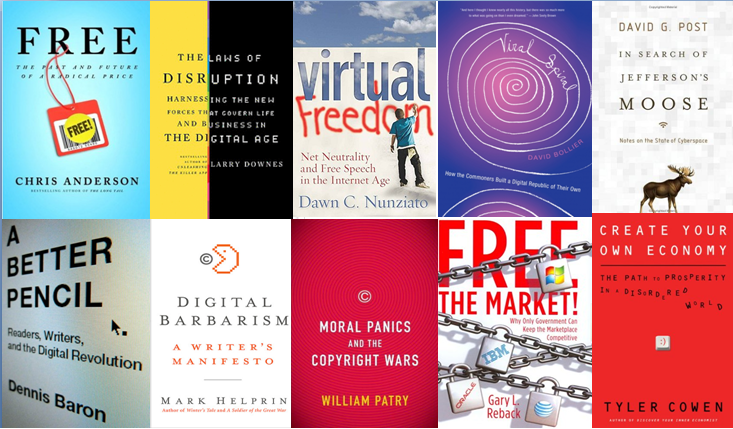
2009 was not as big of a year for Internet and information technology (“info-tech”) policy books as 2008 was, but there were still some notable titles released that offered interesting perspectives about the future of the Net and the impact the Digital Revolution is having on our lives, culture, and economy.  So, like last year, I figured I would throw together my list of the 10 most important info-tech policy books of the year.

book covers collage 2009First, let me repeat a few of the same caveats and disclaimers that I set forth last year.  What qualifies as an “important” info-tech policy book? Simply put, it’s a title that many people are currently discussing and that we will likely be referencing for many years to come.  However, I want to be clear that merely because a book appears on my list it does not necessarily mean I agree with everything said in it. In fact, as was the case in previous years, I found much with which to disagree in my picks for the most important books of 2009 and I find that the cyber-libertarianism I subscribe to has very few fans out there.

Another caveat: Narrowly-focused titles lose a few points on my list. For example, if a book deals mostly with privacy issues, copyright law, or antitrust policy, it does not exactly qualify as the same sort of “tech policy book” as other titles found on this list since it is a narrow exploration of just one set of issues with a bearing on technology policy.

With those caveats in mind, here are my choices for the Most Important Info-Tech Policy Books of 2009. Continue reading →

I recently finished Tyler Cowen’s latest book, Create Your Own Economy: The Path to Prosperity in a Disordered World.  Like everything he writes, this book is worth reading and it will be of interest to those who follow technology policy debates since Cowen makes a passionate case for “Internet optimism” in the face of recent criticisms of the Internet and the Information Age in general.

Cowen is a Professor of Economics at George Mason University and the co-author, along with Alex Tabarrok, of the wonderful  MarginalRevolution.com blog.  And if you haven’t read Cowen’s In Praise of Commercial Culture, stop what you’re doing and go get yourself a copy right now. Brilliant book.  Compared to that book, Create Your Own Economy is a difficult book to summarize.  Seriously, this book is all over the place… but in a good way.  Even though it sometimes feels like “Tyler’s Miscellaneous Ramblings,” those ramblings will keep you engaged and entertained.  Cord Blomquist did a pretty good job of summarizing the general themes of the book in this post two months ago when he noted that, “despite cultural reflexes that would have us do otherwise, we should embrace… new technologies as means to be more selective about what information we absorb and therefore welcome the increased volume of bytes into our lives.  In his new book, [Cowen] explores technology as a vehicle to help you determine what you really value, not a series of a email-powered torture devices.”  That’s a pretty good summation, but the book is about much more than that.

Instead of a full-blown review, I want to focus on some of passages from Cowen’s book about coping with information overload, which I think readers here might find of interest. In doing so, I will contrast Cowen’s views with those of John Freeman, who just penned “A Manifesto for Slow Communication” in The Wall Street Journal. As we will see, Cowen and Freeman’s differences exemplify the heated ongoing debate taking place among “Internet optimists &  pessimists,” which I have discussed here many times before.   Continue reading →

Regular readers will know that Adam and I have been waging a lonely defensive action in the war on “Free!” (ad-supported) content and services online, pointing out that restrictions on data collection and use for advertising would ultimately hurt consumers by reducing funding for the sites they love (1234). In short, there is no free lunch! I’ve also written a number of posts this past week about the dangers inherent in antitrust regulation—arguing that government efforts to make online markets more competitive through antitrust tinkering generally do more harm than good (1, 23).

These two debates have long shared a common thread: Some have argued that effects on privacy should become a part of antitrust analysis and those who consider Google to be “Big Brother” want Washington both to clamp down on data use (“baseline privacy legislation”) and to ramp up antitrust scrutiny of the company.

Eiffel GoogleBut a French company has opened a much more direct front in the War on “Free.” Bottin Cartographes has sued Google for unfair competition (concurrence déloyale—literally, disloyal competition) and abuse of its market dominance. The case is a little more complicated than English language reports suggest: It’s not just that Google is giving away a product (Google Maps) that Bottin charges, or wanted to charge, for.  Like Google, Bottin charges enterprise users. But Bottin complains that Google doesn’t show ads on the public version of Google Maps. (Neither does Bottin, but maybe that’s part of why they’re upset.) Bottin’s lawyer claims that Google’s “strategy is to capture the market and squeeze out the competition by creating a monopoly for itself.” He goes on to assert that Google is “ruining the market” for mapping services.

Bottin seeks half a million Euros (plus interest) in damages, but their lawyer insists: “It’s not a question of money. Either Google puts advertising on Google Maps or the company must be forced to pay damages and abide by the terms of fair competition.”  The hearing is set for October 16.

This argument, crazy as it sounds, is one Google is likely going to have to fend off repeatedly in the coming years—and not just in Europe, where “unfair competition” is still very much about protecting competitors rather than consumers. Chris Anderson, author of the new book Freerecently addressed this very issue. Anderson’s book describes multiple ways of supporting “Free” content and services.

Continue reading →

Wired Magazine editor Chris Anderson has an important new book out, “Free: The Future of a Radical Price.” He focuses on the economics of free services, building on the excellent analysis of thinkers like Mike Masnick (whose 2007 essay, “The Grand Unified Theory on The Economics of Free,” succinctly sums up the concept).free-chris-anderson

Following up on his book, Anderson has a new op-ed up on CNN.com in which he explores how the emergence of free services in the digital age has raised new challenges for antitrust regulators:

Now Google has Microsoft-like dominance in search and search advertising. What should it not be allowed to do? That question may come to define this era of antitrust law. When [Christine] Varney was confirmed, she withdrew the Bush administration’s report setting relatively conservative standards of antitrust enforcement and declared, “The Antitrust Division will be aggressively pursuing cases where monopolists try to use their dominance in the marketplace to stifle competition and harm consumers…

Varney and her team of economists and lawyers are no doubt tangling with the question of how to enforce antitrust laws in a way that ensures an “even” playing field for competition without causing consumers to lose access to free services that are growing more abundant by the day.

But there’s a more important question that Varney should be asking: what actually constitutes market dominance in the age of free? Is the fact that a firm has a substantial share of a distinct marketplace a reliable indicator of dominance? And if the result of firms achieving high market share is an explosion of free goods and services, is it even in consumers’ interests for government to go after “dominant” firms?

Continue reading →

Mark Cuban penned a sharp piece over the weekend entitled “Who Cares What People Write?” in which he explains why people shouldn’t get too worked up about what they might read about themselves (or their organizations) online since, chances are, very few people are ever going to see it anyway.  To explain why, Cuban identifies two kinds of “Outties” (which is shorthand for someone who publishes on the web): (1) “professional outties” (or “Those that attempt to publish in a limited number of locations to a maximum number of readers or listeners, with a reasonable expectation of building a following.”) and (2) “amateur outties” (“Those that attempt to publish in as many places as possible hoping they are “discovered.”)  But those “amateur outties… really [have] no impact on 99.99pct of the population,” Cuban argues, “[and the] vast majority of what is written on the web goes unread and even that which is read, is quickly forgotten.”  Moreover, “even when something is heavily commented on, it  is usually just an onslaught by the ‘amateur outties.’”

Thus, Cuban concludes:

Fragmentation applies to 100pct of media. We have gotten to the point where it is so easy to publish to the web, that most of it is ignored. When it is not ignored and it garners attention, the attention is usually from those people, the amateur outties, whose only goal is to create volume on the web in hopes of being noticed. That’s not to say there are no sites that people consume and pay attention to. There obviously are.  That’s where the “professional outties” come in. They are branded. They have an identity that usually extends beyond the net.  They are able to make a living publishing, even if its not much of one.  They are the sites that people consume and may possibly remember. The moral of the story is that on the internet, volume is not engagement.  Traffic is not reach.  When you see things written about a person, place or thing you care about,  whether its positive or negative, take a very deep breath before thinking that the story means anything to anyone but you.

Continue reading →

Leave it to the English—famous for their superior fluency in the language that bears their name—to reach unparalleled heights of hysteria in the war of words being waged against Google. The Guardian’s Henry Porter claims that “Google is just an amoral menace: The ever-growing empire produces nothing but seems determined to control everything.”

Porter declares that Google is the world’s “most prominent WWM,” his acronym for the “worldwide monopolies that sweep all before them with exuberant contempt for people’s rights, their property and the past.”

Google is in the final analysis a parasite that creates nothing, merely offering little aggregation, lists and the ordering of information generated by people who have invested their capital, skill and time. On the back of the labour of others it makes vast advertising revenues – in the final quarter of last year its revenues were $5.7bn, and it currently sits on a cash pile of $8.6bn.

Let’s review Google’s 2008 Annual Report. Of Google’s 2008 Revenue ($21.78 billion), two-thirds ($14.41 billion) came from advertising on Google sites and just under one-third ($6.71 billion) came from advertising on Google Content Network (GCN) web sites (made up of publishers that sell their ad space to advertisers through Google AdSense). On this revenue, Google made a net profit of $4.2 billion after taxes. To put these numbers in context, Microsoft (Google’s closest peer) earned three times ($60.42 billion) Google’s revenue and produced 4.21 times ($17.68 billion) Google’s profit. Google’s revenue was just 0.1528% of 2008 U.S. GDP and its net income, 0.0294%.

So what does Google actually create with all that revenue? The answer is free content and services.

First, Google cross-subsidizes dozens of its own free services—starting with its search engine but also including email, a free browser, YouTube, a word processing suite, IM, maps, news, and much more.

Second, as the world’s leading ad network, Google supports a significant percentage of the free content and services offered by others. In 2008, Google paid out $5.28 billion (24.22% of revenue) to GCN publishers—significantly more than the $4.2 billion Google earned in net income (19.3% of revenue). Continue reading →

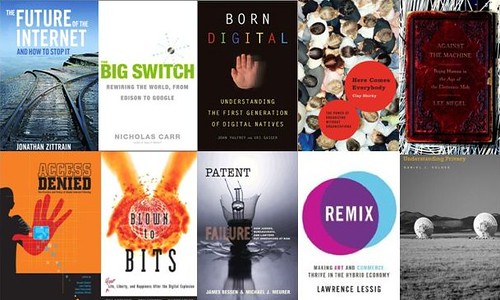
It’s been a big year for tech policy books. Several important titles were released in 2008 that offer interesting perspectives about the future of the Internet and the impact digital technologies are having on our lives, culture, and economy. Back in September, I compared some of the most popular technology policy books of the past five years and tried to group them into two camps: “Internet optimists” vs. “Internet pessimists.” That post generated a great deal of discussion and I plan on expanding it into a longer article soon. In this post, however, I will merely list what I regard as the most important technology policy books of the past year. Best Tech Books of 2008 (covers)

What qualifies as an “important” tech policy book? Basically, it’s a title that many people in this field are currently discussing and that we will likely be talking about for many years to come. I want to make it clear, however, that merely because a book appears on this list it does not necessarily mean I agree with everything said in it. In fact, I found much with which to disagree in my picks for the two most important books of 2008, as well as many of the other books on the list. [Moreover, after reading all these books, I am more convinced than ever that libertarians are badly losing the intellectual battle of ideas over Internet issues and digital technology policy. There’s just very few people defending a “Hands-Off-the-Net” approach anymore. But that’s a subject for another day!]

Another caveat: Narrowly focused titles lose a few points on my list. For example, as was the case in past years, a number of important IP-related books have come out this year. If a book deals exclusively with copyright or patent issues, it does not exactly qualify as the same sort of “tech policy book” as other titles found on this list since it is a narrow exploration of just one set of issues that have a bearing on digital technology policy. The same could be said of a book that deals exclusively with privacy policy, like Solove’s Understanding Privacy. It’s an important book with implications for the future of tech policy, but I demoted it a bit because of its narrow focus.

With those caveats in mind, here are my Top 10 Most Important Tech Policy Books of 2008 (and please let me know about your picks for book of the year):

Continue reading →