 In a recent PFF paper I argued that “We Are Living in the Golden Age of Children’s Programming,” and showed how, despite incessant complaints by many policymakers:
the overall market for family and children’s programming options continues to expand quite rapidly. Thirty years ago, families had a limited number of children’s television programming options at their disposal on broadcast TV. Today, by contrast, there exists a broad and growing diversity of children’s television options from which families can choose.
I then documented there and in my book, Parental Controls & Online Child Protection:
- the many excellent family- or child-oriented networks available on cable, telco, and satellite television today;
- the growing universe of religious / spiritual television networks;
- the many family or educational programs that traditional TV broadcasters offer; or
- the massive market for interactive computer software or Internet websites for children.
And every time I turn around I find another great show, service, or site for families to choose from. Continue reading →
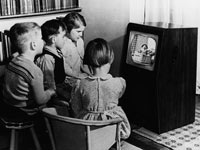 The Senate Commerce Committee held a hearing yesterday where a number of Senators as well as Julius Genachowski, the new Chairman of the Federal Communications Commission, did a lot of fretting about the state of the modern children’s television programming marketplace. According to the Wall Street Journal, Senate Commerce Committee Chairman Jay Rockefeller (D-WV):
suggested that a “little red button” be required on TVs so that a child could push the button to find out how a show is rated. Democratic Sen. Mark Pryor of Arkansas agreed that a red button might help since parents often have difficulties figuring out which shows are appropriate for their children to watch.
Well, I have some good news for the Senators: There are already quite a few little buttons on every remote control made today, and at least one of those buttons can pull up an on-screen guide to get more program info! (Another of them can turn the TV off!) Moreover, the ratings for just about every program already appear at the beginning of each show, and sometimes in between. And you can find out plenty more online about every TV show under the sun if you care to look. So, I’m not sure what that fuss is all about, and we certainly don’t need to mandate “little red buttons” on every TV set when program information can be found in so many other ways.
What is more troubling about all the hand-wringing taking place at the hearing, as well as the talk of reopening the Children’s Television Act of 1990 to potentially impose more content mandates on video programmers and distributors, is that: (1) there doesn’t seem to be much appreciation for just how much wonderful children’s programming is out there today compared to the past, and (2) there doesn’t seem to be much recognition of the serious First Amendment issues at stake when government gets involved in the messy business of regulating video programming.
Continue reading →
As Berin mentioned last week, we have a new paper out on proposals to expand the Children’s Online Privacy Protection Act (COPPA) of 1998. We generically refer to those COPPA-expansion efforts as “COPPA 2.0.” Hence, the title of our paper: “COPPA 2.0: The New Battle over Privacy, Age Verification, Online Safety & Free Speech.” To recap what Berin already noted, in the name of improving online child safety, some legislators and state attorneys general (AGs) are advocating the expansion of COPPA’s “verifiable parental consent” model of age verification before certain sites or services may collect, or enable the sharing of, personal information for children.
Unlike “COPPA 1.0,” however, which only applied to children under the age of 13, “COPPA 2.0” would apply to all minors up to age 17. Moreover, the range of sites covered by the new law would generally be expanded to include just about any site or service with social networking functionality.
Since Berin has already summarized our general concerns with efforts to expand COPPA’s “verifiable parental consent” online age verification system to cover more online users and sites, I thought I would focus here on what I believe will be the most controversial (and important) part of our paper — our discussion about how COPPA 2.0 affects the speech rights of both adults
and adolescents.
Continue reading →

 The Technology Liberation Front is the tech policy blog dedicated to keeping politicians' hands off the 'net and everything else related to technology.