In my ongoing work on technopanics, I’ve frequently noted how special interests create phantom fears and use “threat inflation” in an attempt to win attention and public contracts. In my next book, I have an entire chapter devoted to explaining how “fear sells” and I note how often companies and organizations incite fear to advance their own ends. Cybersecurity and child safety debates are littered with examples.
In their recent paper, “Loving the Cyber Bomb? The Dangers of Threat Inflation in Cybersecurity Policy,” my Mercatus Center colleagues Jerry Brito and Tate Watkins argued that “a cyber-industrial complex is emerging, much like the military-industrial complex of the Cold War.” As Stefan Savage, a Professor in the Department of Computer Science and Engineering at the University of California, San Diego, told The Economist magazine, the cybersecurity industry sometimes plays “fast and loose” with the numbers because it has an interest in “telling people that the sky is falling.” In a similar vein, many child safety advocacy organizations use technopanics to pressure policymakers to fund initiatives they create. [Sometimes I can get a bit snarky about this.] Continue reading →
[NOTE: The following is a template for how to script congressional testimony when invited to speak about online safety issues.]
Mr. Chairman and members of the Committee, thank you inviting me here today to testify about the most important issue to me and everyone in this room: Our children.
There is nothing I care more about than the future of our children. Like Whitney Houston, “I believe the children are our future.”
Mr. Chairman, I remember with fondness the day my little Johnny and Jannie came into this world. They were my little miracles. Gifts from God, I say. At the moment of birth, my wife… oh, well, I could tell you all about it someday but suffice it to say it was a beautiful scene, with the exception of all the amniotic fluid and blood everywhere. I wept for days.
Today my kids are (mention ages of each) and they are the cutest little angels on God’s green Earth. (NOTE: At this point it would be useful for you to hold up a picture of your kids, preferably with them cuddling with cute stuffed animals, a kitten, or petting a pony as in the example below. Alternatively, use a picture taken at a major attraction located in the Chairman’s congressional district.) Continue reading →
The European Commission has a new report out today on “Implementation of the Safer Social Networking Principles for the EU.” It’s a status report on the implementation of “Safer Social Networking Principles for the EU“, a “self-regulatory” agreement the EC brokered with 17 social networking sites and other online operators back in 2009. (Co-regulatory would be more accurate here, since the EC is steering, and industry is simply rowing.) The goal was to make the profiles of minors more private and provide other safeguards.
Generally speaking, the EC’s evaluation suggests that great progress has been made, although there’s always room for improvement. For example, the report found that “13 out of the 14 sites tested provide safety information, guidance and/or educational materials specifically targeted at minors;” “Safety information for minors is quite clear and age-appropriate on all sites that provide it, good progress since the first assessment last year; “Reporting mechanisms are more effective now than in 2010;” and most sites have improved Terms of Use that are easy for minors to understand and/or a child-friendly version of the Terms of Use or Code of Conduct; and many “provide safety information for children and parents which is both easy to find and to understand.” Again, there’s always room for improvement, but the general direction is encouraging, especially considering how new many of these sites are.
Unfortunately, Neelie Kroes, Vice President of the European Commission for the Digital Agenda, spun the report in the opposite direction. She issued a statement saying: Continue reading →
I’m currently plugging away at a big working paper with the running title, “Argumentum in Cyber-Terrorem: A Framework for Evaluating Fear Appeals in Internet Policy Debates.” It’s an attempt to bring together a number of issues I’ve discussed here in my past work on “techno-panics” and devise a framework to evaluate and address such panics using tools from various disciplines. I begin with some basic principles of critical argumentation and outline various types of “fear appeals” that usually represent logical fallacies, including: argumentum in terrorem,
argumentum ad metum, and argumentum ad baculum. But I’ll post more about that portion of the paper some other day. For now, I wanted to post a section of that paper entitled “The Problem with the Precautionary Principle.” I’m posting what I’ve got done so far in the hopes of getting feedback and suggestions for how to improve it and build it out a bit. Here’s how it begins…
________________
The Problem with the Precautionary Principle
“Isn’t it better to be safe than sorry?” That is the traditional response of those perpetuating techno-panics when their fear appeal arguments are challenged. This response is commonly known as “the precautionary principle.” Although this principle is most often discussed in the field of environment law, it is increasingly on display in Internet policy debates.
The “precautionary principle” basically holds that since every technology and technological advance poses
some theoretical danger or risk, public policy should be crafted in such a way that no possible harm will come from a particular innovation before further progress is permitted. In other words, law should mandate “just play it safe” as the default policy toward technological progress. Continue reading →
[UPDATE Feb. 2012: This little essay eventually led to an 80-page working paper, “Technopanics, Threat Inflation, and the Danger of an Information Technology Precautionary Principle.”]
In this essay, I will suggest that (1) while “moral panics” and “techno-panics” are nothing new, their cycles seem to be accelerating as new communications and information networks and platforms proliferate; (2) new panics often “crowd-out” or displace old ones; and (3) the current scare over online privacy and “tracking” is just the latest episode in this ongoing cycle.
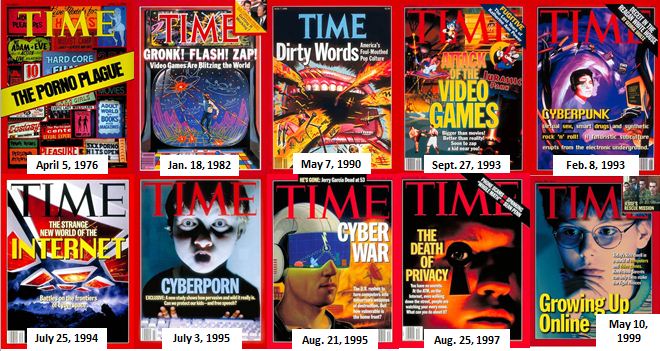
What Counts as a “Techno-Panic”?
First, let’s step back and define our terms. Christopher Ferguson, a professor at Texas A&M’s Department of Behavioral, Applied Sciences and Criminal Justice, offers the following definition: “A moral panic occurs when a segment of society believes that the behavior or moral choices of others within that society poses a significant risk to the society as a whole.” By extension, a “techno-panic” is simply a moral panic that centers around societal fears about a specific contemporary technology (or technological activity) instead of merely the content flowing over that technology or medium. In her brilliant 2008 essay on “The MySpace Moral Panic,” Alice Marwick noted: Continue reading →
The Internet is massive. That’s the ‘no-duh’ statement of the year, right? But seriously, the sheer volume of transactions (both economic and non-economic) is simply staggering. Consider a few factoids to give you a flavor of just how much is going on out there:
- In 2006, Internet users in the United States viewed an average of 120.5 Web pages each day.
- There are over 1.4 million new blog posts every day.
- Social networking giant Facebook reports that each month, its over 300 million users upload more than 2 billion photos, 14 million videos, and create over 3 million events. More than 2 billion pieces of content (web links, news stories, blog posts, notes, photos, etc.) are shared each week. There are also roughly 45 million active user groups on the site.
- YouTube reports that 20 hours of video are uploaded to the site every minute.
- Amazon reported that on December 15, 2008, 6.3 million items were ordered worldwide, a rate of 72.9 items per second.
- Every six weeks, there are 10 million edits made to Wikipedia.
Now, let’s think about how some of our lawmakers and media personalities talk about the Internet. If we were to judge the Internet based upon the daily headlines in various media outlets or from the titles of various Congressional or regulatory agency hearings, then we’d be led to believe that the Internet is a scary, dangerous place. That ‘s especially the case when it comes to concerns about online privacy and child safety. Everywhere you turn there’s a bogeyman story about the supposed dangers of cyberspace.
But let’s go back to the numbers. While I certainly understand the concerns many folks have about their personal privacy or their child’s safety online, the fact is
the vast majority of online transactions that take place online each and every second of the day are of an entirely harmless, even socially beneficial nature. I refer to this disconnect as the “problem of proportionality” in debates about online safety and privacy. People are not just making mountains out of molehills, in many cases they are just making the molehills up or blowing them massively out of proportion. Continue reading →
Just read this AP article that reported on a Tuesday hearing of the Ohio Supreme Court about an Ohio “harmful to minors” law. According to the article, the statute makes it illegal to distribute harmful material to minors through “direct communications by people who know or have reason to believe the recipient is a minor.”
The case is in the 6th Circuit Court of Appeals, which has asked the Ohio Supreme Court to interpret “mass distribution” and “personally directed devices.” Per the law:
2) A person remotely transmitting information by means of a method of mass distribution does not directly sell, [etc.] … if either of the following applies:
(a) The person has inadequate information to know or have reason to believe that a particular recipient of the information or offer is a juvenile.
(b) The method of mass distribution does not provide the person the ability to prevent a particular recipient from receiving the information.
In the hearing (see the video) Justice Robert Cupp coins this beauty of a statement: “It’s not really the statute that’s confusing here, it’s the technologies.” Judge say what?
Isn’t the whole point of a statute to be applied to factual situations? Anything can make sense in the abstract (even law!). But applied to everyday life, the simplistic becomes complex — and can have unintended consequences. Continue reading →
Yesterday up on Capitol Hill, I hosted a very interesting discussion about “Next-Generation Parental Controls & Child Safety Efforts.” I thought I’d provide a quick recap here for those who couldn’t attend. [Note: audio of the event will be up shortly at the link above and transcript is in the works.] The event featured Steve Crown, Vice President and Deputy General Counsel of Microsoft Corporation’s Entertainment & Devices Division; Dane Snowden, Vice President of External & State Affairs of CTIA – The Wireless Association; and Stephen Balkam, Chief Executive Officer of Family Online Safety Institute.
Steve Crown of Microsoft kicked the show off with a terrific overview of some the current and next-generation parental control tools and awareness efforts that Microsoft is deploying to help empower parents and keep kids safer both online and in gaming environments. Crown outlined Microsoft’s 5-prong strategy regarding how they have approached these issues on the gaming front, and I think it represents an excellent model of how sensible industry self-regulation and “best practices” can go a long way toward addressing concerns that many parents and policymakers have. The five strategies Crown outlined were: (1) Respect both the freedom of game creators and freedom of choice for game consumers; (2) empower parents with ratings, tools, and information; (3) use independent ratings (like the ESRB) to label content; (4) require all games be rated before they can be used on a platform so that parents can implement blocking controls; and (5) respect regional laws and rating systems in different parts of the globe.
In my book on
Parental Controls & Online Child Safety: A Survey of Tools & Methods, I’ve documented many of the empowerment tools that Microsoft has deployed in recent years to make this empowerment vision a reality. One of the most important things MS does on its XBox 360 console is to provide an immediate “out-of-the-box” prompt for parents to set up parental controls and establish other limitations on online chat, spending, or Internet access. Microsoft announced another cool new feature in November 2007, the “Family Timer.” It lets parents limit how and when children play games on the console. This is similar to the time management tools Microsoft offers in its Vista operating system for PCs. Incidentally, my wife has asked me to start using the Family Timer on our XBox — not for our kids, but for me! This particular 40-year-old man is still a big kid at heart.
Continue reading →
On July 27th, The Progress & Freedom Foundation hosted a Capitol Hill panel discussion entitled “Online Child Safety, Privacy, and Free Speech: An Overview of Challenges in Congress & the States.” The event featured remarks from:
- Parry Aftab, Executive Director, WiredSafety.org
- Todd Haiken, Senior Manager of Policy, Common Sense Media
- Jim Halpert, Partner, DLA Piper
- Berin Szoka, Senior Fellow, The Progress & Freedom Foundation
We’ve just released the transcript of the event, which I have also pasted down below the fold in a Scribd document reader. Also, the audio for this event can be heard by clicking below:
Download mp3
Here is the full event description: Continue reading →

 The Technology Liberation Front is the tech policy blog dedicated to keeping politicians' hands off the 'net and everything else related to technology.