Reason magazine recently published my review of Franklin Foer’s new book, World Without Mind: The Existential Threat of Big Tech. My review begins as follows:
If you want to sell a book about tech policy these days, there’s an easy formula to follow.
First you need a villain. Google and Facebook should suffice, but if you can throw in Apple, Amazon, or Twitter, that’s even better. Paint their CEOs as either James Bond baddies bent on world domination or naive do-gooders obsessed with the quixotic promise of innovation.
Finally, come up with a juicy Chicken Little title. Maybe something like World Without Mind: The Existential Threat of Big Tech. Wait—that one’s taken. It’s the title of Franklin Foer’s latest book, which follows this familiar techno-panic template almost perfectly.
The book doesn’t break a lot of new ground; it serves up the same old technopanicky tales of gloom-and-doom that many others have said will befall us unless
something is done to save us. But Foer’s unique contribution is to unify many diverse strands of modern tech criticism in one tome, and then amp up the volume of panic about it all. Hence, the “existential” threat in the book’s title. I bet you didn’t know the End Times were so near!
Read the rest of my review over at Reason. And, if you care to read some of my other essays on technopanics through the ages, here’s a compendium of them.
On Tuesday, UN Secretary-General Ban Ki-Moon delivered an address to the UN Security Council “on the Non-Proliferation of Weapons of Mass Destruction.” He made many of the same arguments he and his predecessors have articulated before regarding the need for the Security Council “to develop further initiatives to bring about a world free of weapons of mass destruction.” In particular, he was focused on the great harm that could come about from the use of chemical, biological and nuclear weapons. “Vicious non-state actors that target civilians for carnage are actively seeking chemical, biological and nuclear weapons,” the Secretary-General noted. A stepped-up disarmament agenda is needed, he argued, “to prevent the human, environmental and existential destruction these weapons can cause . . . by eradicating them once and for all.”
The UN has created several multilateral mechanisms to pursue those objectives, including the Nuclear Non-Proliferation Treaty, the Chemical Weapons Convention, and the Biological Weapons Convention. Progress on these fronts has always been slow and limited, however. The Secretary-General observed that nuclear non-proliferation efforts have recently “descended into fractious deadlock,” but the effectiveness of those and similar UN-led efforts have long been challenged by the dual realities of (1) rapid ongoing technological change that has made WMDs more ubiquitous than ever, plus (2) a general lack of teeth in UN treaties and accords to do much to slow those advances, especially among non-signatories.
Despite those challenges, the Secretary-General is right to remain vigilant about the horrors of chemical, biological and nuclear attacks. But what was interesting about this address is that the Secretary-General continued on to discuss his concerns about a rising class of emerging technologies, which we usually don’t hear mentioned in the same breath as those traditional “weapons of mass destruction”: Continue reading →
How is it that we humans have again and again figured out how to assimilate new technologies into our lives despite how much those technologies “unsettled” so many well-established personal, social, cultural, and legal norms?
It’s fair to say that this issue — how individuals, institutions, and cultures adjust to technological change — has become a personal obsession of mine and it is increasingly the unifying theme of much of my ongoing research agenda. The
economic ramifications of technological change are part of this inquiry, of course, but those economic concerns have already been the subject of countless books and essays both today and throughout history. I find that the social issues associated with technological change — including safety, security, and privacy considerations — typically get somewhat less attention, but are equally interesting. That’s why my recent work and my new book narrow the focus to those issues. Continue reading →
When Google announced it was acquiring digital thermostat company Nest yesterday, it set off another round of privacy and security-related technopanic talk on Twitter and elsewhere. Fear and loathing seemed to be the order of the day. It seems that each new product launch or business announcement in the “Internet of Things” space is destined to set off another round of Chicken Little hand-wringing. We are typically told that the digital sky will soon fall on our collective heads unless we act preemptively to somehow head-off some sort of pending privacy or security apocalypse.
Meanwhile, however, a whole heck of lot of people are demanding more and more of these technologies, and American entrepreneurs are already engaged in heated competition with European and Asian rivals to be at the forefront of the next round Internet innovation to satisfy those consumer demands. So, how is this going to play out?
This gets to what becoming the defining policy issue of our time, not just for the Internet but for technology policy more generally:
To what extent should the creators of new technologies seek the blessing of public officials before they develop and deploy their innovations? We can think of this as “the permission question” and it is creating a massive rift between those who desire more preemptive, precautionary safeguards for a variety of reasons (safety, security, privacy, copyright, etc.) and those of us who continue to believe that permissionless innovation should be the guiding ethos of our age. The chasm between these two worldviews is only going to deepen in coming years as the pace of innovation around new technologies (the Internet of Things, wearable tech, driverless cars, 3D printing, commercial drones, etc) continues to accelerate.
Sarah Kessler of
Fast Company was kind enough to call me last night and ask for some general comments about Google buying Nest and she also sought out the comments of Marc Rotenberg of EPIC about privacy in the Internet of Things era more generally. Our comments provide a useful example of the divide between these two worldviews and foreshadow debates to come: Continue reading →
There are few things I find more annoying in the Net neutrality wars than the silly assertion by groups like Free Press and other regulatory radicals that “Net neutrality is the Internet’s First Amendment.” It’s utter rubbish as I have documented here manytimesbefore. But now Sen. Al Franken is running around sputtering such nonsense, as he did in this recent CNN.com editorial, claiming that “Net neutrality is foremost free speech issue of our time.” The folks at CNN invited me to response and below you will find the piece PFF press director Mike Wendy and I submitted.
In his recent CNN.com opinion piece, “Net neutrality is foremost free speech issue of our time,” Sen. Al Franken claims that “our free speech rights are under assault — not from the government but from corporations seeking to control the flow of information in America.”
He alludes to potential corporate blocking of online products and speech and says, “If that scares you as much as it scares me, then you need to care about net neutrality.”
Chicken Little, call your office!
Such sky-is-falling scare tactics are all too common in the heated debate over net neutrality regulation, but actual evidence of such nefarious corporate scheming is nowhere to be found. Perhaps that’s why Franken resorts to such tall tales.
Moreover, his reading of the First Amendment is at odds with the one most of us learned about in civics class (“Congress shall make no law…”). His would empower regulators by converting the First Amendment from a shield against government action into a sword that bureaucrats could wield against private industry. Continue reading →
I’ve just released a new PFF white paper looking at the hysteria that has often accompanied major media mergers and then taking a look at the marketplace reality years after the fact. Here‘s the PDF, but I have also pasted the entire thing down below.
_____________________________
A Brief History of Media Merger Hysteria:
From AOL-Time Warner to Comcast-NBC
by Adam Thierer
Although the pending union of Comcast and NBC Universal has not yet made it to the altar, Chicken Little-esque wails about the marriage have already begun in earnest. For example, the pro-regulatory media organization Free Press has already set up a website to complain about the deal.[1] And Jeff Chester, executive director of the Center for Digital Democracy, has called it “an unholy marriage.”[2] The fever only promises to spread once the deal is formally announced, and a lengthy fight over the deal is expected at the Federal Communications Commission (FCC) and whichever antitrust agency reviews the deal.[3]
But reality tends to play out somewhat less dramatically than the script penned by the media worrywarts. It’s worth looking back at some of the more prominent examples of media merger hysteria in recent years to understand why such panic is unwarranted, and why a deal between Comcast and NBC Universal is unlikely to lead to the sort of problems that the pessimists suggest.[4]Continue reading →
A few months ago, I penned a mega book review about the growing divide between “Internet optimists and pessimists.” I noted that the Internet optimists — people like Chris Anderson, Clay Shirky, Yochai Benkler, Kevin Kelly, and others — believe that the Internet is generally improving our culture, economy, and society for the better. They believe the Net has empowered and liberated the masses, sparked unparalleled human creativity and communication, provided greater personalization and customization of media content, and created greater diversity of thought and a more deliberative democracy. By contrast, the Internet pessimists — including Nick Carr, Andrew Keen, Lee Siegel, and others — argue that the Internet is destroying popular culture and professional media, calling “truth” and “authority” into question by over-glamorizing amateurism and user-generated content, and that increased personalization is damaging deliberative democracy by leading to homogenization, close-mindedness, and an online echo-chamber. Needless to say, it’s a very heated debate!
I am currently working on a greatly expanded version of my “Net optimists vs. pessimists” essay for a magazine in which I will draw out more of these distinctions and weigh the arguments made by those in both camps. I plan on concluding that article by arguing that the optimists generally have the better of the argument, but that the pessimists make some fair points about the downsides of the Net’s radically disintermediating role on culture and economy.
So, this got me thinking that I needed to come up with some sort of a label for my middle-of-the-road position as well as a statement of my personal beliefs. As far as labels go, I guess I would call myself a “pragmatic optimist” since I generally side with the optimists in most of these debates, but not without some occasional reservations. Specifically, I don’t always subscribe to the Pollyanna-ish, rose-colored view of the world that some optimists seem to adopt. But the outright Chicken Little-like Ludditism of some Internet pessimists is even more over-the-top at times. Anyway, what follows is my “Pragmatic (Internet) Optimist’s Creed” which better explains my views. (Again, read my old essay first for some context about the relevant battle lines in this intellectual war).
I just finished reading through The Economist’s new 14-page special report on cloud computing, “Let It Rise” in which Ludwig Siegele provides an outstanding overview of cloud computing and why it is so important:
The rise of the cloud is more than just another platform shift that gets geeks excited. It will undoubtedly transform the information technology (IT) industry, but it will also profoundly change the way people work and companies operate. It will allow digital technology to penetrate every nook and cranny of the economy and of society, creating some tricky political problems along the way.
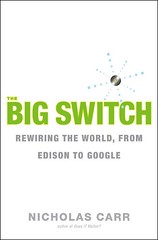
Even if you are very familiar with cloud computing, I recommend you take a look at the article. Anyway, while I was reading it, I was unsurprised to come across some comments from Nicholas Carr, whose new book
The Big Switch: Rewiring the World, from Edison to Google, is essentially an early history of cloud computing and an investigation into its effects on our economy, culture, and society. And that also reminded me that, even though I have mentioned Carr’s book here several times since it was released earlier this year, I have failed to give it a dedicated review. And it certain deserves one because “The Big Switch” is easily one of the most important technology policy books of 2008.
By Berin Szoka & Adam Thierer as part of an ongoing series
With Google celebrating its 10th anniversary this week, many panicky pundits are using the occasion to claim that Google has become the Great “Satan” of the Internet. Nick Carr wonders what the future holds for “The OmniGoogle.” The normally level-headed Mike Malone worries that Google is “turning into Big Brother.” And Washington Post’s Rob Dubbin says that he can’t escape Google’s “tentacles,” even for just 24 hours. Meanwhile, speculation abounds that the Justice Department is preparing a major antitrust lawsuit against Google concerning its advertising partnership with Yahoo! or perhaps even a broader suit concerning Google’s “dominance” of online advertising generally.
Carr quotes Google co-founder Sergey Brin’s now-famous 2003 interview:
I think people tend to exaggerate Google’s significance in both directions. Some say Google is God. Others say Google is Satan. But if they think Google is too powerful, remember that with search engines, unlike other companies, all it takes is a single click to go to another search engine. People come to Google because they choose to. We don’t trick them.
In the last five years, Google has become far more than just a search engine. As Google’s suite of suite of complementary products continues to grow, so too does the specter of Google as an all-knowing and therefore all-powerful economic colossus. Yet Google isn’t even close to being the sort of nefarious monopolist out to destroy user privacy at every turn, as some seem to imply—if not exclaim. Indeed, in our view, the Net is overall a far better place because of the existence of Google and the many free services it provides consumers.
Our point is not that Google should be immune from criticism. Indeed, healthy criticism of corporate actions plays a vital role in the free market by disciplining corporate policies and behavior—often thus providing an effective alternative to government regulation. This is particularly important in the area of consumer privacy protection, as demonstrated by Google’s quick response to public concern about its Chrome EULA. Continue reading →
The Technology Liberation Front is the tech policy blog dedicated to keeping politicians' hands off the 'net and everything else related to technology. Learn more about TLF →



 The Technology Liberation Front is the tech policy blog dedicated to keeping politicians' hands off the 'net and everything else related to technology.