As Berin mentioned last week, we have a new paper out on proposals to expand the Children’s Online Privacy Protection Act (COPPA) of 1998. We generically refer to those COPPA-expansion efforts as “COPPA 2.0.” Hence, the title of our paper: “COPPA 2.0: The New Battle over Privacy, Age Verification, Online Safety & Free Speech.” To recap what Berin already noted, in the name of improving online child safety, some legislators and state attorneys general (AGs) are advocating the expansion of COPPA’s “verifiable parental consent” model of age verification before certain sites or services may collect, or enable the sharing of, personal information for children.
Unlike “COPPA 1.0,” however, which only applied to children under the age of 13, “COPPA 2.0” would apply to all minors up to age 17. Moreover, the range of sites covered by the new law would generally be expanded to include just about any site or service with social networking functionality.
Since Berin has already summarized our general concerns with efforts to expand COPPA’s “verifiable parental consent” online age verification system to cover more online users and sites, I thought I would focus here on what I believe will be the most controversial (and important) part of our paper — our discussion about how COPPA 2.0 affects the speech rights of both adults
and adolescents.
Continue reading →
Adam Thierer & I have just released a detailed examination (PDF) of brewing efforts to expand the Children’s Online Privacy Protection Act of 1998 to cover adolescents and potentially all social networking sites—an approach we call “COPPA 2.0.”
As Adam explained on Larry Magid’s CNET podcast, COPPA mandates certain online privacy protections for children under 13, most importantly that websites obtain the “verifiable consent” of a child’s parent before collecting personal information about that child or giving that child access to interactive functionality that might allow the child to share their personal information with others. The law was intended primarily to “enhance parental involvement in a child’s online activities” as a means of protecting the online privacy and safety of children.
Yet advocates of expanding COPPA—or “COPPA 2.0″—see COPPA’s verifiable parental consent framework as a means for imposing broad regulatory mandates in the name of online child safety and concerns about social networking, cyber-harassment,
etc. Two COPPA 2.0 bills are currently pending in New Jersey and Illinois. The accelerated review of COPPA to be conducted by the FTC next year (five years ahead of schedule) is likely to bring to Washington serious talk of expanding COPPA—even though Congress clearly rejected covering adolescents age 13-16 when COPPA was first proposed back in 1998.
We’ll discuss some of the key points of our paper in a series of blog posts, but here are the top nine reasons for rejecting COPPA 2.0, in that such an approach would:
- Burden the free speech rights of adults by imposing age verification mandates on many sites used by adults, thus restricting anonymous speech and essentially converging—in terms of practical consequences—with the unconstitutional Children’s Online Protection Act (COPA), another 1998 law sometimes confused with COPPA;
- Burden the free speech rights of adolescents to speak freely on—or gather information from—legal and socially beneficial websites;
- Hamper routine and socially beneficial communication between adolescents and adults;
- Reduce, rather than enhance, the privacy of adolescents, parents and other adults because of the massive volume of personal information that would have to be collected about users for authentication purposes (likely including credit card data);
Continue reading →
On the first full day of the new Obama administration, I wrote here, and later followed up, expressing regret that the Obama White House hadn’t ported the “Seat at the Table” program over from the transition. Change.gov published documents submitted to the transition on its Web site for public review and comment. Whitehouse.gov does not.
Now we learn that the White House will not honor an Obama campaign and Whitehouse.gov pledge – not more than nine days old – to post all non-emergency legislation on the White House Web site for five days before the President signs it.
One significant addition to WhiteHouse.gov reflects a campaign promise from the President: we will publish all non-emergency legislation to the website for five days, and allow the public to review and comment before the President signs it.
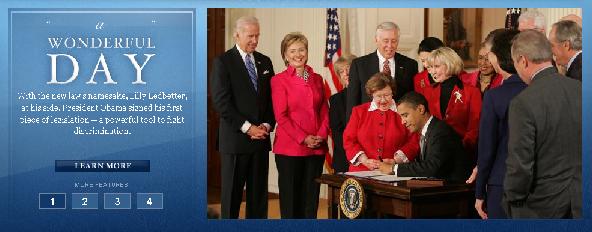
President Obama signed the “Lilly Ledbetter Fair Pay Act of 2009” into law today, one day after Congress delivered it to him. And there’s the bill law, posted on Whitehouse.gov for public review. But it sure hasn’t been up for five days. And it’s not emergency legislation: Bills like it have been floating around in Congress since at least June 2007.
If I was a little demanding about transparency from day one, it was a bit of counterpoint to folks who were going dewy about Obama’s transparency promises. Those were simply words. Judging by the Whitehouse.gov screen cap below, transparency got thrown over the side for a photo op. Welcome to Washington.
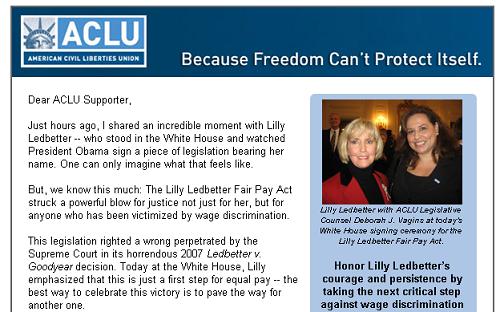
Update: Just got an email that helps illustrate why the sound practices of letting legislation cool and taking public comment would go by the wayside. Getting credit from the ACLU is much more important than pleasing the relatively tiny coterie of transparency fans – and there is almost no expectation among the public that a White House should practice good lawmaking hygiene.
The new Whitehouse.gov went live shortly after Barack Obama became president yesterday. It has much of the look and feel of his transition Web site, Change.gov.
Among the featured items on the homepage today (they will change regularly, of course) is the site itself and the new administration’s commitment to transparency. However, the actual terms of that commitment come up pretty anemic.
In a post on the White House blog, Director of New Media Macon Phillips says:
President Obama has committed to making his administration the most open and transparent in history, and WhiteHouse.gov will play a major role in delivering on that promise. The President’s executive orders and proclamations will be published for everyone to review, and that’s just the beginning of our efforts to provide a window for all Americans into the business of the government. You can also learn about some of the senior leadership in the new administration and about the President’s policy priorities.
Executive orders and proclamations? Information about senior leadership and the President’s priorities? That’s not breaking any new ground on transparency.
The transition’s “Seat at the Table” program required “any documents from official meetings with outside organizations [to] be posted on our website for people to review and comment on.”
The decision to port this practice over to the White House has either not been made, or has been decided against. Given that meetings are already happening, it will be a tough policy to implement if it is not implemented right away.
There is an “Office of Public Liaison” (and intergovernmental affairs) on the Whitehouse.gov site, but it’s nothing more than an email submission form at this point. “More ways for you to interact” are promised.
Words aren’t deeds, and it’s already too late to demonstrate a day-one commitment to transparency. Let’s hope the first steps of the new administration are not steps away from the important transparency precedents set by the transition.
Update: As I wrote this post, news stories were coming out about new executive orders coming out dealing with ethics and transparency. Though I haven’t been able to find them yet – hint hint, Whitehouse.gov – the change to the interpretation of FOIA sound like a welcome, if modest, step in the right direction.

 The Technology Liberation Front is the tech policy blog dedicated to keeping politicians' hands off the 'net and everything else related to technology.