Cyber-Libertarianism: The Case for Real Internet Freedom

by Adam Thierer on August 12, 2009 · Comments

libertyby Adam Thierer & Berin Szoka — (Ver. 1.0 — Summer 2009)

We are attempting to articulate the core principles of cyber-libertarianism to provide the public and policymakers with a better understanding of this alternative vision for ordering the affairs of cyberspace. We invite comments and suggestions regarding how we should refine and build-out this outline. We hope this outline serves as the foundation of a book we eventually want to pen defending what we regard as “Real Internet Freedom.” [Note:  Here's a printer-friendly version, which we also have embedded down below as a Scribd document.]

I. What is Cyber-Libertarianism?

Cyber-libertarianism refers to the belief that individuals—acting in whatever capacity they choose (as citizens, consumers, companies, or collectives)—should be at liberty to pursue their own tastes and interests online.

Generally speaking, the cyber-libertarian’s motto is “Live & Let Live” and “Hands Off the Internet!”  The cyber-libertarian aims to minimize the scope of state coercion in solving social and economic problems and looks instead to voluntary solutions and mutual consent-based arrangements.

Cyber-libertarians believe true “Internet freedom” is freedom from state action; not freedom for the State to reorder our affairs to supposedly make certain people or groups better off or to improve some amorphous “public interest”—an all-to convenient facade behind which unaccountable elites can impose their will on the rest of us.


Continue reading →

Comments Posted in: Advertising & Marketing, Antitrust & Competition Policy, Broadband & Neutrality Regulation, Digital Policy Reading List, E-Commerce Taxation & Regulation, First Amendment, Free Speech & Online Child Safety, Innovation & Entrepreneurship, Intermediary Deputization & Section 230, Philosophy & Cyber-Libertarianism, Privacy, Security & Government Surveillance, Telecom & Cable Regulation, What We're Reading, Wireless & Spectrum Policy

Mill’s On Liberty at 150: Its Legacy for Freedom of Speech & Expression

by Adam Thierer on July 10, 2009 · Comments

Mill On LibertyJohn Stuart Mill’s On Liberty turns 150 this year. Published in 1859, this slender manifesto for human liberty went on to become a classic of modern philosophy and political science.  It remains a beautiful articulation of the core principles of human liberty and a just society.

Anyone familiar with the book recognizes the importance of the opening chapter and Mill’s “one very simple principle” for “the dealings of society with the individual in the way of compulsion and control, whether the means used be physical force in the form of legal penalties, or the moral coercion of public opinion”:

That principle is, that the sole end for which mankind are warranted, individually or collectively, in interfering with the liberty of action of any of their number, is self-protection. That the only purpose for which power can be rightfully exercised over any member of a civilized community, against his will, is to prevent harm to others. His own good, either physical or moral, is not a sufficient warrant. He cannot rightfully be compelled to do or forbear because it will be better for him to do so, because it will make him happier, because, in the opinions of others, to do so would be wise, or even right. These are good reasons for remonstrating with him, or reasoning with him, or persuading him, or entreating him, but not for compelling him, or visiting him with any evil in case he do otherwise. To justify that, the conduct from which it is desired to deter him, must be calculated to produce evil to some one else. The only part of the conduct of any one, for which he is amenable to society, is that which concerns others. In the part which merely concerns himself, his independence is, of right, absolute. Over himself, over his own body and mind, the individual is sovereign.

Mill went on to outline “the appropriate region of human liberty,” and divided it into:

  1. liberty of conscience, in the most comprehensive sense; liberty of thought and feeling; absolute freedom of opinion and sentiment on all subjects, practical or speculative, scientific, moral, or theological. The liberty of expressing and publishing opinions may seem to fall under a different principle, since it belongs to that part of the conduct of an individual which concerns other people; but, being almost of as much importance as the liberty of thought itself, and resting in great part on the same reasons, is practically inseparable from it.”
  2. liberty of tastes and pursuits; of framing the plan of our life to suit our own character; of doing as we like, subject to such consequences as may follow: without impediment from our fellow-creatures, so long as what we do does not harm them, even though they should think our conduct foolish, perverse, or wrong”
  3. freedom to unite, for any purpose not involving harm to others”

Bringing it altogether, he argued:

The only freedom which deserves the name, is that of pursuing our own good in our own way, so long as we do not attempt to deprive others of theirs, or impede their efforts to obtain it. Each is the proper guardian of his own health, whether bodily, or mental and spiritual. Mankind are greater gainers by suffering each other to live as seems good to themselves, than by compelling each to live as seems good to the rest.

To this day, I do not believe there has been a more eloquent or concise summation of the central principles of libertarianism than those passages from Chapter 1 of the book. But what many fail to remember or appreciate is the equally powerful second chapter of Mill’s treatise, “On the Liberty of Thought and Discussion.” It was a bold defense of freedom of speech and expression that was many decades ahead of its time. And it still has lessons and warnings worth heeding in our modern Information Age.

Continue reading →

Comments Posted in: First Amendment, Free Speech & Online Child Safety, Miscellaneous, What We're Reading

Terrific Section 230 Resource

by Adam Thierer on May 10, 2009 · Comments

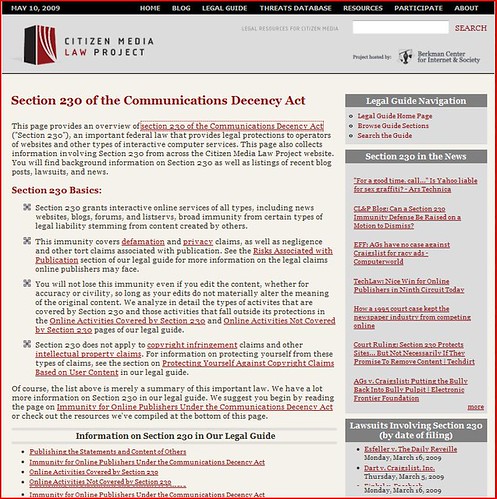
If you’re a cyberlaw geek or tech policy wonk who needs to keep close tabs on Sec. 230 developments, here’s a terrific resource from the Citizen Media Law Project up at the Harvard Berkman Center.  The site offers a wealth of background info, including legislative history, all the relevant case law surrounding 230, and breaking news on this front.  Just a phenomenal resource; a big THANK YOU! to the folks at CMLP who put this together.

If you’re interested in these issues, you might also want to check out this friendly debate that Harvard’s John Palfrey and I engaged in over at Ars recently as well as my essay on how Sec. 230 has spawned a “utopia of utopias” online.

CMLP screen

Comments Posted in: First Amendment, Free Speech & Online Child Safety, Intermediary Deputization & Section 230, Media Regulation, Miscellaneous

The Future of Sec. 230 and Online Immunity: My Debate with Harvard’s John Palfrey

by Adam Thierer on March 6, 2009 · Comments

Ars Technica has just posted the transcript of a friendly debate I recently engaged in with Harvard University law professor John Palfrey about the future of Section 230 of the Communications Decency Act and online liability more generally.  Our debate got started last fall, shortly after I penned a favorable review of John’s excellent new book (with Urs Gasser), Born Digital: Understanding the First Generation of Digital Natives.  [Listen to my podcast with John about it here.]  Although I enjoyed John’s book, I also raised some concerns about his call in the book to reopen and revise Section 230, specifically to address child safety concerns.  At the time, John and I were working together on the Berkman Center’s “Internet Safety Technical Task Force” and we decided to begin an e-mail exchange about the future of 230 and online liability norms more generally.  The result was the debate that Ars has just published.

In our exchange, I begin by asking John to more fully develop some statements and proposals he sets forth in Born Digital.  Specifically, he and co-author Urs Gasser argue that: “The scope of the immunity the CDA provides for online service providers is too broad” and that the law “should not preclude parents from bringing a claim of negligence against [a social networking site] for failing to protect the safety of its users.” They also suggest that “There is no reason why a social network should be protected from liability related to the safety of young people simply because its business operates online.” Specifically, the call for “strengthening private causes of action by clarifying that tort claims may be brought against online service providers when safety is at stake,” although they do not define those instances.

Using those proposals as a launching point for our discussion, I challenge John as follows:

I’m troubled by your proposals because I believe Section 230 has been crucial to the success of the Internet and the robust marketplace of online freedom of speech and expression. In many ways — whether intentional or not — Section 230 was the legal cornerstone that gave rise to many of the online freedoms we enjoy today. I fear that the proposal you have set forth could reverse that. It could lead to crushing liability for many online operators-and not just giants like MySpace or Facebook-that might not be able to absorb the litigation costs. Could you elaborate a bit more about your proposal and explain why you think the time has come to alter Section 230 and online liability norms?

And John does and then we go back-and-forth from there.  Again, you can read the whole exchange over at Ars.

It was a great pleasure to engage in this exchange with Prof. Palfrey and I look forward to what others have to say in response to our debate.  I am working on a longer paper looking broadly at the rising threats to Sec. 230 and the increasing calls for expanded online liability and middleman deputization.  I will use whatever feedback I get from this exchange to refine my paper and proposals.

Comments Posted in: First Amendment, Free Speech & Online Child Safety, Intermediary Deputization & Section 230

Closing the Book on COPA?

by Adam Thierer on January 21, 2009 · Comments

gavelIt appears that the long legal saga of the Child Online Protection Act of 1998 (COPA) has finally come to a close. This morning, according to AP, the U.S. Supreme Court rejected the government’s latest request to revive the law, which was stuck down as an unconstitutional violation of the First Amendment by lower courts and never went into effect.

COPA was an effort by Congress to modify the Communications Decency Act of 1996 (CDA) in response to the Supreme Court’s decision in Reno v. ACLU finding that the CDA was unconstitutionally over-broad. COPA sought to narrow the scope of regulation and protect minors from sexual material on the Internet by making it a crime for someone to “knowingly” place materials online that were “harmful to minors.” The law provided an affirmative defense from prosecution, however, to those parties who made a “good faith” effort to “restrict[ ] access by minors to material that is harmful to minors” using credit cards or age verification schemes. Although narrower than the CDA, COPA was immediately challenged and also blocked by lower courts because it was still too sweeping in effect. Moreover, the courts found there were other “less restrictive means” that parents could use to deal with objectionable content — such as Internet filters.

Following the initial challenge, COPA then became the subject of an epic, decade-long legal battle that finally concluded today when the U.S. Supreme Court refused to revisit the law. COPA had already been reviewed by the Supreme Court twice before — in 2002 and 2004.  Thus, a third visit to the Supreme Court by COPA would have been something of a historical development in the world of First Amendment jurisprudence. But with the Supreme Court’s rejection of the government’s appeal today, lower court rulings stand and COPA will remain unconstitutional and unenforceable.

The key recent legal battle occurred in the Third Circuit Court of Appeals, which upheld a lower court ruling striking down COPA. The Third Circuit’s full decision is here. And I penned a 3-part series on the lower court ruling by Judge Lowell Reed Jr., senior judge of the U.S. District Court for the Eastern District of Pennsylvania, here, here, and here. Also make sure to check out this summary of COPA’s legal journey that Alex Harris penned last November.

While COPA is now dead and buried, it would be foolish to think this is the end of efforts to legislate on this front. Although it remains unclear what the legislative response will look like during a time of Democratic rule, I am certain that legislation will be floated in short order (i.e., “Son of COPA”) to try to get around the constitutional issues and regulate objectionable online content. If legislators were smart, they’d avoid legally risky solutions like more centralized filtering mandates or age verification requirements. They’d be on safer ground to consider going the subsidy route and finding a way to get parental control tools in the hands of more families and institutions. I’m not saying that I favor such subsidies, merely that such an approach would almostly certainly pass legal muster and probably wouldn’t even be challenged in court. They might also consider more public education / PSA-driven approached to online safety. Those approaches may end up finding more support in a Democratic Congress and administration anyway.

[More coverage at NYT, Reuters, CNet and Ars.]

Comments Posted in: First Amendment, Free Speech & Online Child Safety

Web 2.0, Section 230, and Nozick’s “Utopia of Utopias”

by Adam Thierer on January 13, 2009 · Comments

NozickI haven’t been blogging much lately because, along with my PFF colleagues Berin Szoka and Adam Marcus, I’m working on a lengthy paper about the importance of Section 230 to Internet freedom. Section 230 is the sometimes-forgotten portion of the Communications Decency Act of 1996 that shielded Internet Service Providers (ISP) from liability for information posted or published on their systems by users or other third parties. It was enshrined into law with the passage of the historic Telecommunications Act of 1996. Importantly, even though the provisions of the CDA seeking to regulate “indecent” speech on the Internet were struck down as unconstitutional, Sec. 230 was left untouched.

Section 230 of the CDA may be the most important and lasting legacy of the Telecom Act and it is indisputable that it has been remarkably important to the development of the Internet and online free speech and expression in particular. In many ways, Section 230 is the cornerstone of “Internet freedom” in its truest and best sense of the term.

In recent years, however, Sec. 230 has come under fire from some academics, judges, and other lawmakers. Critics raise a variety of complaints — all of which we will be cataloging and addressing in our forthcoming PFF paper. But what unifies most of the criticisms of Sec. 230 is the belief that Internet “middlemen” (which increasingly includes almost any online intermediary, from ISPs, to social networking sites, to search engines, to blogs) should do more to police their networks for potentially “objectionable” or “offensive” content. That could include many things, of course: cyberbullying, online defamation, harassment, privacy concerns, pornography, etc. If the online intermediaries failed to engage in that increased policing role, they would open themselves up to lawsuits and increased liability for the actions of their users.

The common response to such criticisms — and it remains a very good one — is that the alternative approach of strict secondary liability on ISPs and other online intermediaries would have a profound “chilling effect” on online free speech and expression. Indeed, we should not lose sight of what Section 230 has already done to create vibrant, diverse online communities. Brian Holland, a visiting professor at Penn State University’s Dickinson School of Law, has written a brilliant paper that does a wonderful job of doing just that. It’s entitled “In Defense of Online Intermediary Immunity: Facilitating Communities of Modified Exceptionalism” and it can be found on SSRN here. I cannot recommend it highly enough. It is a masterpiece.
Continue reading →

Comments Posted in: First Amendment, Free Speech & Online Child Safety, Intermediary Deputization & Section 230

Book Review: Blown to Bits by Abelson, Ledeen, & Lewis

by Adam Thierer on November 18, 2008 · Comments

Blown to Bits coverI’ve just finished reading Blown to Bits: Your Life, Liberty, and Happiness After the Digital Explosion, by Hal Abelson, Ken Ledeen, and Harry Lewis, and it’s another title worth adding to your tech policy reading list. The authors survey a broad swath of tech policy territory — privacy, search, encryption, free speech, copyright, spectrum policy — and provide the reader with a wonderful history and technology primer on each topic.

I like the approach and tone they use throughout the book. It is certainly something more than “Internet Policy for Dummies.” It’s more like “Internet Policy for the Educated Layman”: a nice mix of background, policy, and advice. I think Ray Lodato’s Slashdot review gets it generally right in noting that, “Each chapter will alternatively interest you and leave you appalled (and perhaps a little frightened). You will be given the insight to protect yourself a little better, and it provides background for intelligent discussions about the legalities that impact our use of technology.”

Abelson, Ledeen, and Lewis aren’t really seeking to be polemical in this book by advancing a single thesis or worldview. To the extent the book’s chapters are guided by any central theme, it comes in the form of the “two basic morals about technology” they outline in Chapter 1:

The first is that information technology is inherently neither good nor bad — it can be used for good or ill, to free us or to shackle us. Second, new technology brings social change, and change comes with both risks and opportunities. All of us, and all of our public agencies and private institutions, have a say in whether technology will be used for good or ill and whether we will fall prey to its risks or prosper from the opportunities it creates. (p. 14)

Mostly, what they aim to show is that digital technology is reshaping society and, whether we like or it not, we better get used to it — and quick!  “The digital explosion is changing the world as much as printing once did — and some of the changes are catching us unaware, blowing to bits our assumptions about the way the world works… The explosion, and the social disruption that it will create, have barely begun.” (p 3)

In that sense, most chapters discuss how technology and technological change can be both a blessing and a curse, but the authors are generally more optimistic than pessimistic about the impact of the Net and digital technology on our society. What follows is a quick summary of some of the major issues covered in Blown to Bits.

Continue reading →

Comments Posted in: Copyright, DMCA, DRM & Piracy, First Amendment, Free Speech & Online Child Safety, Internet Governance & ICANN, Privacy, Security & Government Surveillance, Telecom & Cable Regulation, What We're Reading, Wireless & Spectrum Policy

PFF Launches Center for Internet Freedom

by Berin Szoka on October 24, 2008 · Comments

The Progress & Freedom Foundation has just launched the new Center for Internet Freedom.  CIF offers an alternative to the proliferation of advocacy groups calling for government intervention online by offering timely analyses and critiques of proposals that diminish the vital role of free markets, free speech and property rights.  We aim to drive the Internet policy debate in new directions by emphasizing a layered approach of technological innovation, user education, user self-help, industry self-regulation, and the enforcement of existing laws consistent with the First Amendment.  Such an approach is a less restrictive—and generally more effective—alternative to increased regulation.  

Here are some of the issues I’ll be working on as CIF’s Director in conjunction with my esteemed colleagues Adam Thierer, Adam Marcus, and adjunct fellows: 

  • Defending online advertising as the lifeblood of online content & services, especially in the “Long Tail”;
  • Emphasizing market solutions to problems of privacy protection, especially regarding the use of cookies and packet inspection data;
  • Protecting online speech and expression both in the U.S. and abroad;
  • Defending Section 230 immunity for Internet intermediaries;
  • Opposing online taxation and legal barriers to e-commerce and digital payments, especially at the state and local levels; and
  • Ensuring that Internet governance remains transparent and accountable without hampering the evolution of the Internet.

Comments Posted in: Advertising & Marketing, Broadband & Neutrality Regulation, E-Commerce Taxation & Regulation, First Amendment, Free Speech & Online Child Safety, Inside the Beltway (Politics), Intermediary Deputization & Section 230, Internet Governance & ICANN