Yesterday, Time Warner Cable and CBS reached a deal to end the weeks-long impasse that had resulted in CBS being blacked out in over 3 million U.S. households.
I predicted the two companies would resolve their differences before the start of the NFL season in a RealClearPolicy op-ed published last week:
From Los Angeles to New York, 3 million Americans in eight U.S. cities haven’t been able to watch CBS on cable for weeks, because of a business dispute between the network and Time Warner Cable (TWC). The two companies can’t agree on how much TWC should pay to carry CBS, so the network has blacked out TWC subscribers since August 1. With the NFL season kicking off on September 5, the timing couldn’t be worse for football fans.
Regulators at the Federal Communications Commission (FCC) face growing pressure to force the feuding companies to reach an agreement. But despite viewers’ frustrations with this standoff, government intervention isn’t the answer. If bureaucrats begin “overseeing” disputes between network owners and video providers, television viewers will face higher prices or lower-quality shows.
TWC and CBS are playing hardball over serious cash. CBS reportedly seeks to double its fee to $2 per subscriber each month, which TWC claims is an outrageous price increase. But CBS argues it costs more and more to develop hit new shows like Under the Dome, so it’s only fair viewers pay a bit more.
Both sides have a point. TWC is looking out for its millions of subscribers—and its bottom line—by keeping programming costs down. CBS, on the other hand, needs cash to develop creative new content, and hopes it can make some money doing so.
Continue reading →
 There are few things more likely to get constituents to call their representative than TV programming blackouts, and the increase in broadcasting disruptions arising from licensing disputes in recent years means Congress may be forced to once again fix television and copyright laws. As Jerry Brito explains at Reason, the current standoff between CBS and Time Warner Cable is the result of bad regulations, which contribute to more frequent broadcaster blackouts. While each type of TV distributor (cable, satellite, broadcasters, telcos) is both disadvantaged and advantaged through regulation, broadcasters are particularly favored. As the US Copyright Office has said, the rule at issue in CBS-TWC is “part of a thicket of communications law requirements aimed at protecting and supporting the broadcast industry.”
But as we approach a damaging tipping point of rising programming costs and blackouts, Congress’ potential rescuer–Aereo–appears on the horizon, possibly buying more time before a major regulatory rewrite. Aereo, for the uninitiated, is a small online company that sets up tiny antennas in certain cities to capture broadcast television station signals–like CBS, NBC, ABC, Fox, the CW, and Univision–and streams those signals online to paying customers, who can watch live or record the local signals captured by their own “rented” Aereo antenna. Broadcasters hate this because the service deprives them of lucrative retransmission fees and unsuccessfully sued to get Aereo to cease operations. Continue reading →
As mentioned last week, in a new series of essays, PFF scholars will be examining proposals that would have the government play a greater role in sustaining struggling media enterprises, “saving journalism,” or promoting more “public interest” content. With many traditional media operators struggling, and questions being raised about how journalism in particular will be supported in the future, Washington policymakers are currently considering what role government can and should play in helping media providers reinvent themselves in the face of tumultuous technological change wrought by the Digital Revolution. We will be releasing 6 or 7 essays on this topic leading up to our big filing in the FCC’s “Future of Media” proceeding (deadline is May 7th). And here’s a podcast Berin Szoka and I did providing an overview of the series.
In the first installment of the series, Berin and I critiqued an old idea that’s suddenly gained new currency: taxing media devices or distribution systems to fund media content. In the second installment, “The Wrong Way to Reinvent Media, Part 2: Broadcast Spectrum Taxes to Subsidize Public Media,” I discuss proposals to impose a tax on broadcast spectrum licenses to funnel money to public media projects or other “public interest” content or objectives. Such a tax would be fundamentally unfair to broadcasters, who are struggling for their very survival in the midst of unprecedented marketplace turmoil. Moreover, such a tax is unnecessary in light of the many other sources of “public interest” programming available today. Finally, even if the government creates or subsidizes wonderful, civic- and culturally-enriching content, there’s no way to force people to consume it. Nor should government force such media choices upon the public. There’s no good reason for government to be socially-engineering media choices through taxes.
I’ve attached the entire essay down below.
Continue reading →
By Adam Thierer & Berin Szoka
The Wall Street Journal reports (see Financial Times, too) that “CBS Corp. and Walt Disney Co. are considering participating in Apple Inc.’s plan to offer television subscriptions over the Internet, according to people familiar with the matter, as Apple prepares a potential new competitor to cable and satellite TV.”
If Apple signs up enough networks to launch a viable service—still a very big if—it could ultimately alter the economics of the television business. The service could undermine the big bundles of channels that cable, satellite and telecommunications companies, including Comcast Corp. and DirecTV Inc., have traditionally sold in packages to subscribers.
And Brian Stelter of The New York Times says of the plan:
Broadband Internet subscriptions to TV networks could potentially destabilize the bedrock of the television business, which relies on subscribers paying for dozens of bundled channels.
As we have noted have noted here in our ongoing “Cutting the Video Cord” series, it’s just another sign that the video marketplace is vibrantly competitive and experiencing unprecedented innovation. So, why is Washington regulating this marketplace like we still live in the disco era?
The
New York Times itself seems to be of two minds on this: Brian seems to recognize that the rise of Internet television means that cable providers no longer have any sort of special “gatekeeper” or “bottleneck” control over the programming available to consumers, just as his colleague Nick Bilton at the Times‘ BITS blog recently declared that “Cable Freedom Is a Click Away.” And yet, as Berin recently noted, when the DC Circuit struck down the FCC’s outdated 30% cap on the number of homes a single cable provider could serve (based on “gatekeeper” concerns) back in September, the Times editorial page bemoaned the decision and demanded further regulation of the cable industry—even as Internet TV is fundamentally changing the marketplace for video programming and rendering moot “gatekeeper” concerns far more effectively than any law could ever do.
“Right hand, meet Left hand. Howyadoinnicetameetcha!”
Over at Ars, Matt Lasar has a piece about the need for better FCC indecency complaint statistics. He has been monitoring the wild fluctuations in indecency complaint tallies in recent years and wonders:
whether the agency’s indecency/obscenity statistics reflect spontaneous viewer response to the level of erotic/linguistic friskiness on TV or solely on the power of coordinated campaigns launched by groups like the Parents Television Council.
Indeed, PTC is the primary culprit. As I noted in my big 2005 PFF report “Examining the FCC’s Complaint-Driven Broadcast Indecency Enforcement Process”, “The PTC’s increasingly effective use of computer-generated campaigns against specific TV programs is a leading factor in explaining the large jump in indecency complaints in recent years.” The PTC has even taken credit for it themselves, as I noted in the paper.
How did the FCC’s indecency process get so screwy, and how did the PTC come to influence it so greatly? As I noted in that paper (as well as a Supreme Court filing with my friends at CDT), in recent years the FCC has quietly and without major notice made two methodological changes to its tallying of broadcast indecency complaints, both changes urged upon the FCC by a single advocacy group — the PTC — targeting broadcast indecency:
Continue reading →
Over at DrewClark.com, earlier today I reported today that television networks – which in recent years have had a strained relationship with local broadcasters on a variety of fronts – joined with the National Association of Broadcasters in calling for a time out on the politically simmering issue of “white spaces.” Here’s the start of the story, and you can read the full post at DrewClark.com
WASHINGTON, October 23 – The top executives of the four major broadcast networks on Thursday urged the head of the Federal Communications Commission to delay a vote on a politically simmering issue that pits broadcasters against Google and high-tech executives.
In the letter, the CEOs of CBS Corp., NBC Universal and Walt Disney, and the chief operating officer of News Corp., urge that the FCC exercise caution before taking irreparable action with regard to the vacant television channels known as “white spaces.”
Google and the other technology executives, including Microsoft, Motorola, Philips and others, want the FCC to authorize electronic devices that capable of transmitting internet signals over vacant television bands.
The network executives – CBS’s Leslie Moonves, Disney’s Robert Iger, NBC’s Jeffrey Zucker and Peter Chernin of News Corp. – want a time out.
They join their local broadcasting colleagues, as well as manufacturers and users of wireless microphones, like the National Football League and Boadway theater owners, who have been actively lobbying the issue.
[…]
Read the rest of the story at my blog, DrewClark.com – The Politics of Telecom, Media and Technology
Friend of TLF and chief political correspondent for CNET Declan McCullagh has a new column on CBSNews.com called “Other People’s Money.”
Nice name, but we’ll have to see whether his status as a fully decorated part of the mainstream media draws him from principled writing to constant applause for self-appointed experts who want to spend our taxed-away dollars for us.
His freshman effort looks pretty good. “Will U.S. Taxpayers Need a Bailout?” points out the perils of politically directed investments in the banking sector.
Lately I’ve been writing about potentially historic upcoming First Amendment case of FCC v. Fox Television Stations. The Supreme Court will hear the case on Tuesday, November 4th. All the briefs in the case are in and can be found on the ABA website here. But I’ve pasted the links for all of them below as well. In coming days and weeks I might be highlighting some of the comments from the briefs. [The docket number for the case is 07-582]. The amicus brief I filed with my friends at CDT can be found here, and I wrote about it last week here on the TLF.
The
FCC v. Fox case is the indecency case involving the FCC’s new policy for “fleeting expletives.” I wrote about the Second Circuit Court of Appeals decision here. The full decision is here. The FCC v. Fox case could become the most important First Amendment-related Supreme Court case since FCC v. Pacifica Foundation, which just turned 30 years old last month. Anyway, here are all the briefs in the case, starting with the merit briefs by the lead parties:
Continue reading →
 Along with my friends John Morris and Sophia Cope of the Center for Democracy & Technology, I have just submitted an amicus brief to the Supreme Court in the potentially historic free speech case FCC v. Fox, which will be heard in November.
[Reminder: The
FCC v. Fox case is the indecency case involving the FCC’s new policy for “fleeting expletives.” I wrote about the Second Circuit Court of Appeals decision here. The full decision is here. By contrast, the so-called “Janet Jackson case” — CBS v. FCC — took place in the Third Circuit Court of Appeals and that court recently handed down a decision that also went against the FCC. I wrote about the Third Circuit’s decision here.]
The
FCC v. Fox case could become the most important First Amendment-related Supreme Court case since FCC v. Pacifica Foundation, which just turned 30 years old last month. Of course, it could be that the Supreme Court simply sticks to the procedural questions regarding whether the FCC moved too far, too fast in reversing it’s long-standing policy of restraint regarding “fleeting expletives.” That’s essentially what the Second Circuit did. On the other hand, the Supremes might reach the substantive First Amendment issues tied up in the Pacifica case. We just won’t know for sure until the case is handed down.
Regardless, in the joint CDT-PFF amicus brief filed today, we argue that the FCC has both gone too far procedurally and that “the time is rapidly approaching for this Court to find that broadcast, like the Internet and other means of mass communication, ‘is entitled to the highest protection from government intrusion’ and that there is no longer a factual ‘basis for qualifying the level of First Amendment scrutiny that should be applied to this medium.'” Citing
Reno v. ACLU, 521 U.S. at 863, 870.”
A more detailed summary of our argument follows below.
Continue reading →
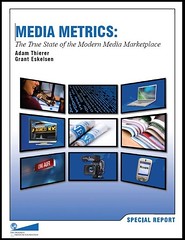 Faithful readers will recall that, several months ago, I penned a 7-part “Media Metrics” series that took a hard look at the health of the media marketplace. Today, the Progress & Freedom Foundation is releasing a greatly expanded version of these essays that I have put together with my PFF colleague Grant Eskelsen. In this 100-page special report, “Media Metrics: The True State of the Modern Media Marketplace,” we begin by noting that heated debates about the state of the media marketplace continue to rage in Washington, and opinions seem to range from grim to outright apocalyptic. As we note on pg. 1:
Many people—including a large number of legislators and regulators—argue that America’s media marketplace is in a miserable state. Some claim that citizens lack choice in media outlets and that options are just as scarce as ever. Others believe that media “localism” is dead or that many groups or niches go underserved because of a lack of true “diversity” in media. Others argue that the market is hopelessly over-concentrated in the hands of a few evil media barons who are hell-bent on force-feeding us corporate propaganda. And still others say that the quality of news and entertainment in our society has deteriorated because of a combination of all of the above. It all sounds quite troubling, but is any of it true?
After taking an objective look at the true state of America’s media marketplace, we conclude that such pessimism is unwarranted. Indeed, a careful review of the facts reveals that—contrary to what those media critics suggest—we have more media choice, more media competition, and more media diversity than ever before. Indeed, to the extent there was ever a “golden age” of media in America, we are living in it today. The media sky has never been brighter and it is getting brighter with each passing year.
Continue reading →

 The Technology Liberation Front is the tech policy blog dedicated to keeping politicians' hands off the 'net and everything else related to technology.