Industrial Policy is a red-hot topic once again with many policymakers and pundits of different ideological leanings lining up to support ambitious new state planning for various sectors — especially 5G, artificial intelligence, and semiconductors. A remarkably bipartisan array of people and organizations are advocating for government to flex its muscle and begin directing more spending and decision-making in various technological areas. They all suggest some sort of big plan is needed, and it is not uncommon for these industrial policy advocates to suggest that hundreds of billions will need to be spent in pursuit of those plans.
Others disagree, however, and I’ll be using this post to catalog some of their concerns on an ongoing basis. Some of the criticisms listed here are portions of longer essays, many of which highlight other types of steps that governments can take to spur innovative activities. Industrial policy is an amorphous term with many definitions of a broad spectrum of possible proposals. Almost everyone believes in
some form of industrial policy if you define the term broadly enough. But, as I argued in a September 2020 essay “On Defining ‘Industrial Policy‘,” I believe it is important to narrow the focus of the term such that we can continue to use the term in a rational way. Toward that end, I believe a proper understanding of industrial policy refers to targeted and directed efforts to plan for specific future industrial outputs and outcomes.
The collection of essays below is merely an attempt to highlight some of the general concerns about the most ambitious calls for expansive industrial policy, many of which harken back to debates I was covering in the late 1980s and early 1990s, when I first started a career in policy analysis. During that time, Japan and South Korea were the primary countries of concern cited by industrial policy advocates. Today, it is China’s growing economic standing that is fueling calls for ambitious state-led targeted investments in “strategic” sectors and technologies. To a lesser extent, grandiose European industrial policy proposals are also prompting new US counter-proposals.
All this activity is what has given rise to many of the critiques listed below. If you have suggestions for other essays I might add to this list, please feel free to pass them along. FYI: There’s no particular order here.
A pandemic is no time for bad governance. As the COVID-19 crisis intensified, bureaucrats and elected officials slumbered. Government regulations prevented many in the private sector from helping with response efforts. The result was a sudden surge of evasive entrepreneurialism and technological civil disobedience. With institutions and policies collapsing around them, many people took advantage of cutting‐edge technological capabilities to evade public policies that were preventing practical solutions from emerging.
Examples were everywhere. Distilleries started producing hand sanitizers to address shortages while average folks began sharing do‐it‐yourself sanitizer recipes online. The Food and Drug Administration (FDA) looked to modify hand sanitizer guidelines quickly to allow for it, but few really cared because those rules weren’t going to stop them. Gray markets in face masks, medical face shields, and respirators developed. Some people and organizations worked together to make medical devices using off‐the‐shelf hardware and open source software. More simply, others just fired up sewing machines to make masks—and then, faced with an emerging public health consensus, the guidance from the federal government shifted dramatically: where formerly ordinary people were instructed not to buy or use masks, within a matter of days, the policy reversed, and all were encouraged to make and use cloth protective masks. Continue reading →
Compliance paradox: The situation in which heightened legal or regulatory efforts fail to reverse unwanted behavior and instead lead to increased legal evasion and additional enforcement problems.
Demosclerosis: Growing government dysfunction brought on by the inability of public institutions to adapt to change, especially technological change.
Evasive entrepreneurs: Innovators who do not always conform to social or legal norms.
Free innovation: Bottom-up, noncommercial forms of innovation that often take on an evasive character. Free innovation is sometimes called “grassroots” or “household” innovation or “social entrepreneurialism.” Even though it is typically noncommercial in character, free innovation often involves regulatory entrepreneurialism and technological civil disobedience.
Innovation arbitrage: The movement of ideas, innovations, or operations to jurisdictions that provide legal and regulatory environments most hospitable to entrepreneurial activity. It can also be thought of as a form of jurisdictional shopping and can be facilitated by competitive federalism.
Innovation culture: The various social and political attitudes and pronouncements toward innovation, technology, and entrepreneurial activities that, taken together, influence the innovative capacity of a culture or nation.
Pacing problem: A term that generally refers to the inability of legal or regulatory regimes to keep up with the intensifying pace of technological change.
Permissionless innovation: The general notion that “it’s easier to ask forgiveness than it is to get permission.” As a policy vision, it refers to the idea that experimentation with new technologies and innovations should generally be permitted by default.
Precautionary principle: The practice of crafting public policies to control or limit innovations until their creators can prove that they will not cause any harm or disruptions.
Regulatory entrepreneurs: Evasive entrepreneurs who set out to intentionally challenge and change the law through their innovative activities. In essence, policy change is part of their business model.
Soft law: Informal, collaborative, and constantly evolving governance mechanisms that differ from hard law in that they lack the same degree of enforceability.
Technological civil disobedience: The technologically enabled refusal of individuals, groups, or businesses to obey certain laws or regulations because they find them offensive, confusing, time-consuming, expensive, or perhaps just annoying and irrelevant.
Technologies of freedom: Devices and platforms that let citizens openly defy (or perhaps just ignore) public policies that limit their liberty or freedom to innovate. Another term with the same meaning is “technologies of resistance.”
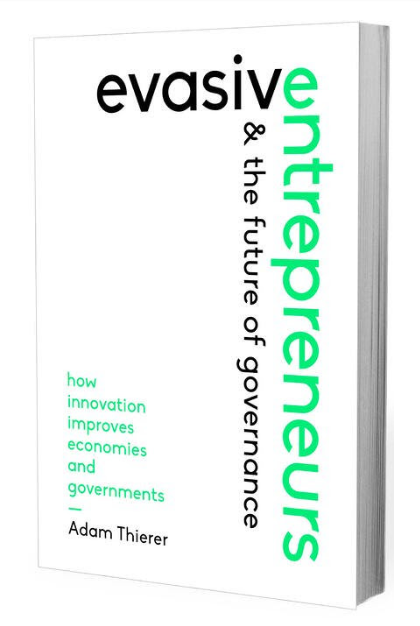
In coming days and weeks I will be occasionally blogging about different arguments made in the 368-page book, but here’s a quick summary of some of the key points I make in the book. These ten passages are pulled directly from the text:
“the freedom to innovate is essential to human betterment for each of us individually and for civilization as a whole. That freedom deserves to be taken more seriously today.”
“Entrepreneurialism and technological innovation are the fundamental drivers of economic growth and of the incredible advances in the everyday quality of life we have enjoyed over time. They are the key to expanding economic opportunities, choice, and mobility.”
“Unfortunately, many barriers exist to expanding innovation opportunities and our entrepreneurial efforts to help ourselves, our loved ones, and others. Those barriers include occupational licensing rules, cronyism-based industrial protectionist schemes, inefficient tax schemes, and many other layers of regulatory red tape at the federal, state, and local levels. We should not be surprised, therefore, when citizens take advantage of new technological capabilities to evade some of those barriers in pursuit of their right to earn a living, to tinker with or try doing new things, or just to learn about the world and serve it better.”
“Evasive entrepreneurs rely on a strategy of permissionless innovation in both the business world and the political arena. They push back against ‘the Permission Society,’ or the convoluted labyrinth of permits and red tape that often encumber entrepreneurial activities.”
“We should be willing to tolerate a certain amount of such outside-the-box thinking because entrepreneurialism expands opportunities for human betterment by constantly replenishing the well of important, life-enhancing ideas and applications.”
“we should better appreciate how creative acts and the innovations they give rise to can help us improve government by keeping public policies fresh, sensible, and in line with common sense and the consent of the governed.”
“Evasive entrepreneurialism is not so much about evading law altogether as it is about trying to get interesting things done, demonstrating a social or an economic need for new innovations in the process, and then creating positive leverage for better results when politics inevitably becomes part of the story. By acting as entrepreneurs in the political arena, innovators expand opportunities for themselves and for the public more generally, which would not have been likely if they had done things by the book.”
“Dissenting through innovation can help make public officials more responsive to the people by reining in the excesses of the administrative state, making government more transparent and accountable, and ensuring that our civil rights and economic liberties are respected.”
“In an age when many of the constitutional limitations on government power are being ignored or unenforced, innovation itself can act as a powerful check on the power of the state and can help serve as a protector of important human liberties.”
“Lawmakers and regulators need to consider a balanced response to evasive entrepreneurialism that is rooted in the realization that technology creators and users are less likely to seek to evade laws and regulations when public policies are more in line with common sense.”
It was my great pleasure to recently join Paul Matzko and Will Duffield on the Building Tomorrow podcast to discuss some of the themes in my last book and my forthcoming one. During our 50-minute conversation, which you can listen to here, we discussed:
the “pacing problem” and how it complicates technological governance efforts;
the steady rise of “innovation arbitrage” and medical tourism across the globe;
the continued growth of “evasive entrepreneurialism” (i.e., efforts to evade traditional laws & regs while innovating);
new forms of “technological civil disobedience;”
the rapid expansion of “soft law” governance mechanism as a response to these challenges; and,
craft beer bootlegging tips! (Seriously, I move a lot of beer in the underground barter markets).
Bounce over to the Building Tomorrow site and give the show a listen. Fun chat.
Writing last week in The Wall Street Journal, Matt Moffett noted how many European countries continue to struggle with chronic unemployment and general economic malaise. (“New Entrepreneurs Find Pain in Spain“) It’s a dismal but highly instructive tale about how much policy incentives matter when it comes to innovation and job creation–especially the sort of entrepreneurial activity from small start-ups that is so essential for economic growth. Here’s the key takeaway:
Scarce capital, dense bureaucracy, a culture deeply averse to risk and a cratered consumer market all suppress startups in Europe. The Global Entrepreneurship Monitor, a survey of startup activity, found the percentage of the adult population involved in early stage entrepreneurial activity last year was just 5% in Germany, 4.6% in France and 3.4% in Italy. That compares with 12.7% in the U.S. Even once they are established, European businesses are, on average, smaller and slower growing than those in the U.S. The problems of entrepreneurs are one reason Europe’s economy continues to struggle after six years of crisis. The European Union this month cut its growth forecasts for the region for this year and next, citing weaker than expected performance in the eurozone’s biggest economies, Germany, France and Italy. This week, the Organization for Economic Cooperation and Development delivered its own pessimistic appraisal, with chief economist Catherine Mann saying, “The eurozone is the locus of the weakness in the global economy.”
[…]
Europe’s unemployment crisis may be eroding a deeply ingrained fear of failure that is a bigger impediment to entrepreneurship on the Continent than in other regions, according to academic surveys. “Fear of failure is less of an issue because the whole country is a failure, and most of us are out of business or have a hard time paying our bills,” said Nick Drandakis of Athens, who in 2011 founded Taxibeat, an app that provides passenger ratings on taxi drivers.
Last week, it was my pleasure to speak at a Cato Institute event on “The End of Transit and the Beginning of the New Mobility: Policy Implications of Self-Driving Cars.” I followed Cato Institute Senior Fellow Randal O’Toole and Marc Scribner, a Research Fellow at the Competitive Enterprise Institute. They provided a broad and quite excellent overview of all the major issues at play in the debate over driverless cars. I highly recommend you read the excellent papers that Randal and Marc have published on these issues.
My role on the panel was to do a deeper dive into the privacy and security implications of not just the autonomous vehicles of our future, but also the intelligent vehicle technologies of the present. I discussed these issues in greater detail in my recent Mercatus Center working paper, “Removing Roadblocks to Intelligent Vehicles and Driverless Cars,” which was co-authored with Ryan Hagemann. (That article will appear in a forthcoming edition of the Wake Forest Journal of Law & Policy.) I’ve embedded the video of the event down below (my remarks begin at the 38:15 mark) as well as my speaking notes. Again, please consult the longer paper for details.
On Monday it was my great pleasure to participate in a Cato Institute briefing on Capitol Hill about “Internet Taxation: Should States Be Allowed to Tax outside Their Borders?” Also speaking was my old friend Dan Mitchell, a senior fellow with Cato. From the event description: “State officials have spent the last 15 years attempting to devise a regime so they can force out-of-state vendors to collect sales taxes, but the Supreme Court has ruled that such a cartel is not permissible without congressional approval. Congress is currently considering the Main Street Fairness Act, a bill that would authorize a multistate tax compact and force many Internet retailers to collect sales taxes for the first time. Is this sensible? Are there alternative ways to address tax “fairness” concerns in this context?”
Watch the video for our answers. Also, here’s the big Cato paper that Veronique de Rugy and I penned for Cato on this back in 2003 and here’s a shorter recent piece we did for Mercatus.
The Technology Liberation Front is the tech policy blog dedicated to keeping politicians' hands off the 'net and everything else related to technology. Learn more about TLF →



 The Technology Liberation Front is the tech policy blog dedicated to keeping politicians' hands off the 'net and everything else related to technology.