Yesterday’s Supreme Court decision in Citizens United v. FEC essentially stands for the proposition that free speech is free speech regardless of the speaker. The 5-4 majority for the Court ruled that “We find no basis for the proposition that, in the context of political speech, the Government may impose restrictions on certain disfavored speakers. Both history and logic lead us to this conclusion.” (at 25) Echoing its early decision in Bellotti, the Court noted that “Political speech is ‘indispensable to decisionmaking in a democracy, and this is no less true because the speech comes from a corporation rather than an individual.’” (at 33) “All speakers, including individuals and the media, use money amassed from the economic marketplace to fund their speech. The First Amendment protects the resulting speech, even if it was enabled by economic transactions with persons or entities who disagree with the speaker’s ideas.” (at 35) “There is simply no support for the view that the First Amendment, as originally understood, would permit the suppression of political speech by media corporations.” (at 37)
Somehow this has proven controversial, even radical, to some. But, as George Will correctly notes, “This was radical only because after nearly four decades of such ‘reform’ the First Amendment has come to seem radical. Which, indeed, it is. The Supreme Court on Thursday restored First Amendment protection to the core speech that it was designed to protect — political speech.” Essentially, the decision gets Congress out of the game of picking who, or what platform, deserves full First Amendment protection when it comes to uttering political speech. And there’s nothing radical about that.
Indeed, as Justice Kennedy noted for the majority, there is nothing surprising about this reasoning once you realize that almost every other type legislative or regulatory speech restriction has been struck down as a violation of the First Amendment. “The law before us is an outright ban [on political speech], backed by criminal sanctions,” Kennedy noted (at 20). “If the First Amendment has any force, it prohibits Congress from fining or jailing citizens, or associations of citizens, for simply engaging in political speech.” (at 33) Think about this for a second: Criminal sanctions or jail time for political speech! How in the world did we get to the point in this nation where criminalizing political speech became acceptable to our legislators? Ignoring the obvious answer—it’s all about protecting incumbents—what is really “radical” here is not that the Supreme Court setting us back on the right path, but that our legislative branch has veered so far off of it.
Continue reading →
The week-long Cato Unbound online debate about the 10th anniversary of Lawrence Lessig’s Code and Other Laws of Cyberspace continues today with Prof. Lessig’s response to Declan McCullagh’s opening essay, “What Larry Didn’t Get,” Jonathan Zittrain’s follow-up essay, and my essay on, “Code, Pessimism, and the Illusion of ‘Perfect Control.’” Needless to say, Prof. Lessig isn’t too happy with my response. You should jump over to the Cato site to read the entire thing, but here are a couple of excerpts and my response.
To my suggestion that there is a qualitative difference between law and code, Prof. Lessig says:
I’ve argued that things aren’t quite a simple as some libertarians would suggest. That there’s not just bad law. There’s bad code. That we don’t need to worry just about Mussolini. We also need to worry about DRM or the code AT&T deploys to help the government spy upon users. That public threats to liberty can be complemented by private threats to liberty. And that the libertarian must be focused on both. […]
Of course, law is law. Who could be oblivious to that? And who would need a book to explain it? But the fact that “law is law” does not imply that it has a “much greater impact in shaping markets and human behavior.” Sometimes it does — especially when that “law” is delivered by a B1 bomber. But ask the RIAA whether it is law or code that is having a “greater impact in shaping markets” for music. Or ask the makers of Second Life whether the citizens of that space find themselves more constrained by the commercial code of their geo-jurisdiction or by the fact that the software code of Second Life doesn’t permit you simply to walk away (so to speak) with another person’s scepter. Whether and when law is more effective than code is an empirical matter — something to be studied, and considered, not dismissed by banalities spruced up with italics.
Well, I beg the professor’s pardon for excessive use of italics. [I won’t ask for an apology for misspelling my last name in his piece!] Regardless, it’s obvious that we’ll just never see eye-to-eye on the crucial distinction between law and code. Again, as I stated in my essay: “With code, escape is possible. Law, by contrast, tends to lock in and limit; spontaneous evolution is supplanted by the stagnation of top-down, one-size-fits-all regulatory schemes.”
Lessig largely dismisses much of this with that last line above, suggesting that we just need to keep studying the matter to determine the right mix of what works best. To be clear, while I’m all for studying the impact of law vs. code as “an empirical matter,” that in turn begs the question of how we define effectiveness or success. I suspect that the professor and I would have a “values clash” over some rather important first principles in that regard. This is, of course, a conflict of visions that we see throughout the history of philosophy; a conflict between those who put the individual and the individual’s rights at the core of any ethical political system versus those who would place the rights of “the community,” “the public” or some other amorphous grouping(s) at the center of everything. It’s a classic libertarian vs. communitarian / collectivist debate.
Continue reading →
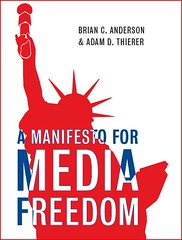 I’m pleased to announce the publication of A Manifesto for Media Freedom, which I co-authored with Brian C. Anderson of the Manhattan Institute. Brian serves as editor of Manhattan Institute’s excellent City Journal and he is the author of best-selling books like South Park Conservatives and Democratic Capitalism and Its Discontents.
In this little manifesto, we highlight one of the central ironies of the Information Age. Namely, that despite “the breathtaking abundance of new and old media outlets for obtaining news, information, and entertainment…”
many people hate this profusion, and never more than when it involves political speech. The current media market, they charge, doesn’t represent true diversity, or isn’t fair, or is subject to manipulation by a small and shrinking group of media barons. They want the government to regulate it into better shape, which just happens to be a shape that benefits them. Doing so… would be a disaster, a kind of soft or not-so-soft tyranny that would wipe out whole sectors of media, curtailing free speech and impoverishing our democracy.
In other words, instead of celebrating the unprecedented cornucopia of media choices at our collective disposal, many policymakers and media critics are calling for just as much media regulation as ever. We itemize these threats in our chapters and they include: efforts to revive the “Fairness Doctrine”, media ownership regulations, “localism” requirements, Net neutrality mandates, a la carte regulations, cable and satellite censorship, video game censorship, regulation of social networking sites, campaign finance-related speech restrictions, and so on.
In each case, we advance a pro-freedom paradigm to counter the advocates of media control. What do we mean by the “media freedom” that we advocate as the alternative to these new regulatory crusades? Here’s how we put it in the book:
Continue reading →
Writing at Slate, Tim Wu tries to make Obama out to be the real Big Government candidate on media policy, who will deliver “if not a chicken in every pot, a fiber-optic cable in every home.” By contrast, Wu implies that McCain is just another pro-big business lackey who doesn’t understand “that the media and information industries are special—that like the transportation, energy, or financial industries, they are deeply entwined with the public interest.” Wu goes on to say:
Ultimately, most of the difference in Obama’s and McCain’s media policies boils down to questions about whether the media is special and a dispute over how much to trust the private sector. Camp McCain would tend to leave the private sector alone, with faith that it will deliver to most Americans what they want and deserve. The Obama camp would probably administer a more frequent kick in the pants, in the belief that good behavior just isn’t always natural.
First, as a factual matter, Wu is just wrong about McCain being some sort of a radical hands-off, pro-market liberalizer on media policy issues. Oh, if only that were true! But for those of us who have been in DC covering telecom and media policy for many years, it is widely understood there is no nailing down John McCain on any tech, telecom or media policy issue. He’s been all over the board. While he has sponsored or supported
some deregulatory initiatives on the telecom front in the past, he’s also been a supporter of other regulatory causes. His battles with broadcasters and cable, for example, are well-known. Most recently, McCain has been leading the effort to impose a la carte mandates on cable and satellite operators.
Continue reading →

 The Technology Liberation Front is the tech policy blog dedicated to keeping politicians' hands off the 'net and everything else related to technology.