Three months ago, when the DC Circuit struck down the FCC’s “Cable Cap”—which prevented any one cable company from serving more than 30% of US households out of fear that he larger cable companies would use their “gatekeeper” power to restrict programming—the New York Times
bemoaned the decision:
The problem with the cap is not that it is too onerous, but that it is not demanding enough.
Even with the cap — and satellite television — there is a disturbing lack of price competition. The cable companies have resisted letting customers choose, a la carte, the channels they actually watch….
[The FCC] needs to ensure that customers have an array of choices among cable providers, and that there is real competition on price and program offerings.
Perhaps the
Times‘ editors should have consulted with the Lead Technology Writer of their excellent BITS blog. Nick Bilton might have told him the truth: “Cable Freedom Is a Click Away.” That’s the title of his excellent survey of devices and services (Hulu, Boxee, iTunes, Joost, YouTube, etc.) that allow users to get cable television programming without a cable subscription.
Nick explains that consumers can “cut the video cord” and still find much, if not all, their favorite cable programming—as well as the vast offerings of online video—without a hefty monthly subscription. (Adam recently described how Clicker.com is essentially TV guide for the increasing cornucopia of Internet video.) This makes the 1992 Cable Act’s requirement that the FCC impose a cable cap nothing more than the vestige of a bygone era of platform scarcity, predating not just the Internet, but also competing subscription services offered by satellite and telcos over fiber. That’s precisely what we argued in PFF’s amicus brief to the DC Circuit a year ago, and largely why the court ultimately struck down the cap.
Bilton notes that “this isn’t as easy as just plugging a computer into a monitor, sitting back and watching a movie. There’s definitely a slight learning curve.” But, as he describes, cutting the cord isn’t rocket science. If getting used to using a wireless mouse is the thing that most keeps consumers “enslaved” to the cable “gatekeepers” the FCC frets so much about, what’s the big deal? Does government really need to set aside the property and free speech rights of cable operators to run their own networks just because some people may not be as quick to dump cable as Bilton? Is the lag time between early adopters and mainstream really such a problem that we would risk maintaining outdated systems of architectural censorship (Chris Yoo’s brilliant term) that give government control over speech in countless subtle and indirect ways? Continue reading →
The D.C. Circuit has struck down as arbitrary and capricious the FCC’s “cable cap.” The cap prevented a single cable operator from serving more than 30% of U.S. homes—precisely the same percentage limit struck down by the court in 2001. The court ruled that the FCC had failed to demonstrate that “allowing a cable operator to serve more than 30% of all cable subscribers would threaten to reduce either competition or diversity in programming.”
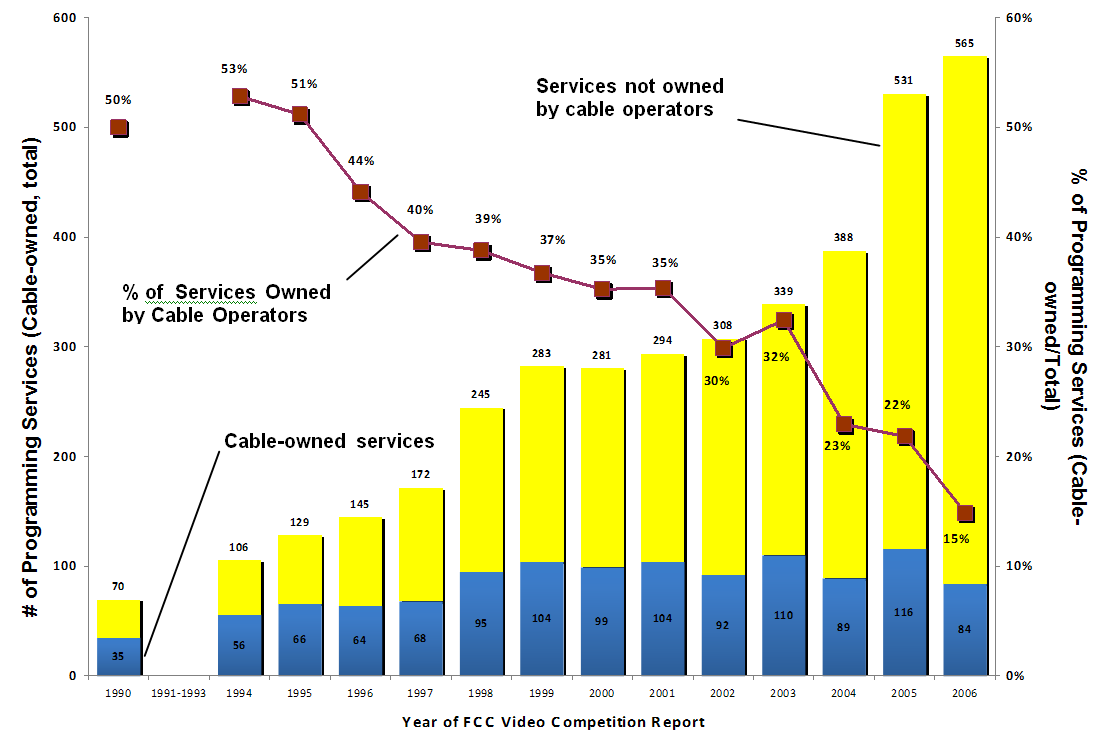
The court’s decision rested on the two critical charts (both generated by my PFF colleague Adam Thierer in his excellent
Media Metrics special report) at the heart of the PFF amicus brief I wrote with our president, Ken Ferree:
First, the record is replete with evidence of ever increasing competition among video providers: Satellite and fiber optic video providers have entered the market and grown in market share since the Congress passed the 1992 Act, and particularly in recent years. Cable operators, therefore, no longer have the bottleneck power over programming that concerned the Congress in 1992.
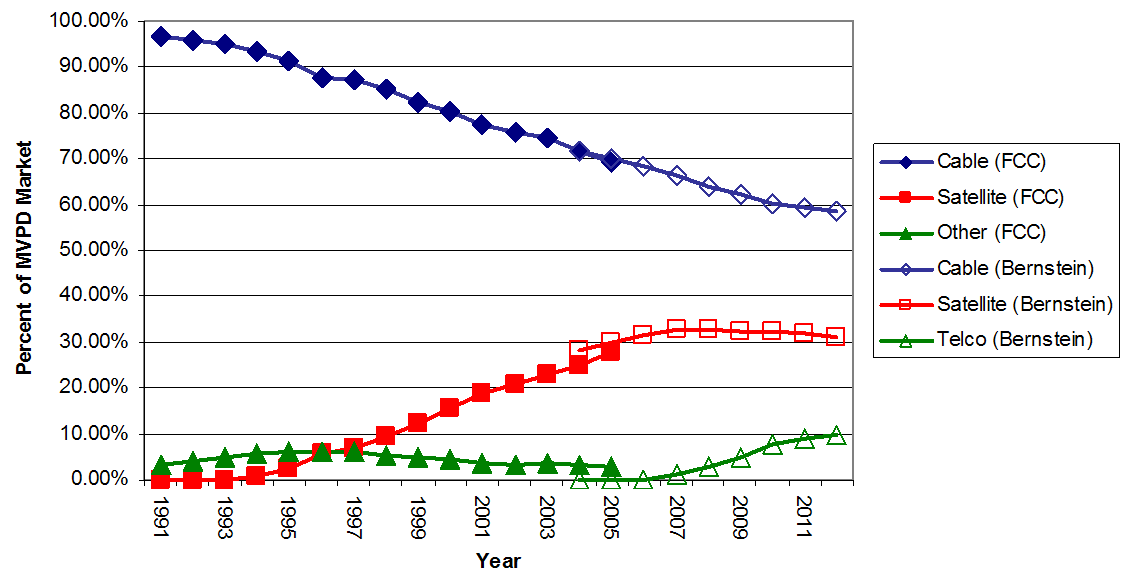
Second, over the same period there has been a dramatic increase both in the number of cable networks and in the programming available to subscribers.
Our chart shows the explosion in the number of programmers (though not the total amount of programming), as well as the falling rate of affiliation between cable operators and programmers, which was among the prime factors motivating Congress when it authorized a cable cap in the 1992 Cable Act:
Continue reading →
Continuing the “Cutting the (Video) Cord” series started by my PFF colleague Adam Thierer: The WSJ had two great pieces yesterday about the increasing competitive relevance of television distributed by Internet—a trend that was at the heart of an amicus
brief PFF recently filed in support of C omcast’s challenge of the FCC’s 30% cap on cable ownership. The first WSJ piece declares that:
After more than a decade of disappointment, the goal of marrying television and the Internet seems finally to be picking up steam. A key factor in the push are new TV sets that have networking connections built directly into them, requiring no additional set-top boxes for getting online. Meanwhile, many consumers are finding more attractive entertainment and information choices on the Internet — and have already set up data networks for their PCs and laptops that can also help move that content to their TV sets.
The easier it is for consumers to receive traditional television programming (in addition to other kinds of video content) distributed over the Internet on their television, the less “gatekeeper” or “bottleneck” power cable distributors have over programming. So the Netflix-capable and Yahoo-widget-capable televisions described by the WSJ piece go a long way to increasing the substitutability of what we call Internet Video Programming Distributors (IVPDs) for Multichannel Video Programming Distributors (MVPDs), such as cable, satellite television and fiber services offered by telcos such as Verizon’s FiOS.
While such televisions are only expected to reach 14% of all TV sales by 2012, one must remember that a growing number of set-top boxes (
e.g., the Roku Digitial Video Player, game consoles like the Microsoft XBox 360 and Sony PlayStation 3, and TiVo DVRs) allow users to users to receive IVPD programming on their existing televisions.
As we argued in our amicus brief, the immense competitive importance of IVPDs lies not in the potential for some users to “cut the cord” to cable and other MVPDs (though that will surely happen), but in the immediate impact IVPDs have as an alternative distribution channel for programmers. In the pending D.C. Circuit case, we argue that both the FCC’s 30% cap, issued in December 2007, and the underlying portions of the 1992 Cable Act authorizing such a cap should be struck down as unconstitutional because the ready availability of IVPDs as an alternative distribution channel means that cable no longer has the “special characteristic” of gatekeeper/bottleneck power that would justify imposing such a unique burden on the audience size of cable operators. (Of course, Direct Broadcast Satellite and Telco Fiber are also eating away at cable’s share of the MVPD marketplace.)
The second WSJ piece, an op/ed, illustrates beautifully how cable operators are already losing “market power” (or at least negotiating leverage) in a very tangible way: they’re having to pay more for programming. Specifically, the Journal describes how Viacom plaid chicken with Time Warner—and won. Continue reading →
Ken Ferree and I just filed an amicus brief with the D.C. Circuit in what could be among the most important First Amendment cases involving economic regulation in years: Comcast’s challenge to the FCC’s cap on the maximum size of a cable operator’s nationwide subscriber-audience. While few may feel righteous indignation at limitations targeted at large corporations such as Comcast or Time Warner, the larger principle at stake here is deeply important: Will the First Amendment provide a meaningful check on what USC law professor Chris Yoo has called “architectural censorship” (i.e., so-called “structural” regulations that “have the unintended consequence of reducing the quantity, quality, and diversity of media content”).
In a nutshell, we argue that that:
- The provisions of the 1992 Cable Act authorizing the FCC to impose a “cable cap” are outdated in world of media abundance and vibrant platform competition.
- Because cable is no longer the unique “bottleneck” or “gatekeeper” that it was in 1992, these statutory provisions (not just the FCC’s 30% rule) must be subject to strict scrutiny under the First Amendment as a limitation on free speech.
- Because there are “less restrictive means” of ensuring cable operators do not impede the flow of video programming to consumers, the court should strike down these provisions.
- Even if the court upholds the statute, it should nonetheless strike down the cap issued by the FCC in December 2007 (30% of all Multichannel Video Programming (MVPD) subscribers as based on an outdated model of the video marketplace.
I encourage you to read our brief (below). I’ve provided a summary below, along with some additional commentary we just couldn’t cover under our 3500 word limit.
Strict Scrutiny. Yoo’s article Architectural Censorship and the FCC is essential reading for anyone who believes that government regulations on the size and shape of the “soapbox” can have huge effects on speech itself. Yoo argues that the First Amendment should check this kind of regulation–however “content-neutral” it might seem–under “strict scrutiny”, which requires that the government show that a regulation is the “least restrictive means” available for advancing a “compelling government interest.” But Yoo ultimately concludes (pp. 713-718, PDF pp. 45-50) that, under existing precedent, most “architectural censorship will be effectively insulated from meaningful judicial review.” Continue reading →

 The Technology Liberation Front is the tech policy blog dedicated to keeping politicians' hands off the 'net and everything else related to technology.