In an earlier post, I mentioned an important new online child safety task force report that has just been released from the “Point Smart. Click Safe.” Blue Ribbon Working Group. It’s a great report and I encourage you to read the whole thing. It was my great pleasure to serve on this task force, and as we started finalizing our conclusions and recommendations, I started thinking about how much of what we were finding and recommending was consistent with what past online safety task forces had also concluded.
By way of background, over the past decade, five major online safety task forces or blue ribbon commissions have been convened to study online safety issues. Two of these task forces were convened in the United States and issued reports in 2000 (“COPA Commission”) and 2002 (“Thornburgh Commission“). Another was commissioned by the British government in 2007 and issued in a major report in March 2008 (“Byron Review“). Finally, two additional online safety task forces were formed in the U.S. in 2008 and concluded their work, respectively, in January (“Internet Safety Technical Task Force“) and July (“Point Smart. Click Safe.“) of 2009. [And yet another task force — the Online Safety Technology Working Group — was recently formed and has now gotten underway.]
In a new PFF white paper, ”
Five Online Safety Task Forces Agree: Education, Empowerment & Self-Regulation Are the Answer,” I walk through a chronological summary of each of these past task forces [click on covers of each report below to read them in their entirety] and highlight some of the similar themes and recommendations from them.
 Continue reading →
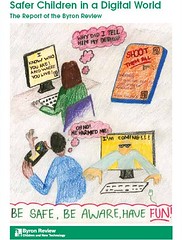
The long-awaited final report of the UK’s Byron Review on Children and New Technology is finally out. It is called Safer Children in a Digital World. It focuses on the benefits and risks associated with the Internet and video games. I will be posting more about the specifics in coming days, but the general thrust of the report–at least from the executive summary–looks quite good. Here’s a few key quotes:
* Technology offers extraordinary opportunities for all of society including children and young people. The internet allows for global exploration which can also bring risks, often
paralleling the offline world.
* “New media are often met by public concern about their impact on society and anxiety and polarisation of the debate can lead to emotive calls for action.” … “Debates and research in this area can be highly polarised and charged with emotion.”
* “I propose that we seek to achieve gains in these three areas by having a national strategy for child internet safety which involves better self-regulation and better provision of information and education for children and families.”
* “We need to take into account children’s individual strengths and vulnerabilities, because the factors that can discriminate a ‘beneficial’ from a ‘harmful’ experience online and in video games will often be individual factors in the child. The very same content can be useful to a child at a certain point in their life and development and may be equally damaging to another child.”
I like the focus on education and parental oversight that I see in the report. Here’s a particular good recommendation that closely parallels what I have called for in my own work:
Continue reading →

 The Technology Liberation Front is the tech policy blog dedicated to keeping politicians' hands off the 'net and everything else related to technology.