Posts tagged as:

The New York Times today published my response to an oped by Senators Lindsey Graham & Elizabeth Warren calling for a new “Digital Consumer Protection Commission” to micromanage the high-tech information economy. “Their new technocratic digital regulator would do nothing but hobble America as we prepare for the next great global technological revolution,” I argue. Here’s my full response:

Senators Lindsey Graham and Elizabeth Warren propose a new federal mega-regulator for the digital economy that threatens to undermine America’s global technology standing.

A new “licensing and policing” authority would stall the continued growth of advanced technologies like artificial intelligence in America, leaving China and others to claw back crucial geopolitical strategic ground.

America’s digital technology sector enjoyed remarkable success over the past quarter-century — and provided vast investment and job growth — because the U.S. rejected the heavy-handed regulatory model of the analog era, which stifled innovation and competition.

The tech companies that Senators Graham and Warren cite (along with countless others) came about over the past quarter-century because we opened markets and rejected the monopoly-preserving regulatory regimes that had been captured by old players.

The U.S. has plenty of federal bureaucracies, and many already oversee the issues that the senators want addressed. Their new technocratic digital regulator would do nothing but hobble America as we prepare for the next great global technological revolution.

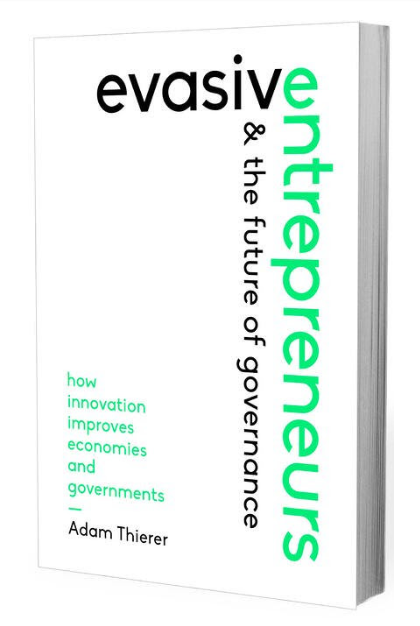
[Originally published on the Cato Institute blog.]

A pandemic is no time for bad governance. As the COVID-19 crisis intensified, bureaucrats and elected officials slumbered. Government regulations prevented many in the private sector from helping with response efforts. The result was a sudden surge of evasive entrepreneurialism and technological civil disobedience. With institutions and policies collapsing around them, many people took advantage of cutting‐​edge technological capabilities to evade public policies that were preventing practical solutions from emerging.

Examples were everywhere. Distilleries started producing hand sanitizers to address shortages while average folks began sharing do‐​it‐​yourself sanitizer recipes online. The Food and Drug Administration (FDA) looked to modify hand sanitizer guidelines quickly to allow for it, but few really cared because those rules weren’t going to stop them. Gray markets in face masks, medical face shields, and respirators developed. Some people and organizations worked together to make medical devices using off‐​the‐​shelf hardware and open source software. More simply, others just fired up sewing machines to make masks—and then, faced with an emerging public health consensus, the guidance from the federal government shifted dramatically: where formerly ordinary people were instructed not to buy or use masks, within a matter of days, the policy reversed, and all were encouraged to make and use cloth protective masks. Continue reading →

I honestly don’t know. I haven’t been following his work, and, by saying I don’t know, I don’t imply that he didn’t achieve anything. But it’s utterly unclear from this interview with Nancy Scola what he achieved as chief technology officer in the Obama Administration the last few years.

I was piqued by the amusing—almost comical—claims to specificity he makes, right from the outset:

What is the elevator pitch on what you’ve been doing since you were named Chief Technology Officer of the United States?
What I do is advance the president’s innovation agenda by incorporating his bottom-up theory of change. To be very specific about it, I execute the president’s innovation strategy in a manner that taps into the expertise of the American people to solve big problems.

There is nothing specific about, “I execute the president’s innovation strategy in a manner that taps into the expertise of the American people to solve big problems.” If you were to look up “vague” in the dictionary, that sentence would illustrate the first definition of the word.

Ever notice how people say, “I don’t mean to interrupt,” when they are interrupting? How they say, “to make a long story short,” when it’s already too late? Chopra says he’s going to be specific as he heads into empty generalities. Further along in the interview , he talks about his role and his involvement, which would be interesting meta-information if it set the stage for describing accomplishment.

So the question stands: What things happened under Aneesh Chopra that wouldn’t have happened in his absence?

Caveats: Aneesh Chopra seems like a nice guy. I don’t doubt his sincerity or intention to have done good things. I don’t think he’s unique among bureaucrats in not having identifiable achievements. I am open to learning what he did achieve. He just hasn’t explained it himself.

This line of questioning also may seem disrespectful. Chopra has acted as a public servant the last few years and deserves credit for that, some would argue. But I disagree that the claim to “public service” should act as insulation against being held to account for performance. What did Aneesh Chopra achieve?

Here’s a sharp editorial from The Economist about Internet governance entitled,  “In Praise of Chaos: Governments’ Attempts to Control the Internet Should be Resisted.” In the wake of the recent Internet Governance Forum meeting, many folks are once again debating the question of who rules the Net? Along with Wayne Crews, I edited a huge collection of essays on that topic back in 2003 and it’s a subject that continues to interest me greatly. As I noted here last week, many of those who desire greater centralization of control over Net governance decisions are using the fear that “fragmentation” will occur without some sort of greater plan for the Net’s future. I believe these fears are greatly overstated and are being used to justify expanded government meddling with online culture and economics.

The new Economist piece nicely brings into focus the key question about who or what we should trust to guide the future of the Internet. It rightly notes that the current state of Net governance is, well, messy. But that’s not such a bad thing when compared to the alternative: Continue reading →

[Note: This post is updated regularly as I discover relevant old or new material.]

“Regulatory capture” occurs when special interests co-opt policymakers or political bodies — regulatory agencies, in particular — to further their own ends.  Capture theory is closely related to the “rent-seeking” and “political failure” theories developed by the public choice school of economics.  Another term for regulatory capture is “client politics,” which according to James Q. Wilson, “occurs when most or all of the benefits of a program go to some single, reasonably small interest (and industry, profession, or locality) but most or all of the costs will be borne by a large number of people (for example, all taxpayers).”  (James Q. Wilson, Bureaucracy, 1989, at 76).

While capture theory cannot explain all regulatory policies or developments, it does provide an explanation for the actions of political actors with dismaying regularity.  Because regulatory capture theory conflicts mightily with romanticized notions of “independent” regulatory agencies or “scientific” bureaucracy, it often evokes a visceral reaction and a fair bit of denialism.  (See, for example, the reaction of New Republic’s Jonathan Chait to Will Wilkinson’s recent Economist column about the prevalence of corporatism in our modern political system.)  Yet, countless studies have shown that regulatory capture has been at work in various arenas: transportation and telecommunications; energy and environmental policy; farming and financial services; and many others.

I thought it might be useful to build a compendium of quotes from various economists and political scientists who have studied the regulatory process throughout history and identified regulatory capture or client politics as a major problem.  I would greatly appreciate having others suggest additional quotes and studies to add to this list since I plan to update it frequently and eventually work all of this into a future paper or book. [ Note: I have updated this compendium over a dozen times since the original post, so please check back for updates.]

The following list is chronological and begins, surprisingly, with the thoughts of progressive hero Woodrow Wilson…

Continue reading →

Today I am attending, and speaking at, a terrific event in downtown DC sponsored by the Catholic University Law School on“Implementing the National Broadband Plan: Perspectives from Government, Industry, and Consumers.” It’s being held at the offices of the law firm of Wiley Rein LLP.  Edward Lazarus, Chief of Staff to FCC Chairman Julius Genachowski kicked off the event with a nice keynote address talking about the broad goals of the FCC’s coming National Broadband Plan. Lazarus broke the ice by joking with the crowd — which is heavily made up of communications industry lawyers — that “The FCC is doing everything it can to provide full employment for telecom lawyers.  Whatever else we are failing at, we are succeeding at that.” Again, it was a joke, so I don’t want to make too much out of it, but…  No, strike that, I do want to talk about that for a minute! Because this is actually a very important question: Exactly how much bureaucracy and deadweight loss to the economy (in the form of more lawyering and lobbying) is going to accompany the National Broadband Plan?

Two years ago, I posted an essay on “Lawyers, Lawsuits and Net Neutrality Regulation,” in which I attempted to highlight the uncomfortable fact that Net neutrality regulation will likely lead to a bureaucratic nightmare at the FCC and a lawyer’s bonanza once the lawsuits start flying in court. Of course, now we have Net neutrality regulations and a National Broadband Plan pending at the FCC, so the potential for bloated bureaucracy will only grow larger. Do you think I am exaggerating? Well, here are some facts to consider from our recent experience in the field of “telecom reform.”  In the years following passage of the Telecom Act, entire forests fell because of the thousands of pages of regulatory and judicial interpretations that were handed down trying to figure out what that word meant. In fact, let’s take a quick tally of the paperwork burden the FCC managed to churn out in just three major “competition” rules it issued in an attempt to implement the Telecom Act and define the “cost” of unbundled network elements (“UNEs”):

You’d think that in 2009, when global networks are handling exabytes of data in a single day and OC192 fiber optic connections crisscross the planet, the FCC — the most important communications agency in the United States — would at least be able to use modern technology to stream its own public meetings.tlf image realplayer

Nope. The FCC is still streaming its webcasts with RealPlayer, a horrendous and arguably obsolete application that fell out of favor with techies years ago and has since been overtaken by superior streaming platforms like Adobe’s Flash Media Server.

Today’s big tech news item is the FCC’s “three-pronged probe” of the wireless industry, which was set to be announced today at this morning’s Open Commission Meeting.

Want to watch the FCC’s meeting and see what our “public servants” in Washington are up to? Good luck. The FCC’s streaming video server only supports 200 simultaneous connections.

In a nation of 270 million wireless users, why not offer, say, 1000 or even 10000 connections? Given the agency’s $339 million dollar budget that’s not too much to ask, is it?

It’s especially ironic that the FCC still struggles with streaming webcasts given that the FCC is launching an investigation of alleged “anti-competitive” practices in the wireless industry. Why isn’t the FCC investigating its own inability to accomplish relatively simple tasks, like stream live video or run a halfway decent website?

The FCC doesn’t just use RealPlayer for Open Commission Meetings. Even the FCC’s “Broadband Workshops” — which are supposedly going to guide the future of broadband deployment in America — are using the same tired streaming platform.

Of course, in the grand scheme of things, the platform the FCC uses for streaming video isn’t all that important. But it is a much-needed reminder that bureaucrats in Washington aren’t very good at keeping pace with modern technology. Unfortunately, many seem to have forgotten this fact.

ADDENDUM: Turns out the FCC does use a modern platform for streaming open commission meeting, Cisco Webex Webinar (accessible via www.broadband.gov) but only offers RealPlayer streams on the official FCC.gov website. Also, once meetings are finished, they are available online exclusively in the Real video format.

Before commenting on Lawrence Lessig’s latest call to abolish the Federal Communications Commission (he issued a similar call for the FCC’s abolition earlier this year, which I commented on here), let’s recall what Tim Lee posted yesterday about “Real Regulators“:

Too many advocates of regulation seem to have never considered the possibility that the FCC bureaucrats in charge of making these decisions at any point in time might be lazy, incompetent, technically confused, or biased in favor of industry incumbents. That’s often what “real regulators” are like, and it’s important that when policy makers are crafting regulatory scheme, they assume that some of the people administering the law will have these kinds of flaws, rather than imagining that the rules they write will be applied by infallible philosopher-kings.

Ironically, Prof. Lessig — who typically defends many forms of high-tech regulation like Net neutrality and online content labeling — is essentially agreeing with Tim’s critique of bureaucracy. But Lessig seems to ignore the underlying logic of Tim’s critique and instead imagines that we need only reinvent bureaucracy in order to save it. But I’m getting ahead of myself. First, let’s hear what Lessig proposes.

In a Newsweek column this week entitled “Reboot the FCC,” Lessig argues that the FCC is beyond saving because, instead of protecting innovation, the agency has succumb to an “almost irresistible urge to protect the most powerful instead.” Consequently, he continues:

The solution here is not tinkering. You can’t fix DNA. You have to bury it. President Obama should get Congress to shut down the FCC and similar vestigial regulators, which put stability and special interests above the public good. In their place, Congress should create something we could call the Innovation Environment Protection Agency (iEPA), charged with a simple founding mission: “minimal intervention to maximize innovation.” The iEPA’s core purpose would be to protect innovation from its two historical enemies–excessive government favors, and excessive private monopoly power.

As was the case with his earlier call to “blow up the FCC,” I am tickled to hear Lessig call for shutting down an agency that many of us have been fighting against for the last few decades. (Here’s a 1995 blueprint for abolishing the FCC that I contributed to, and here’s PFF’s recent “DACA” project to comprehensively reform and downsize the agency.)

But is Lessig really calling for the same sort of sweeping regulatory reform and downsizing that others have been calling for? And has he identified the real source of the problem that he hopes to correct?  I don’t think so. There are 3 basic problems with the argument Lessig is putting forward in his essay. I will address each in turn.

Continue reading →