
Posts tagged as:

GMLR coverI’m pleased to announce the release of my latest law review article, “A Framework for Benefit-Cost Analysis in Digital Privacy Debates.” It appears in the new edition of the George Mason University Law Review. (Vol. 20, No. 4, Summer 2013)

This is the second of two complimentary law review articles I am releasing this year dealing with privacy policy. The first, “The Pursuit of Privacy in a World Where Information Control is Failing,” was published in Vol. 36 of the Harvard Journal of Law & Public Policy this Spring. (FYI: Both articles focus on privacy claims made against private actors — namely, efforts to limit private data collection — and not on privacy rights against governments.)

My new article on benefit-cost analysis in privacy debates makes a seemingly contradictory argument: benefit-cost analysis (“BCA”) is extremely challenging in online child safety and digital privacy debates, yet it remains essential that analysts and policymakers attempt to conduct such reviews. While we will never be able to perfectly determine either the benefits or costs of online safety or privacy controls, the very act of conducting a regulatory impact analysis (“RIA”) will help us to better understand the trade-offs associated with various regulatory proposals. Continue reading →

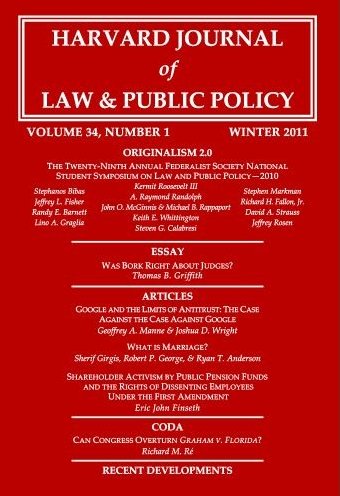
HJLPP coverI’m excited to announce the release of my latest law review article, “The Pursuit of Privacy in a World Where Information Control is Failing,” which appears in the next edition (vol. 36) of the Harvard Journal of Law & Public Policy. This is the first of two complimentary law review articles that I will be releasing this year dealing with privacy policy. The second, which will be published later this summer by the George Mason University Law Review, is entitled, “A Framework for Benefit-Cost Analysis in Digital Privacy Debates.” (FYI: Both articles focus on privacy claims made against private actors — namely, efforts to limit private data collection — and not on privacy rights against governments.)

The new Harvard Journal article is divided into three major sections. Part I focuses on some of normative challenges we face when discussing privacy and argues that there may never be a widely accepted, coherent legal standard for privacy rights or harms here in the United States. It also explores the tensions between expanded privacy regulation and online free speech. Part II turns to the many enforcement challenges that are often ignored when privacy policies are being proposed or formulated and argues that legislative and regulatory efforts aimed at protecting privacy must now be seen as an increasingly intractable information control problem. Most of the problems policymakers and average individuals face when it comes to controlling the flow of private information online are similar to the challenges they face when trying to control the free flow of digitalized bits in other information policy contexts, such as online safety, cybersecurity, and digital copyright.

If the effectiveness of law and regulation is limited by the normative considerations discussed in Part I and the practical enforcement complications discussed in Part II, what alternatives remain to assist privacy-sensitive individuals? I address that question in Part III of the paper and argue that the approach America has adopted to deal with concerns about objectionable online speech and child safety offers a path forward on the privacy front as well. Continue reading →

[Here’s an oped of mine that recently ran on Reuters.  Readers will recognize many of these themes and arguments since I have developed them here on the TLF many times before.]

Privacy Regulation and the “Free” Internet

by Adam Thierer, Mercatus Center at George Mason University

Would you like to pay $20 a month for Facebook, or a dime every time you did a search on Google or Bing?  That’s potentially what is at stake if the Obama administration and advocates of stepped-up regulation of online advertising get their way.

The Internet feels like the ultimate free lunch.  Once we pay for basic access, a cornucopia of seemingly free services and content is at our fingertips.  But those services don’t just fall to Earth like manna from heaven.  What powers the “free” Internet are data collection and advertising. In essence, the relationship between consumers and online content and service providers isn’t governed by any formal contract, but rather by an unwritten  quid pro quo: tolerate some ads or we’ll be forced to charge you for service.  Most consumers gladly take that deal—even if many of them gripe about annoying or intrusive ads, at times. Continue reading →

Today I was invited to the Federal Communications Commission (FCC) to testify at one of the agency’s Broadband Working Group workshops. This particular workshop was on “Broadband Consumer Context,” which focused on “a range of challenges and opportunities as the internet becomes a focal point for commercial transactions, social networking, and a host of activities pertaining to information gathering and exchange.”

I was asked to address the issue of whether there is a relationship between online safety concerns and broadband uptake. In my testimony, I noted that, in my 15 years of research in this area, I have never unearthed any substantive empirical evidence suggesting a correlation between parental concerns about online activity and overall household broadband uptake. I have seen occasional anecdotal news stories discussing the concerns some parents have had about their kids online that led them to reject online connectivity, but these stories have been exceedingly rare (and I haven’t seen any in recent memory).

I also argued that I did not think it at all surprising that such anecdotes are harder to find, or that empirical evidence on this front seems non-existent. I argued that there were four logical explanations for why parental concerns about online safety haven’t “moved the broadband needle” much in the negative direction:

  1. Not every home has children present
  2. Parents use a variety of household media rules to control media & Internet usage
  3. A vibrant marketplace of parental control technologies exists
  4. Likely that most parents believe that the benefits of broadband outweigh the potential downsides

For all the details on each of those, read my entire testimony or check out the presentation embedded below that I made to the FCC today. Continue reading →

Really, what would we do without European antitrust regulators protecting us from the evils of browser innovation? If Microsoft was allowed to actually bundle its Internet Explorer browser alongside its operating system we might actually do something really crazy… like perhaps try it! After all, the latest browser stats make it pretty clear most of us have a choice and that fewer and fewer of us rely on IE. As Erick Schonfeld noted on Tech Crunch today:

The new browser wars on on. More than a decade after Microsoft killed off Netscape with Internet Explorer, competition in the browser market has never been stronger. Just last week, Mozilla released Firefox 3.5, which has now been downloaded nearly 14 million times. Earlier in June, Apple released Safari 4. In March, Microsoft introduced Internet Explorer 8, and Google came out with a speedier beta of its Chrome browser. Some early data is coming in showing relative market share and how fast people are upgrading. If you look at the chart above from Statcounter, it indicates that since March Internet Explorer has lost 11.4 percent market share to other browsers. [..] Where did that go? It went to Firefox, Safari, and Chrome. Nearly 5 percent of that, or about half, went to Firefox 3.0, which currently has 27.6 percent market share. That doesn’t count last week’s upgrade.

08-09 browser stats

Alas, as I pointed out in my essay a few weeks ago (“European Regulators Think Consumers Too Stupid to Know How to Download a Different Browser“), some Euro-crats still seem to believe that changing browsers requires great detective skills to unearth alternatives.  It’s just pure poppycock and yet another sad example of how antitrust law is usually hopelessly behind the times and has absolutely nothing to do with protecting consumers or fostering innovation.

Now, please excuse me while I get back to surfing the Net via Firefox and Chrome (and Opera on my mobile phone). My God, how did I ever find these browser alternatives!

According to Ina Fried of CNet News, Microsoft plans to remove its Internet Explorer web browser from the new versions of Windows 7 when it ships it in Europe later this year. [Additional coverage at ZDNet.]  MS is apparently doing so to assuage the concerns of EU antitrust officials, who have been obsessed with the company for the past decade. [Update: Here is MS official announcement.]

Apparently, European officials think their citizens are too stupid to find an alternative browser.  I mean, seriously, how hard is it?  Does the competition lack name recognition such that consumers can’t find them?  Hmmm… Google and Apple seem to be pretty well known brands, and their browsers (Chrome & Safari) are pretty easy to find.  And then there’s Mozilla’s Firefox browser (my PC favorite) and Opera (my mobile phone favorite), which are outstanding browsers. [Incidentally, Firefox already has 31% share of the European market.]

OK, OK, the regulators might say, but these competitors are just too expensive!  Uh, no, wait… every one of them is free. So, strike that theory.

Well, the regulators need another theory then. How about illegal tying of products and services! You know, there’s only certain sites or services you can use with IE, right?   Nope, that theory doesn’t work either.  And does anyone believe that MS could really tie OS functionality to the use of IE? How long would the world tolerate Outlook e-mails or Word documents that only allowed linking to URLs via IE??  Come on.

OK, any other theories left? Not that I can think of. Which brings us back to the only theory the Euro-crats have left: people are sheep. They’ll take whatever MS bundles into the OS free, you see, and they will use it more than they use competing products.  Thus, we regulators have to save them from their own stupidity! The masses just don’t know what’s good for them!  These free, integrated services are harming them! And, therefore, the only remaining solution is to kill innovation by crippling functionality and removing the free offering. That’s pro-consumer! … or so say the European antitrust bureaucrats.

Meanwhile, back in the real world, a whole lotta innovation continues to take place. But shhhh.. don’t tell the Euro-crats. They need a company to pick on. Welcome to the Theater of the Techno-Absurd.

Ted Dziuba has penned a humorous and sharp-tongued piece for The Register about last week’s Adblock vs. NoScript fiasco.  For those of you who aren’t Firefox junkies, a nasty public spat broke out between the makers of these two very popular Firefox Browser extensions (they are the #1 and #3 most popular downloads respectively).  To make a long and complicated story much shorter, basically, NoScript didn’t like Adblock placing them on their list of blacklisted sites and so they fought back by tinkering with the NoScript code to evade the prohibition.  Adblock responded by further tinkering with their code to circumvent the circumvention!  And then, as they say, words were exchanged.

Thus, a war of words and code took place.  In the end, however, it had a (generally) happy ending with NoScript backing down and apologizing. Regardless, Mr. Dzuiba doesn’t like the way things played out:

The real cause of this dispute is something I like to call Nerd Law.  Nerd Law is some policy that can only be enforced by a piece of code, a public standard, or terms of service. For example, under no circumstances will a police officer throw you to the ground and introduce you to his friend the Tazer if you crawl a website and disrespect the robots.txt file. The only way to adjudicate Nerd Law is to write about a transgression on your blog and hope that it gets to the front page of Digg. Nerd Law is the result of the pathological introversion software engineers carry around with them, being too afraid of confrontation after that one time in high school when you stood up to a jock and ended up getting your ass kicked.

Dziuba goes on to suggest that “If you actually talk to people, network, and make agreements, you’ll find that most are reasonable” and, therefore, this confrontation and resulting public fight could have been avoided. They “could have come to a mutually-agreeable solution,” he says.

But no. Sadly, software engineers will do what they were raised to do. And while it may be a really big hullabaloo to a very small subset of people who Twitter and blog their every thought as if anybody cared, to the rest of us, it just reaffirms our knowledge that it’s easy to exploit your average introvert.  After all, what’s he gonna do? Blog about it?

OK, so maybe the developers could have come to some sort of an agreement if they had opened direct channels of communications or, better yet, if someone at the Mozilla Foundation could have intervened early on and mediated the dispute.  At the end of the day, however, that did not happen and a public “Nerd War”  ensued.  But I’d like to say a word in defense of Nerd Law and public fights about “a piece of code, a public standard, or terms of service.”

Continue reading →

Firefox logoAs noted in the first installment of our “Privacy Solution Series,” we are outlining various user-empowerment or user “self-help” tools that allow Internet users to better protect their privacy online-and especially to defeat tracking for online behavioral advertising purposes. These tools and methods form an important part of a layered approach that we believe offers an effective alternative to government-mandated regulation of online privacy.

In the last installment, we covered the privacy features embedded in Microsoft’s Internet Explorer (IE) 8. This installment explores the privacy features in the Mozilla Foundation’s Firefox 3, both the current 3.0.7 version and the second beta for the next release, 3.5 (NOTE – The name for the next version of Firefox was just changed from 3.1 to 3.5 to reflect the large number of changes, but the beta is still named 3.1 Beta 2). We’ll make it clear which features are new to 3.1/3.5 and those which are shared with 3.0.7. Future installments will cover Google’s Chrome 1.0, Apple’s Safari 4, and some of the more useful privacy plug-ins for browsers . The availability and popularity of privacy plug-ins for Firefox such as AdBlock (which we discussed here), NoScript and Tor significantly augments the privacy management capabilities of Firefox beyond the capability currently baked into the browser.  In evaluating the Web browsers, we examine:

(1) cookie management; (2) private browsing; and (3) other privacy features

Continue reading →

By Adam Thierer, Berin Szoka, & Adam Marcus

IE logoAs noted in the first installment of our “Privacy Solution Series,” we are outlining various user-empowerment or user “self-help” tools that allow Internet users to better protect their privacy online-and especially to defeat tracking for online behavioral advertising purposes.  These tools and methods form an important part of a layered approach that we believe offers an effective alternative to government-mandated regulation of online privacy.

In some of the upcoming installments we will be exploring the privacy controls embedded in the major web browsers consumers use today: Microsoft’s Internet Explorer (IE) 8, the Mozilla Foundation’s Firefox 3, Google’s Chrome 1.0, and Apple’s Safari 4. In evaluating these browsers, we will examine three types of privacy features:

(1) cookie management controls; (2) private browsing; and (3) other privacy features

We will first be focusing on the default features and functions embedded in the browsers. We plan to do subsequent installments on the various downloadable “add-ons” available for browsers, as we already did for AdBlock Plus in the second installment of this series. Continue reading →

Shame on Mozilla

by on February 10, 2009 · 11 comments

Over at Ars, Ryan Paul has an appropriately sharp-tongued response to the Mozilla Foundation’s troubling move to become a cheerleader for the European Commission’s ongoing antitrust efforts against Microsoft. Apparently Mozilla will assist the EC’s investigation “by offering expertise about the browser market.”

Paul focuses on what’s wrong with this in both a micro and macro sense. He rightly points out that the potential remedies here do not bode well for the future of this sector, since regulatory tinkering with high-tech product standards is bound to end badly and create a terrible precedent for future interventions. “It’s hard to find a rational argument in favor of mandatory standards enforcement,”  Paul says. “It would be punitive and unhelpful to the advancement of the web.” Moreover, Paul notes that things have never looked better on the browser front:

Claims that Microsoft’s monopoly status has eliminated competition in the browser market sound hollow in the face of the profoundly vibrant browser market that exists today. The record-setting launch of Firefox 3 added up to over 8 million downloads in the first 24 hours alone. Firefox’s global market share continues to climb every month and the browser has grabbed almost 30 percent of the European market.

And let’s not forget about those two little companies called Google and Apple who have competing products in the field! They’re making serious inroads in the browser wars. Moreover, Microsoft is struggling to hold on to whatever “dominance” they have left in their core market: OS. As Paul concludes:

To the observant tech enthusiast, all signs seem to indicate that Microsoft’s monopoly is on its way out. The Redmond giant is in no danger of annihilation, but it’s definitely not positioned to dictate terms to the rest of the industry anymore.

But what is perhaps most shocking about Mozilla’s call for intervention is the way that Mozilla Foundation chairperson Mitchell Baker minimizes the importance of not just Firefox, but the entire open source movement, when justifying EC intervention in this marketplace.

Continue reading →