Posts tagged as:

What explains the rebirth of analog era media? Many people (including me!) predicted that vinyl records, turntables, broadcast TV antennas and even printed books seemed destined for the dustbin of technological history. We were so wrong, as I note in this new oped that has gone out through the Tribune Wire Service.

“Many of us threw away our record collections and antennas and began migrating from physical books to digital ones,” I note. “Now, these older technologies are enjoying a revival. What explains their resurgence, and what’s the lesson?”

I offer some data about the rebirth of analog era media as well as some possible explanations for their resurgence. “With vinyl records and printed books, people enjoy making a physical connection with the art they love. They want to hold it in their hands, display it on their wall and show it off to their friends. Digital music or books don’t satisfy that desire, no matter how much more convenient and affordable they might be. The mediums still matter.”

Read more here. Meanwhile, my own personal vinyl collection continues to grow without constraint! …

The Wall Street Journal reported yesterday that the White House is crafting a plan for $1 trillion in infrastructure investment. I was intrigued to learn that President Trump “inquired about the possibility of auctioning the broadcast spectrum to wireless carriers” to help fund the programs. Spectrum sales are the rare win-win-win: they stimulate infrastructure investment (cell towers, fiber networks, devices), provide new wireless services and lower prices to consumers, and generate billions in revenue for the federal government.

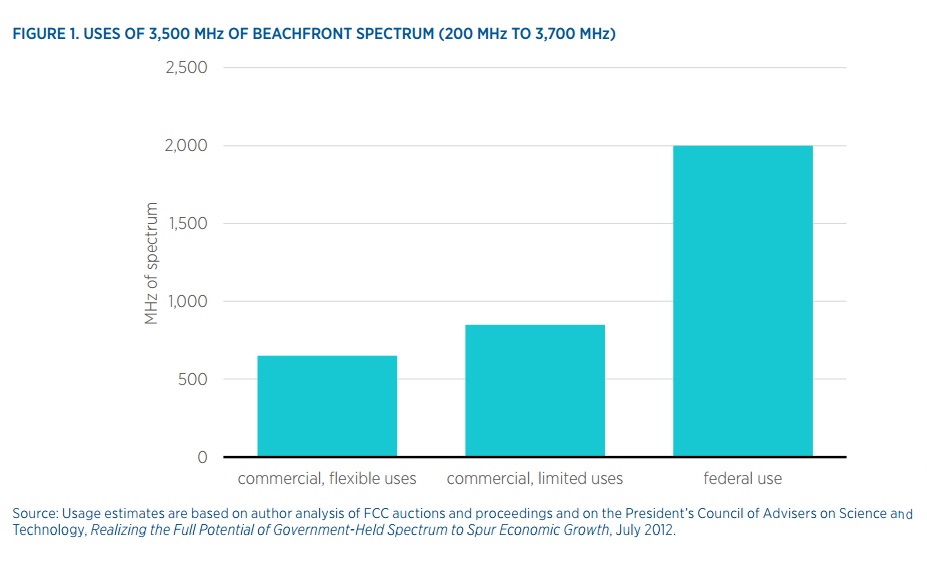
Broadcast TV spectrum is good place to look for revenue but the White House should also look at federal agencies, who possess about ten times what broadcasters hold.

Large portions of spectrum are underused or misallocated because of decades of command-and-control policies. Auctioning spectrum for flexible uses, on the other hand, is a free-market policy that is often lucrative for the federal government. Since 1993, when Congress authorized spectrum auctions, wireless carriers and tech companies have spent somewhere around $120 billion for about 430 MHz of flexible-use spectrum, and the lion’s share of revenue was deposited in the US Treasury.

A few weeks ago, the FCC completed the $19 billion sale of broadcast TV spectrum, the so-called incentive auction. Despite underwhelming many telecom experts, this was the third largest US spectrum auction ever in terms of revenue and will transfer a respectable 70 MHz from restricted (broadcast TV) use to flexible use.

The remaining broadcast TV spectrum that President Trump is interested in totals about 210 MHz. But even more spectrum is under the President’s nose.

As Obama’s Council of Advisors on Science and Technology pointed out in 2012, federal agencies possess around 2,000 MHz of “beachfront” (sub-3.7 GHz) spectrum. I charted various spectrum uses in a December 2016 Mercatus policy brief.

This government spectrum is very valuable if portions can be cleared of federal users. Federal spectrum was part of the frequencies the FCC auctioned in 2006 and 2015, and the slivers of federal spectrum (around 70 MHz of the federal total) sold for around $27 billion combined.

The Department of Commerce has been analyzing which federal spectrum bands could be used commercially and the Mobile Now Act, a pending bill in Congress, proposes more sales of federal spectrum. These policies have moved slowly (and the vague language about unlicensed spectrum in the Mobile Now bill has problems) but the Trump administration has a chance to expedite spectrum reallocation processes and sell more federal spectrum to commercial users.

Title II allows the FCC to determine what content and media Internet access providers must transmit on their own private networks, so the First Amendment has constantly dogged the FCC’s “net neutrality” proceedings. If the Supreme Court agrees to take up an appeal from the DC Circuit Court of Appeals, which rejected a First Amendment challenge this summer, it will likely be because of Title II’s First Amendment deficiencies.

Title II has always been about handicapping ISPs qua speakers and preventing ISPs from offering curated Internet content. As former FCC commissioner Copps said, absent the Title II rules, “a big cable company could block access to an investigative report about its less-than-stellar customer service.” Tim Wu told members of Congress that net neutrality was intended to prevent ISPs from favoring, say, particular news sources or sports teams.

But just as a cable company chooses to offer some channels and not others, and a search engine chooses to promote some pages and not others, choosing to offer a curated Internet to, say, children, religious families, or sports fans involves editorial decisions. As communications scholar Stuart Benjamin said about Title II’s problem, under current precedent, ISPs “can say they want to engage in substantive editing, and that’s enough for First Amendment purposes.”

Title II – Bringing Broadcast Regulation to the Internet

Title II regulation of the Internet is frequently compared to the Fairness Doctrine, which activists used for decades to drive conservatives out of broadcast radio and TV. As a pro-net neutrality media professor explained in The Atlantic last year, the motivation for the Fairness Doctrine and Title II Internet regulation is the same: to “rescue a potentially democratic medium from commercial capture.” This is why there is almost perfect overlap between the organizations and advocates who support the Fairness Doctrine and those who lobbied for Title II regulation of the Internet. Continue reading →

Adam and I recently published a Mercatus research paper titled Video Marketplace Regulation: A Primer on the History of Television Regulation And Current Legislative Proposals, now available on SSRN. I presented the paper at a Silicon Flatirons academic conference last week.

We wrote the paper for a policy audience and students who want succinct information and history about the complex world of television regulation. Television programming is delivered to consumers in several ways, including via cable, satellite, broadcast, IPTV (like Verizon FiOS), and, increasingly, over-the-top broadband services (like Netflix and Amazon Instant Video). Despite their obvious similarities–transmitting movies and shows to a screen–each distribution platform is regulated differently.

The television industry is in the news frequently because of problems exacerbated by the disparate regulatory treatment. The Time Warner Cable-CBS dispute last fall (and TWC’s ensuing loss of customers), the Aereo lawsuit, and the Comcast-TWC proposed merger were each caused at least indirectly by some of the ill-conceived and antiquated TV regulations we describe. Further, TV regulation is a “thicket of regulations,” as the Copyright Office has said, which benefits industry insiders at the expense of most everyone else.

We contend that overregulation of television resulted primarily because past FCCs, and Congress to a lesser extent, wanted to promote several social objectives through a nationwide system of local broadcasters:

1) Localism 2) Universal Service 3) Free (that is, ad-based) television; and 4) Competition

These objectives can’t be accomplished simultaneously without substantial regulatory mandates. Further, these social goals may even contradict each other in some respects.

For decades, public policies constrained TV competitors to accomplish those goals. We recommend instead a reliance on markets and consumer choice through comprehensive reform of television laws, including repeal of compulsory copyright laws, must-carry, retransmission consent, and media concentration rules.

At the very least, our historical review of TV regulations provides an illustrative case study of how regulations accumulate haphazardly over time, demand additional “correction,” and damage dynamic industries. Congress and the FCC focused on attaining particular competitive outcomes through industrial policy, unfortunately. Our paper provides support for market-based competition and regulations that put consumer choice at the forefront.

Aereo’s antenna system is frequently characterized perjoratively as a Rube Goldberg contraption, including in the Supreme Court oral arguments. Funny enough, Preston Padden, a veteran television executive, has characterized the legal system producing over-the-air broadcast television–Aereo’s chief legal opponents–precisely the same way. It’s also ironic that Aereo is in a fight for its life over alleged copyright violations since communications law diminishes the import of copyright law and makes copyright almost incomprehensible. Larry Downes calls the legal arguments for and against Aereo a “tangled mess.” David Post at the Volokh Conspiracy likewise concluded the situation is “pretty bizarre, when you think about it” after briefly exploring how copyright law interacts with communications law.

I agree, but Post actually understates how distorted the copyright law becomes when TV programs pass through a broadcaster’s towers, as opposed to a cable company’s headend. In particular, a broadcaster, which is mostly a passive transmitter of TV programs, gains more control over the programs than the copyright owners. It’s nearly impossible to separate the communications law distortions from the copyright issues, but the Aereo issue could be solved relatively painlessly by the FCC. It’s unfortunate copyright and television law intertwine like this because a ruling adverse to Aereo could potentially–and unnecessarily–upend copyright law.

This week I’ve seen many commentators, even Supreme Court justices, mischaracterize the state of television law when discussing the Aereo case. This is a very complex area and below is my attempt to lay out some of the deeper legal issues driving trends in the television industry that gave rise to the Aereo dispute. Crucially, the law is even more complex than most people realize, which benefits industry insiders and prevents sensible reforms. Continue reading →

WP coverThe Mercatus Center at George Mason University has just released a new paper by Brent Skorup and me entitled, “A History of Cronyism and Capture in the Information Technology Sector.” In this 73-page working paper, which we hope to place in a law review or political science journal shortly, we document the evolution of government-granted privileges, or “cronyism,” in the information and communications technology marketplace and in the media-producing sectors. Specifically, we offer detailed histories of rent-seeking and regulatory capture in: the early history of the telephony and spectrum licensing in the United States; local cable TV franchising; the universal service system; the digital TV transition in the 1990s; and modern video marketplace regulation (i.e., must-carry and retransmission consent rules, among others.

Our paper also shows how cronyism is slowly creeping into new high-technology sectors.We document how Internet companies and other high-tech giants are among the fastest-growing lobbying shops in Washington these days. According to the Center for Responsive Politics, lobbying spending by information technology sectors has almost doubled since the turn of the century, from roughly $200 million in 2000 to $390 million in 2012.  The computing and Internet sector has been responsible for most of that growth in recent years. Worse yet, we document how many of these high-tech firms are increasingly seeking and receiving government favors, mostly in the form of targeted tax breaks or incentives. Continue reading →

“All this top-40s music sounds the same.”  I think we’ve all heard this sentiment.  The nature of regional radio broadcasting almost requires a regression to the mean in musical tastes.  A radio station cannot be all things to all people.  I suspect most people will be surprised to learn that some of the most innovative radio broadcasts are taking place at hundreds of stations across the country—and only few people can listen to them.  These stations, known as low power FM (LPFM), carry niche programming like independent folk rock music, fishing shows, political news, reggae, blues, and religious programming.  (And one station in Sitka, Alaska consists entirely of a live feed of whale sounds.) Continue reading →

Writing over at the conservative Big Government blog (part of the Breitbart.com network of blogs), someone who goes by the pseudonym “Capitol Connection” has posted an editorial about the debate over retransmission consent reform that is full of misinformation and misguided policy prescriptions, at least if you believe is truly limited government. The piece is entitled, “Big Cable Would Prefer if You Paid Their Bills,” and the problems are almost immediately evident from that headline alone.  First, what is a supposedly small government-oriented blog doing using a silly label like “Big Cable” to describe a vigorously competitive sector of our capitalist economy? Using terms like “Big Cable” is a silly lefty tactic. Second, no one in the cable industry is proposing anyone “pay their bills” except for the customers who enjoy their services. Isn’t a fee for service part of capitalism?

Anyway, that’s just the problem with the title of the essay. Sadly, the rest of the piece is filled with even more erroneous information and arguments about the retransmission consent regulatory process as well as the bill that aims to reform that process, “The Next Generation Television Marketplace Act” (H.R. 3675 and S. 2008). That bill, which is sponsored by Senator Jim DeMint (R-SC) and Rep. Steve Scalise (R-LA), represents a comprehensive attempt to deregulate America’s heavily regulated video marketplace. In a recent Forbes oped, I argued that the DeMint-Scalise effort would take us “Toward a True Free Market in Television Programming” by eliminating a litany of archaic media regulations that should have never been on the books to begin with. The measure would:

  • eliminate: “retransmission consent” regulations (rules governing contractual negotiations for content);
  • end “must carry” mandates (the requirement that video distributors carry broadcast signals even if they don’t want to);
  • repeal “network non-duplication” and “syndicated exclusivity” regulations (rules that prohibit distributors from striking deals with broadcasters outside their local communities);
  • end various media ownership regulations; and
  • end the compulsory licensing requirements of the Copyright Act of 1976, which essentially forced a “duty to deal” upon content owners to the benefit of video distributors.

This represents genuine and much-needed deregulation of a market that has been encumbered with far too much top-down control and micro-management by the FCC over the past several decades. To be clear, none of these rules apply to any other segment of our modern information economy. Every day of the week, deals are cut between content creators and distributors in many other segments of the media industry without these rules encumbering the process. The DeMint-Scalise bill is an attempt to get big government out of the way and let these deals be cut in a truly free market without regulators putting their thumb on the scale in one direction or the other. Continue reading →

In the latest PFF TechCast, I discuss the issues considered in the second essay in our ongoing series, “The Wrong Way to Reinvent Media.”  In this 6-minute podcast, PFF’s press director Mike Wendy chats with me about proposals to impose taxes on broadcast spectrum licenses to funnel money to public media or “public interest” content.  In my paper and this podcast, I make the case again socially engineering media choices and outcomes through the tax code.

MP3 file: PFF TechCast #2 – Saving the Media Through Broadcast Spectrum Taxes (4/5/2010)

As mentioned last week, in a new series of essays, PFF scholars will be examining proposals that would have the government play a greater role in sustaining struggling media enterprises, “saving journalism,” or promoting more “public interest” content. With many traditional media operators struggling, and questions being raised about how journalism in particular will be supported in the future, Washington policymakers are currently considering what role government can and should play in helping media providers reinvent themselves in the face of tumultuous technological change wrought by the Digital Revolution. We will be releasing 6 or 7 essays on this topic leading up to our big filing in the FCC’s “Future of Media” proceeding (deadline is May 7th).  And here’s a podcast Berin Szoka and I did providing an overview of the series.

In the first installment of the series, Berin and I critiqued an old idea that’s suddenly gained new currency: taxing media devices or distribution systems to fund media content. In the second installment, “The Wrong Way to Reinvent Media, Part 2: Broadcast Spectrum Taxes to Subsidize Public Media,” I discuss proposals to impose a tax on broadcast spectrum licenses to funnel money to public media projects or other “public interest” content or objectives. Such a tax would be fundamentally unfair to broadcasters, who are struggling for their very survival in the midst of unprecedented marketplace turmoil.  Moreover, such a tax is unnecessary in light of the many other sources of “public interest” programming available today. Finally, even if the government creates or subsidizes wonderful, civic- and culturally-enriching content, there’s no way to force people to consume it.  Nor should government force such media choices upon the public. There’s no good reason for government to be socially-engineering media choices through taxes.

I’ve attached the entire essay down below.

Continue reading →