Posts tagged as:

James Barrat, author of Our Final Invention: Artificial Intelligence and the End of the Human Era, discusses the future of Artificial Intelligence (AI). Barrat takes a look at how to create friendly AI with human characteristics, which other countries are developing AI, and what we could expect with the arrival of the Singularity. He also touches on the evolution of AI and how companies like Google and IBM and government entities like DARPA and the NSA are developing artificial general intelligence devices right now.

Download

Related Links

Is there a Bitcoin bubble? Jason Kuznicki thinks so and believes that he has conclusive proof. He blogs three graphs that show more or less that there is a lot of speculation in Bitcoin. But does speculation prove that there’s a bubble? Let’s use Bayes’s rule to think about this carefully.

Bayes’s rule is a mathematical tool for thinking about the incorporation of new evidence into subjective probabilities. Let’s suppose that there is some proposition A for which you have a prior belief. Somebody offers evidence B for or against A. How much should you change your belief in A based on evidence B?

Bayes’s rule boils the answer down to a simple mathematical form: Continue reading →

Sherwin Siy, Vice President of Legal Affairs at Public Knowledge, discusses emerging issues in digital copyright policy. He addresses the Department of Commerce’s recent green paper on digital copyright, including the need to reform copyright laws in light of new technologies. This podcast also covers the DMCA, online streaming, piracy, cell phone unlocking, fair use recognition, digital ownership, and what we’ve learned about copyright policy from the SOPA debate.

Download

Related Links

Washington Post columnist Robert J. Samuelson published an astonishing essay today entitled, “Beware the Internet and the Danger of Cyberattacks.” In the print edition of today’s Post, the essay actually carries a different title: “Is the Internet Worth It?” Samuelson’s answer is clear: It isn’t. He begins his breathless attack on the Internet by proclaiming:

If I could, I would repeal the Internet. It is the technological marvel of the age, but it is not — as most people imagine — a symbol of progress. Just the opposite. We would be better off without it. I grant its astonishing capabilities: the instant access to vast amounts of information, the pleasures of YouTube and iTunes, the convenience of GPS and much more. But the Internet’s benefits are relatively modest compared with previous transformative technologies, and it brings with it a terrifying danger: cyberwar.

And then, after walking through a couple of worst-case hypothetical scenarios, he concludes the piece by saying:

the Internet’s social impact is shallow. Imagine life without it. Would the loss of e-mail, Facebook or Wikipedia inflict fundamental change? Now imagine life without some earlier breakthroughs: electricity, cars, antibiotics. Life would be radically different. The Internet’s virtues are overstated, its vices understated. It’s a mixed blessing — and the mix may be moving against us.

What I found most troubling about this is that Samuelson has serious intellectual chops and usually sweats the details in his analysis of other issues. He understands economic and social trade-offs and usually does a nice job weighing the facts on the ground instead of engaging in the sort of shallow navel-gazing and anecdotal reasoning that many other weekly newspaper columnist engage in on a regular basis.

But that’s not what he does here. His essay comes across as a poorly researched, angry-old-man-shouting-at-the-sky sort of rant. There’s no serious cost-benefit analysis at work here; just the banal assertion that a new technology has created new vulnerabilities.  Really, that’s the extent of the logic at work here. Samuelson could have just as well substituted the automobile, airplanes, or any other modern technology for the Internet and drawn the same conclusion: It opens the door to new vulnerabilities (especially national security vulnerabilities) and, therefore, we would be better off without it in our lives. Continue reading →

David Garcia, post doctoral researcher at the Swiss Federal Institute of Technology and co-author of Social Resilience in Online Communities: The Autopsy of Friendster, discusses the concept of social resilience and how online communities, like Facebook and Friendster, withstand changes in their environment.

Garcia’s paper examines one of the first online social networking sites, Friendster, and analyzes its post-mortem data to learn why users abandoned it.

Garcia goes on to explain how opportunity cost and cost benefit analysis can affect a user’s decision whether or not to remain in an online community.

Download

Related Links


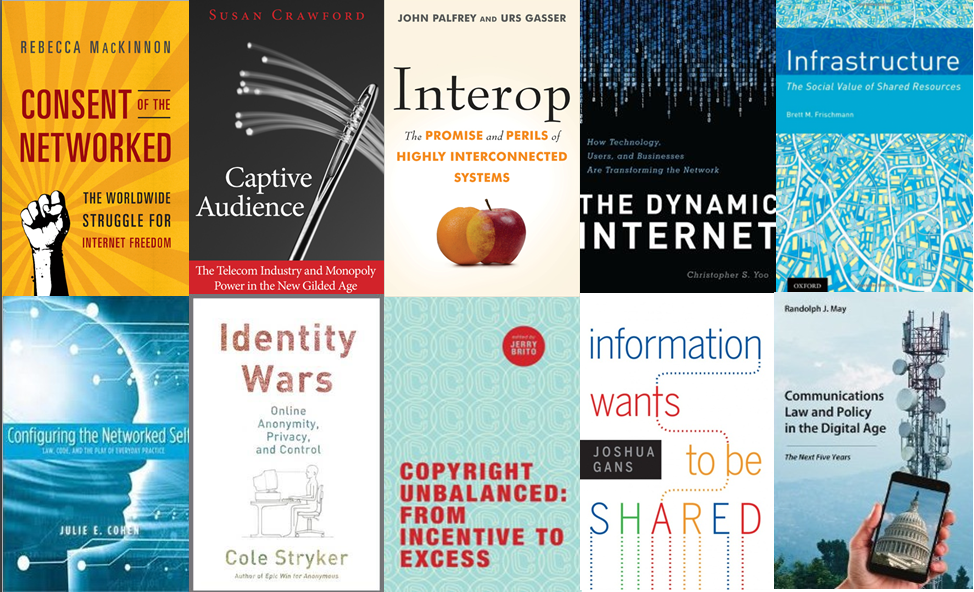
The number of major cyberlaw and information tech policy books being published annually continues to grow at an astonishing pace, so much so that I have lost the ability to read and review all of them. In past years, I put together end-of-year lists of important info-tech policy books (here are the lists for 2008, 2009, 2010, and 2011) and I was fairly confident I had read just about everything of importance that was out there (at least that was available in the U.S.). But last year that became a real struggle for me and this year it became an impossibility. A decade ago, there was merely a trickle of Internet policy books coming out each year. Then the trickle turned into a steady stream. Now it has turned into a flood. Thus, I’ve had to become far more selective about what is on my reading list. (This is also because the volume of journal articles about info-tech policy matters has increased exponentially at the same time.)

So, here’s what I’m going to do. I’m going to discuss what I regard to be the five most important titles of 2012, briefly summarize a half dozen others that I’ve read, and then I’m just going to list the rest of the books out there. I’ve read most of them but I have placed an asterisk next to the ones I haven’t.  Please let me know what titles I have missed so that I can add them to the list. (Incidentally, here’s my compendium of all the major tech policy books from the 2000s and here’s the running list of all my book reviews.)

Continue reading →

In their paper, “Loving the Cyber Bomb? The Dangers of Threat Inflation in Cybersecurity Policy,” my Mercatus Center colleagues Jerry Brito and Tate Watkins warned of the dangers of “threat inflation” in cybersecurity policy debates. In early 2011, Mercatus also published a paper by Sean Lawson, an assistant professor in the Department of Communication at the University of Utah, entitled “Beyond Cyber Doom” that documented how fear-based tactics and cyber-doom scenarios and rhetoric increasingly were on display in cybersecurity policy debates.  Finally, in my recent Mercatus Center working paper, “Technopanics, Threat Inflation, and the Danger of an Information Technology Precautionary Principle,” I extended their threat inflation analysis and developed a comprehensive framework offering additional examples of, and explanations for, threat inflation in technology policy debates.

These papers make it clear that a sort of hysteria has developed around cyberwar and cybersecurity issues. Frequent allusions are made in cybersecurity debates to the potential for a “Digital Pearl Harbor,” a “cyber cold war,” a “cyber Katrina,” or even a “cyber 9/11.” These analogies are made even though these historical incidents resulted in death and destruction of a sort not comparable to attacks on digital networks. Others refer to “cyber bombs” even though no one can be “bombed” with binary code. And new examples of such inflationary rhetoric seem to emerge each day. Continue reading →

In my ongoing work on technopanics, I’ve frequently noted how special interests create phantom fears and use “threat inflation” in an attempt to win attention and public contracts. In my next book, I have an entire chapter devoted to explaining how “fear sells” and I note how often companies and organizations incite fear to advance their own ends. Cybersecurity and child safety debates are littered with examples.

In their recent paper, “Loving the Cyber Bomb? The Dangers of Threat Inflation in Cybersecurity Policy,” my Mercatus Center colleagues Jerry Brito and Tate Watkins argued that “a cyber-industrial complex is emerging, much like the military-industrial complex of the Cold War.” As Stefan Savage, a Professor in the Department of Computer Science and Engineering at the University of California, San Diego, told The Economist magazine, the cybersecurity industry sometimes plays “fast and loose” with the numbers because it has an interest in “telling people that the sky is falling.” In a similar vein, many child safety advocacy organizations use technopanics to pressure policymakers to fund initiatives they create. [Sometimes I can get a bit snarky about this.] Continue reading →

Those of you interested in transparency and “Government 2.0” issues will absolutely want to pick up Open Government: Collaboration, Transparency, and Participation in Practice, a terrific collection of 34 essays edited by Daniel Lathrop and Laurel Ruma. Much like Access Controlled, the collection of essays on global Internet filtering and censorship that I praised here last month, Open Government is a resource like no other in its field. It offers an amazing diversity of viewpoints covering virtual every aspect of the debate over transparency and open government.

The collection was published by O’Reilly Media and Tim O’Reilly himself has one of the best chapters in the book on “Government as a Platform.” “The magic of open data is that the same openness that enables transparency also enables innovation, as developers build applications that reuse government data in unexpected ways.” (p. 25)  This explains why in their chapter on “Enabling Innovation for Civic Engagement,” David G. Robinson, Harlan Yu, and Edward W. Felten, of the Center for Information Technology Policy at Princeton University, speak of “a new baseline assumption about the public response to government data: when government puts data online, someone, somewhere will do something valuable and innovative with it.” (p.84) “By publishing its data in a form that is free, open, and reusable,” they continue, “government will empower citizens to dream up and implement their own innovative ideas of how to best connect with their governments.” (p. 89)

Indeed, just think about some of the many exciting sites and projects (both public and private) that have been developed thanks to government data becoming more accessible in recent years. Here’s a short list of some of the best: Continue reading →

Blown to Bits coverI’ve just finished reading Blown to Bits: Your Life, Liberty, and Happiness After the Digital Explosion, by Hal Abelson, Ken Ledeen, and Harry Lewis, and it’s another title worth adding to your tech policy reading list. The authors survey a broad swath of tech policy territory — privacy, search, encryption, free speech, copyright, spectrum policy — and provide the reader with a wonderful history and technology primer on each topic.

I like the approach and tone they use throughout the book. It is certainly something more than “Internet Policy for Dummies.” It’s more like “Internet Policy for the Educated Layman”: a nice mix of background, policy, and advice. I think Ray Lodato’s Slashdot review gets it generally right in noting that, “Each chapter will alternatively interest you and leave you appalled (and perhaps a little frightened). You will be given the insight to protect yourself a little better, and it provides background for intelligent discussions about the legalities that impact our use of technology.”

Abelson, Ledeen, and Lewis aren’t really seeking to be polemical in this book by advancing a single thesis or worldview. To the extent the book’s chapters are guided by any central theme, it comes in the form of the “two basic morals about technology” they outline in Chapter 1:

The first is that information technology is inherently neither good nor bad — it can be used for good or ill, to free us or to shackle us. Second, new technology brings social change, and change comes with both risks and opportunities. All of us, and all of our public agencies and private institutions, have a say in whether technology will be used for good or ill and whether we will fall prey to its risks or prosper from the opportunities it creates. (p. 14)

Mostly, what they aim to show is that digital technology is reshaping society and, whether we like or it not, we better get used to it — and quick!  “The digital explosion is changing the world as much as printing once did — and some of the changes are catching us unaware, blowing to bits our assumptions about the way the world works… The explosion, and the social disruption that it will create, have barely begun.” (p 3)

In that sense, most chapters discuss how technology and technological change can be both a blessing and a curse, but the authors are generally more optimistic than pessimistic about the impact of the Net and digital technology on our society. What follows is a quick summary of some of the major issues covered in Blown to Bits.

Continue reading →