Posts tagged as:

[Cross-posted from Medium.]

[Cross-posted from Medium]

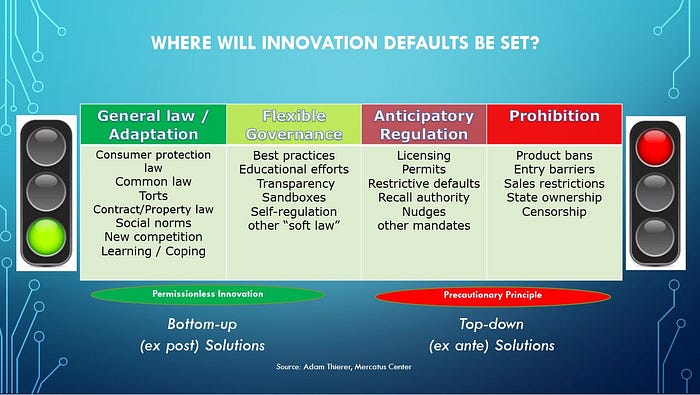
There are two general types of technological governance that can be used to address challenges associated with artificial intelligence (AI) and computational sciences more generally. We can think of these as “on the ground” (bottom-up, informal “soft law”) governance mechanisms versus “on the books” (top-down, formal “hard law”) governance mechanisms.

Unfortunately, heated debates about the latter type of governance often divert attention from the many ways in which the former can (or already does) help us address many of the challenges associated with emerging technologies like AI, machine learning, and robotics. It is important that we think harder about how to optimize these decentralized soft law governance mechanisms today, especially as traditional hard law methods are increasingly strained by the relentless pace of technological change and ongoing dysfunctionalism in the legislative and regulatory arenas.

Continue reading →

[last updated 4/3/2025 – Check my Medium page for latest posts]

This a running list of all the essays and reports I’ve already rolled out on the governance of artificial intelligence (AI), machine learning (ML), and robotics. Why have I decided to spend so much time on this issue? Because this will become the most important technological revolution of our lifetimes. Every segment of the economy will be touched in some fashion by AI, ML, robotics, and the power of computational science. It should be equally clear that public policy will be radically transformed along the way.

Eventually, all policy will involve AI policy and computational considerations. As AI “eats the world,” it eats the world of public policy along with it. The stakes here are profound for individuals, economies, and nations. As a result, AI policy will be the most important technology policy fight of the next decade, and perhaps next quarter century. Those who are passionate about the freedom to innovate need to prepare to meet the challenge as proposals to regulate AI proliferate.

There are many socio-technical concerns surrounding algorithmic systems that deserve serious consideration and appropriate governance steps to ensure that these systems are beneficial to society. However, there is an equally compelling public interest in ensuring that AI innovations are developed and made widely available to help improve human well-being across many dimensions. And that’s the case that I’ll be dedicating my life to making in coming years.

Here’s the list of what I’ve done so far. I will continue to update this as new material is released: Continue reading →

What explains the rebirth of analog era media? Many people (including me!) predicted that vinyl records, turntables, broadcast TV antennas and even printed books seemed destined for the dustbin of technological history. We were so wrong, as I note in this new oped that has gone out through the Tribune Wire Service.

“Many of us threw away our record collections and antennas and began migrating from physical books to digital ones,” I note. “Now, these older technologies are enjoying a revival. What explains their resurgence, and what’s the lesson?”

I offer some data about the rebirth of analog era media as well as some possible explanations for their resurgence. “With vinyl records and printed books, people enjoy making a physical connection with the art they love. They want to hold it in their hands, display it on their wall and show it off to their friends. Digital music or books don’t satisfy that desire, no matter how much more convenient and affordable they might be. The mediums still matter.”

Read more here. Meanwhile, my own personal vinyl collection continues to grow without constraint! …

[Updated: March 2022]

I was speaking at a conference recently and discussing my life’s work, which for 30 years has been focused on the importance of innovation and intellectual battles over what we mean progress. I put together up a short list of some things I have written over the last few years on this topic and thought I would just re-post them here. I will try to keep this regularly updated, at least for a few years.

UNDERSTANDING THE CHALLENGE WE FACE:

HOW WE MUST RESPOND = “Rational Optimism” / Right to Earn a Living / Permissionless Innovation

Continue reading →

Marc Andreessen is interviewed by Sriram Krishan in his new newsletter, The Observer Effect, and asked what motivates him to support technological innovation and “to go read up on a new topic every day” related to tech and progress. His answer is inspirational and perfectly encapsulates why I also have made technological progress the focus of my life’s work:

I am a deep believer in – after learning a lot over the years about economic history and of cultural history – that technology really is the driver. There were basically millennia of just subsistence farming industry and all of a sudden, there was this vertical takeoff a few hundred years ago. And quality of life exploded around the world. Not evenly but starting in Europe and expanding out. It’s basically all technology. It’s always the printing press, it’s the internet and on and on. And you get this incredible upward trajectory. We have the potential over the course of the next century or over the next few centuries to really dramatically advance and have life be better for virtually everybody. Technology is quite literally the lever for being able to take natural resources and able to make something better out of them. And so it’s just it’s the most interesting and by far the most useful and the most beneficial thing I can think of doing.

Amen, brother! I devoted my last two books (Permissionless Innovation and Evasive Entrepreneurs) and all my life’s work, to proving that exact point. Also, I really like Andreessen’s definition of technology as, “the lever for being able to take natural resources and able to make something better out of them.” I’ve added that to my running compendium, “Defining Technology,” which features various definitions of technology.


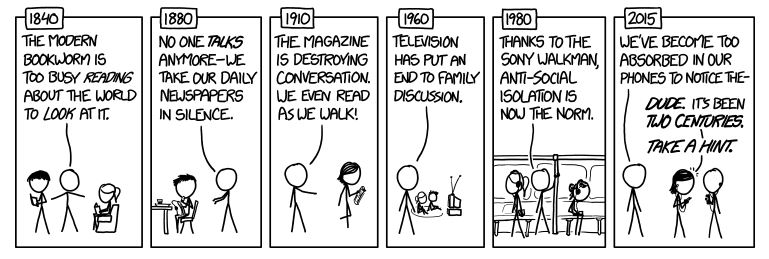
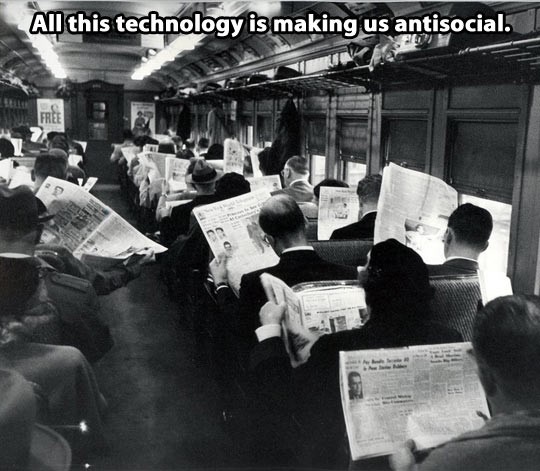
Last week, science writer Michael Shermer tweeted out this old xkcd comic strip that I had somehow missed before. Shermer noted that it represented, “another reply to pessimists bemoaning modern technologies as soul-crushing and isolating.” Similarly, there’s this meme that has been making the rounds on Twitter and which jokes about how newspapers made us as antisocial in the past much as newer technologies supposedly do today.

‏The sentiments expressed by the comic and that image make it clear how people often tend to romanticize past technologies or fail to remember that many people expressed the same fears about them as critics do today about newer ones. I’ve written dozens of articles about “moral panics” and “techno-panics,” most of which are cataloged here. The common theme of those essays is that, when it comes to fears about innovations, there really is nothing new under the sun. Continue reading →

Reason magazine recently published my review of Franklin Foer’s new book, World Without Mind: The Existential Threat of Big Tech. My review begins as follows:

If you want to sell a book about tech policy these days, there’s an easy formula to follow. First you need a villain. Google and Facebook should suffice, but if you can throw in Apple, Amazon, or Twitter, that’s even better. Paint their CEOs as either James Bond baddies bent on world domination or naive do-gooders obsessed with the quixotic promise of innovation. Finally, come up with a juicy Chicken Little title. Maybe something like World Without Mind: The Existential Threat of Big Tech. Wait—that one’s taken. It’s the title of Franklin Foer’s latest book, which follows this familiar techno-panic template almost perfectly.

The book doesn’t break a lot of new ground; it serves up the same old technopanicky tales of gloom-and-doom that many others have said will befall us unless  something is done to save us. But Foer’s unique contribution is to unify many diverse strands of modern tech criticism in one tome, and then amp up the volume of panic about it all. Hence, the “existential” threat in the book’s title. I bet you didn’t know the End Times were so near!

Read the rest of my review over at Reason. And, if you care to read some of my other essays on technopanics through the ages, here’s a compendium of them.

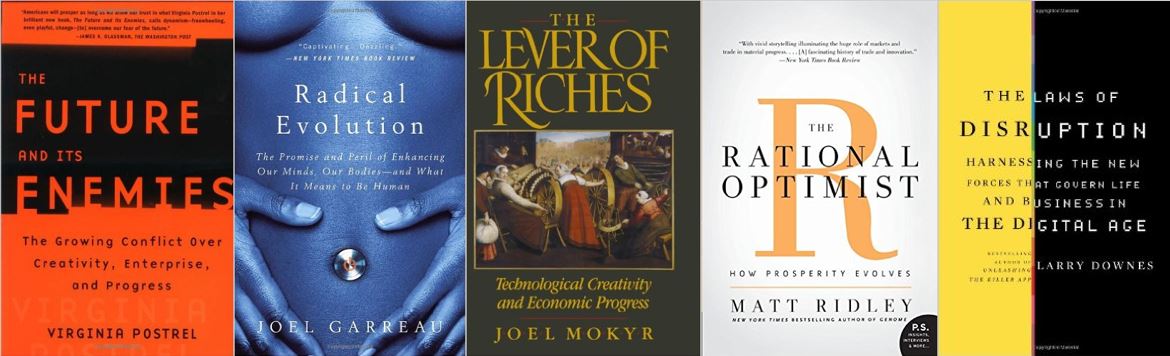
I was delivering a lecture to a group of academics and students out in San Jose recently [see the slideshow here] and someone in the crowd asked me to send them a list of some of the many books I had mentioned during my talk, which was about future policy clashes over various emerging technologies. I cut the list down to the five books that I believe best frame the nature of debates over innovation and technology policy. They are:

If you haven’t read these amazing books yet, add them to your collection  right now! They are worth reading again and again. They will forever change the way you think about debates over technology and innovation.

5 innovation book covers

It was my great pleasure to join Jasmine McNealy last week on the “New Books in Technology” podcast to discuss my new book, Permissionless Innovation: The Continuing Case for Comprehensive Technological Freedom. (A description of my book can be found here.)

My conversation with Jasmine was wide-ranging and lasted 47 minutes. The entire show can be heard here if you’re interested.

By the way, if you don’t follow Jasmine, you should begin doing so immediately. She’s on Twitter and here’s her page at the University of Kentucky School of Library and Information Science.  She’s doing some terrifically interesting work. For example, check out her excellent essay on “Online Privacy & The Right To Be Forgotten,” which I commented on here.