Posts tagged as:

A Better Pencil book coverI very much enjoyed Dennis Baron’s new book, A Better Pencil: Readers, Writers, and the Digital Revolution, and highly recommend you pick it up. Baron does a wonderful job exploring the history of techno-pessimism and the endless battles about the impact of new technologies on life and learning, something I have written about here before in my essays on “Internet optimists vs. pessimists” (See: 1, 2, 3).

I have a complete review of Baron’s A Better Pencil now up on the City Journal‘s website here.  I’ve also pasted it down below.


Plato Wrote it Down by Adam Thierer

a review of A Better Pencil: Readers, Writers, and the Digital Revolution, by Dennis Baron (Oxford University Press, 280 pp., $24.95)

In the beginning, Dennis Baron reminds us in his new book, A Better Pencil, there was the word—the spoken word, that is. Oral tradition, the passing of knowledge through stories and lectures, was the primary method of instruction and learning throughout early human civilization. But then a few innovative souls decided to start writing everything down on stones and clay. Almost as soon as they did, a great debate began on the impact of new communications technology on culture and education. And it rages on today, with a new generation of optimists and skeptics battling over the impact that computing, the Internet, and digital technologies have on our lives and on how we learn about the world.

Continue reading →

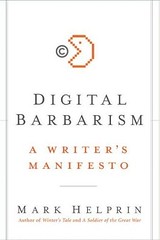
Last month, Digital Barbarism book cover National Review magazine published a review that I penned of Mark Helprin’s new book, Digital Barbarism: A Writer’s Manifesto.  Helprin’s book is both a passionate defense of copyright law as well as a mini-autobiography.  Helprin is one of the great novelists and essayists of the past half-century, and his book A Soldier of a Great War is one of my all-time favorite novels.  I cannot in strong enough words encourage you to read that book; it is profoundly moving. (I almost named my son after the lead character in the book!)

Thus, I was quite excited when I learned that Helprin had penned a defense of copyright and I jumped at the chance to review it when the folks at National Review asked me to do so.  Alas, as you will see in my review, I was terribly disappointed.  I wish Helprin would have stuck with the very reasonable tone he adopted in this excellent podcast interview he did recently with John J. Miller of National Review Online. Unfortunately, he went a different direction in the book, as I make clear in my review:


National Review July 20, 2009

“Man, Machine, and Copyright” a review of Digital Barbarism: A Writer’s Manifesto, by Mark Helprin by Adam Thierer

It would be difficult to think of anyone more ideally suited to pen a passionate defense of copyright law than novelist Mark Helprin.  Helprin has written several of the finest works of modern literature, including his masterpiece, A Soldier of the Great War, a narrative of transcendent beauty. In Digital Barbarism, Helprin sets out to use his formidable gift for the written word to repel the “cyber mob” that has attacked copyright law and called for its curtailment, or even abolition.

Unfortunately, while Helprin occasionally rises to great heights in his defense of copyright, he too often sinks to lamentable lows — by resorting to the same unbecoming rhetorical tactics used by the mob he seeks to condemn. Indeed, his book is filled with gratuitous vitriol and neo-Luddite ramblings about the Internet and Information Age that severely detract from his defense of copyright. This is a shame, because, in places, Digital Barbarism makes a fine case against those critics who wrongly view copyright as an impediment to the creation and diffusion of content. “The availability of information is not and will not be restrained by the copyright system any more than it is or will be restrained by the delivery systems that make it possible,” Helprin argues. Why, he asks, “must ‘content’ be free” when everything else — access to the Internet, digital devices, etc. — costs good money? He notes that the movement that advocates “free,” universal access to all copyrighted material in the name of “openness” and “the public good” would, ironically, “destroy the dream it advocates”: Continue reading →

Planet GoogleI finally got around to reading Planet Google: One Company’s Audacious Plan to Organize Everything We Know, by Randall Stross. It’s very well done. Stross is a frequently contributor to the New York Times and the author of several other interesting books on the technology industry. He knows how to weave a story together, and it helps that Google’s story is a pretty amazing one.

Each chapter discusses a different part of Google’s growing family of services — GMail, Google Maps, Google Earth, Book Search, and YouTube. Of course, it all started with search and Stross does a good job explaining how the ingenious Google search algorithm has grown from dorm room project to the greatest aggregator of human knowledge that the world has ever known. This, in turn, has powered Google’s hugely successful online advertising system. The real secret of their success with online advertising, Stross argues, is that “Google’s impersonal, mathematical approach search also provides you with the ability to serve advertisements that are tailored to a search, rather than to the person submitting the search request, whose identity would have to be known.”

Despite the benefits of such generally anonymous searching, as Google has grown and added new services and capabilities, concerns about the sheer volume of data that the company collects have led to heightened privacy concerns. Indeed, privacy is a core theme that Stross uses in the book to tie many of the chapters and issues together. Google is constantly struggling to strike the right balance between providing more access to the world’s information while also being careful not to raise privacy concerns. But it’s unclear exactly how much more information collection that users (or public officials) will tolerate before advocating stricter limits on Google’s reach.  As Stross points out:

Guided by its founding mission, to organize all the world’s information, Google has created storage capacity that allows it to gain control of what its users are you doing in a comprehensive way that no other company has done, and to preserve those records indefinitely, without the need to clear out old records to make way for new ones. Moreover, Google differentiates its service by refining its own proprietary software formula to mine and massage the data, technology that it zealously protects from the sight of rivals. This sets up a conflict between Google’s wish to operate a “black box” (completely opaque to the outside) and its users’ wish for transparency.

Continue reading →

Post Jeffersons MooseI used to have a (semi-crazy) uncle who typically began conversations with lame jokes or bad riddles. This sounds like one he might have used had he lived long enough: What do Thomas Jefferson, a moose, and cyberspace have in common?

The answer to that question can be found in a new book, In Search of Jefferson’s Moose: Notes on the State of Cyberspace, by David G. Post, a Professor of Law at Temple University. Post, who teaches IP and cyberspace law at Temple, is widely regarded as one of the intellectual fathers of the “Internet exceptionalist” school of thinking about cyberlaw.  Basically, Post sees this place we call “cyberspace” as something truly new, unique, and potentially worthy of some special consideration, or even somewhat different ground rules than we apply in meatspace. More on that in a bit.

[ Full disclosure: Post’s work was quite influential on my own thinking during the late 1990s, so much so that when I joined the Cato Institute in 2000, one of the first things I did was invite David to become an adjunct scholar with Cato. He graciously accepted and remains a Cato adjunct scholar today. Incidentally, Cato is hosting a book forum for him on February 4th that I encourage you to attend or watch online. Anyway, it’s always difficult to be perfectly objective when you know and admire someone, but I will try to do so here.]

Post’s book is essentially an extended love letter — to both cyberspace and Jefferson. Problem is, as Post even admits at the end, it’s tough to know which subject this book is suppose to teach us more about. The book loses focus at times — especially in the first 100 pages — as Post meanders between historical tidbits of Jefferson’s life and thinking and what it all means for cyberspace. But the early focus is on TJ.  Thus, those who pick up the book expecting to be immediately immersed in cyber-policy discussions may be a bit disappointed at first.  As a fellow Jefferson fanatic, however, I found all this history terrifically entertaining, whether it was the story of Jefferson’s Plow and his other agricultural inventions and insights, TJ’s unique interest in science (including cryptography), or that big moose of his.

OK, so what’s the deal with the moose? When TJ was serving as a minister to France in in the late 1780s, at considerable expense to himself, he had the complete skeleton, skin and horns of a massive American moose shipped to the lobby of his Paris hotel. Basically, Jefferson wanted to make a bold statement to his French hosts about this New World he came from and wake them up to the fact that some very exciting things were happening over there that they should be paying attention to. That’s one hell of way to make a statement!

Continue reading →

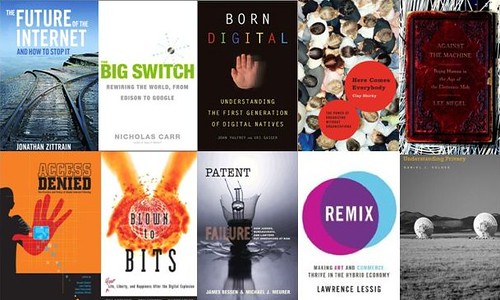
It’s been a big year for tech policy books. Several important titles were released in 2008 that offer interesting perspectives about the future of the Internet and the impact digital technologies are having on our lives, culture, and economy. Back in September, I compared some of the most popular technology policy books of the past five years and tried to group them into two camps: “Internet optimists” vs. “Internet pessimists.” That post generated a great deal of discussion and I plan on expanding it into a longer article soon. In this post, however, I will merely list what I regard as the most important technology policy books of the past year. Best Tech Books of 2008 (covers)

What qualifies as an “important” tech policy book? Basically, it’s a title that many people in this field are currently discussing and that we will likely be talking about for many years to come. I want to make it clear, however, that merely because a book appears on this list it does not necessarily mean I agree with everything said in it. In fact, I found much with which to disagree in my picks for the two most important books of 2008, as well as many of the other books on the list. [Moreover, after reading all these books, I am more convinced than ever that libertarians are badly losing the intellectual battle of ideas over Internet issues and digital technology policy. There’s just very few people defending a “Hands-Off-the-Net” approach anymore. But that’s a subject for another day!]

Another caveat: Narrowly focused titles lose a few points on my list. For example, as was the case in past years, a number of important IP-related books have come out this year. If a book deals exclusively with copyright or patent issues, it does not exactly qualify as the same sort of “tech policy book” as other titles found on this list since it is a narrow exploration of just one set of issues that have a bearing on digital technology policy. The same could be said of a book that deals exclusively with privacy policy, like Solove’s Understanding Privacy. It’s an important book with implications for the future of tech policy, but I demoted it a bit because of its narrow focus.

With those caveats in mind, here are my Top 10 Most Important Tech Policy Books of 2008 (and please let me know about your picks for book of the year):

Continue reading →

Solove Understanding Privacy book coverWith the publication of Understanding Privacy (Harvard University Press 2008), George Washington University Law School professor Daniel J. Solove has firmly established himself as one of America’s leading intellectuals in the field of information policy and cyberlaw.  Solove had already made himself a force to be reckoned with in this field with the publication of important books like The Future of Reputation: Gossip, Rumor, and Privacy on the Internet (Yale University Press 2007), The Digital Person: Technology and Privacy in the Information Age (NYU Press 2004) and his treatise on Information Privacy Law with Paul M. Schwartz of the Berkeley School of Law (Aspen Publishing, 2d ed. 2006).  But with Understanding Privacy, Solove has now elevated himself to that rarefied air of “people worth watching” in the cyberlaw field; an intellectual — like Lawrence Lessig or Jonathan Zittrain — whose every publication becomes something of an event in the field to which all eyes turn upon release.

Like those other intellectuals, however, my respect for their stature should not be confused with agreement with their positions.  In fact, my disagreements with Lessig and Zittrain are frequently on display here and, we have been critical of Solove here in the past as well. [Here’s Jim Harper’s review of Solove’s last book, with which I am in wholehearted agreement.]  In a similar vein, although I greatly appreciate what Prof. Solove attempts to accomplish in Understanding Privacy — and I am sure it will change the way we conceptualize and debate privacy policy in the future — I found his approach and conclusions highly problematic.

Continue reading →

Carr Big Switch book coverI just finished reading through The Economist’s new 14-page special report on cloud computing, “Let It Rise” in which Ludwig Siegele provides an outstanding overview of cloud computing and why it is so important:

The rise of the cloud is more than just another platform shift that gets geeks excited. It will undoubtedly transform the information technology (IT) industry, but it will also profoundly change the way people work and companies operate. It will allow digital technology to penetrate every nook and cranny of the economy and of society, creating some tricky political problems along the way.

Even if you are very familiar with cloud computing, I recommend you take a look at the article. Anyway, while I was reading it, I was unsurprised to come across some comments from Nicholas Carr, whose new book The Big Switch: Rewiring the World, from Edison to Google, is essentially an early history of cloud computing and an investigation into its effects on our economy, culture, and society. And that also reminded me that, even though I have mentioned Carr’s book here several times since it was released earlier this year, I have failed to give it a dedicated review. And it certain deserves one because “The Big Switch” is easily one of the most important technology policy books of 2008.

Continue reading →

Siegel Against the Machine book coverOf the titles I included in a mega-book review about Internet optimists and pessimists that I posted here a few months ago, I mentioned Lee Siegel’s new book, Against the Machine: Being Human in the Age of the Electronic Mob.  It is certainly the dourest of the recent books that have adopted a pessimistic view of the impact the Internet is having on our culture, society, and economy. Because Siegel’s book is one of the most important technology policy books of 2008, however, I decided to give it a closer look here.

Siegel’s book essentially picks up where Andrew Keen’s leaves off in Cult of the Amateur: How Today’s Internet is Killing our Culture (2007).  I posted a two-part review of Keen’s book here last year [Part 1, Part 2], but here’s a quick taste of Keen’s take on things.  He argues “the moral fabric of our society is being unraveled by Web 2.0” and that “our cultural standards and moral values are not all that are at stake.  Gravest of all,” Keen continues, “the very traditional institutions that have helped to foster and create our news, our music, our literature, our television shows, and our movies are under assault as well.”

As I noted in my earlier “Net optimists vs. pessimists” essay, after reading Cult of the Amateur, I didn’t think anyone else could ever be quite as over-the-top and Chicken Little-ish as Keen. But after working my way through Siegel’s Against the Machine, I realized I was wrong. It made Keen seem downright reasonable and cheery by comparison! Keen and Siegel seem to be in heated competition for the title “High Prophet of Internet Doom,” but Siegel is currently a nose ahead in that race.

Continue reading →

Born Digital coverEarlier this year, I mentioned an outstanding book that John Palfrey of the Berkman Center for Internet & Society at Harvard Law School co-edited entitled Access Denied: The Practice and Policy of Global Internet Filtering.  It’s an excellent resource for anyone studying the methods governments are (unfortunately) using to stifle online expression across the globe.  It’s one of the most important technology policy books of the year.

Well, it looks like John Palfrey will have a second title on this year’s “Best Tech Books” list.  I’ve just finished his new book with his Berkman Center colleague Urs Gasser, Born Digital: Understanding the First Generation of Digital Natives, and it is definitely worthy of your attention. In my book review posted today on the City Journal’s website, I argue that “Palfrey and Gasser’s fine early history of this generation serves as a starting point for any conversation about how to mentor the children of the Web.”  It’s a comprehensive and very even-handed discussion about a variety of concerns or Internet pathologies, including: online safety, personal privacy, copyright piracy, offensive content, classroom learning, and much more.

My City Journal review is down below, but in coming weeks I will be posting some additional thoughts about some specific things in the book worthy of more attention (including a few things I disagreed with).  Overall, I’d say Born Digital is a close runner-up in the race for “Tech Book of the Year,” closely trailing Jonathan Zittrain’s Future of the Internet and How to Stop It (which I have reviewed multiple times) and Nick Carr’s The Big Switch.  But I found far more to agree with in Born Digital than I did in those two books.  Highly recommended.

Continue reading →

[Note: You might want to first read my review of Jonathan Zittrain’s book to give this essay some context.]

Jonathan Zittrain must have been smiling as he read Leander Kahney’s excellent Wired cover story this month, “How Apple Got Everything Right By Doing Everything Wrong.” In a sense, the article vindicates Zittrain’s thesis in The Future of the Internet–And How to Stop It. Apple Jobs soviet art style Again, in his provocative book, Zittrain argues that, for a variety of reasons, the glorious days of the generative, open Internet and general-purpose PCs are supposedly giving way to closed networks and a world of what he contemptuously calls “sterile, tethered devices.” And Apple products such as the iPhone, the iPod, and iTunes serve as prime examples of the troubling world that await us. And Kahney’s article confirms that Apple is every bit as closed and insular as Zittrain suggests. Kahney nicely contrasts Apple with Google, a company that “embraces openness,” trusts “the wisdom of crowds,” and has its famous “Don’t be evil” philosophy:

It’s ironic, then, that one of the Valley’s most successful companies ignored all of these tenets. Google and Apple may have a friendly relationship — Google CEO Eric Schmidt sits on Apple’s board, after all — but by Google’s definition, Apple is irredeemably evil, behaving more like an old-fashioned industrial titan than a different-thinking business of the future. Apple operates with a level of secrecy that makes Thomas Pynchon look like Paris Hilton. It locks consumers into a proprietary ecosystem. And as for treating employees like gods? Yeah, Apple doesn’t do that either.

Continue reading →