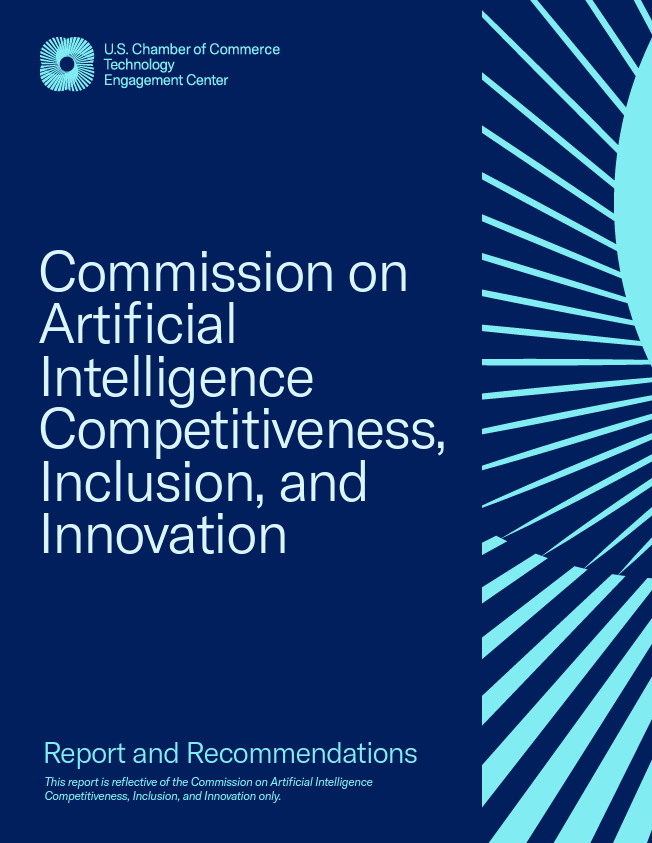
This week, the U.S. Chamber of Commerce Commission on Artificial Intelligence Competitiveness, Inclusion, and Innovation (AI Commission) released a major report on the policy considerations surrounding AI, machine learning (ML) and algorithmic systems. The 120-page report concluded that “AI technology offers great hope for increasing economic opportunity, boosting incomes, speeding life science research at reduced costs, and simplifying the lives of consumers.” It was my honor to serve as one of the commissioners on the AI Commission and contribute to the report.
Over at the R Street Institute blog, I offer a quick summary of the major findings and recommendations from the report and argue that, along with the National Institute of Standards and Technology (NIST)’s recently released AI Risk Management Framework, the AI Commission report offers, “a constructive, consensus-driven framework for algorithmic governance rooted in flexibility, collaboration and iterative policymaking. This represents the uniquely American approach to AI policy that avoids the more heavy-handed regulatory approaches seen in other countries and it can help the United States again be a global leader in an important new technological field,” I conclude. Check out the blog post and the full AI Commission report if you are following debates of algorithmic policy issues. There’s lot of important material in there.
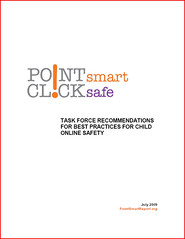
In an earlier post, I mentioned an important new online child safety task force report that has just been released from the “Point Smart. Click Safe.” Blue Ribbon Working Group. It’s a great report and I encourage you to read the whole thing. It was my great pleasure to serve on this task force, and as we started finalizing our conclusions and recommendations, I started thinking about how much of what we were finding and recommending was consistent with what past online safety task forces had also concluded.
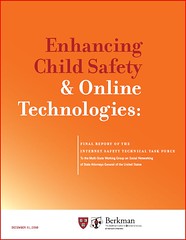
By way of background, over the past decade, five major online safety task forces or blue ribbon commissions have been convened to study online safety issues. Two of these task forces were convened in the United States and issued reports in 2000 (“COPA Commission”) and 2002 (“Thornburgh Commission“). Another was commissioned by the British government in 2007 and issued in a major report in March 2008 (“Byron Review“). Finally, two additional online safety task forces were formed in the U.S. in 2008 and concluded their work, respectively, in January (“Internet Safety Technical Task Force“) and July (“Point Smart. Click Safe.“) of 2009. [And yet another task force — the Online Safety Technology Working Group — was recently formed and has now gotten underway.]
The Technology Liberation Front is the tech policy blog dedicated to keeping politicians' hands off the 'net and everything else related to technology. Learn more about TLF →

 The Technology Liberation Front is the tech policy blog dedicated to keeping politicians' hands off the 'net and everything else related to technology.