Posts tagged as:

Here’s the first of two essays I’ve recently penned making “The Case for Internet Optimism.” This essay was included in the book, The Next Digital Decade: Essays on the Future of the Internet (2011), which was edited by Berin Szoka and Adam Marcus of TechFreedom.  In these essays, I identify two schools of Internet pessimism: (1) “Net Skeptics,” who are pessimistic about the Internet improving the lot of mankind; and (2) “Net Lovers,” who appreciate the benefits the Net brings society but who fear those benefits are disappearing, or that the Net or openness are dying.  (Regular readers of this blog will be familiar with these themes since I sketched them out in previous essays here such as, “Are You an Internet Optimist or Pessimist?” and “Two Schools of Internet Pessimism.”) The second essay is here.

This essay focuses on the first variant of Internet pessimism, which is rooted in general skepticism about the supposed benefits of cyberspace, digital technologies, and information abundance. The proponents of this pessimistic view often wax nostalgic about some supposed “good ‘ol days” when life was much better (although they can’t seem to agree when those were). At a minimum, they want us to slow down and think twice about life in the Information Age and how it’s personally affecting each of us.  Occasionally, however, this pessimism borders on neo-Ludditism, with some proponents recommending steps to curtail what they feel is the destructive impact of the Net or digital technologies on culture or the economy.  I identify the leading exponents of this view of Internet pessimism and their major works. I trace their technological pessimism back to Plato but argue that their pessimism is largely unwarranted. Humans are more resilient than pessimists care to admit and we learn how to adapt to technological change and assimilate new tools into our lives over time. Moreover, were we really better off in the scarcity era when we were collectively suffering from information poverty?  Generally speaking, despite the challenges it presents society, information abundance is a better dilemma to be facing than information poverty.  Nonetheless, I argue, we should not underestimate or belittle the disruptive impacts associated with the Information Revolution.  But we need to find ways to better cope with turbulent change in a dynamist fashion instead of attempting to roll back the clock on progress or recapture “the good ‘ol days,” which actually weren’t all that good.

Down below, I have embedded the entire chapter in a Scribd reader, but the essay can also be found on the TechFreedom website for the book as well as on SSRN.  I have also includes two updated tables that appeared in my old “optimists vs. pessimists” essay.  The first lists some of the leading Internet optimists and pessimists and their books. The second table outlines some of the major lines of disagreement between these two camps and I divided those disagreements into (1) Cultural / Social beliefs vs. (2) Economic / Business beliefs.

Continue reading →

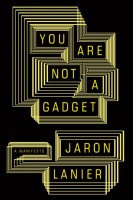
Of the many tech policy-related books I’ve read in recent years, I can’t recall ever being quite so torn over one of them as much as I have been about Jaron Lanier‘s You Are Not a Gadget: A Manifesto.  There were moments while I was reading through it when I was thinking, “Yes, quite right!,” and other times when I was muttering to myself, “Oh God, no!”

The book is bound to evoke such strong emotions since Lanier doesn’t mix words about what he believes is the increasingly negative impact of the Internet and digital technologies on our lives, culture, and economy. In this sense, Lanier fits squarely in the pessimist camp on the Internet optimists vs. pessimists spectrum. (I outlined the intellectual battle lines between these two camps my essay, “Are You An Internet Optimist or Pessimist? The Great Debate over Technology’s Impact on Society.”) But Lanier is no techno-troglodyte. Generally speaking, his pessimism isn’t as hysterical in tone or Luddite-ish in its prescriptions as the tracts of some other pessimists.  And as a respected Internet visionary, a gifted computer scientist, an expert on virtual reality, and a master wordsmith, the concerns Lanier articulates here deserve to be taken seriously— even if one ultimately does not share his lugubrious worldview.

On the very first page of the book, Lanier hits on three interrelated concerns that other Net pessimists have articulated in the past:

  1. Loss of individuality & concerns about “mob” behavior (Lanier: “these words will mostly be read by nonpersons–automatons or numb mobs composed of people who are no longer acting as individuals.”)
  2. Dangers of anonymity (Lanier: “Reactions will repeatedly degenerate into mindless chains of anonymous insults and inarticulate controversies.”)
  3. “Sharecropper” concern that a small handful of capitalists are getting rich off the backs of free labor (Lanier: “Ultimately these words will contribute to the fortunes of those few who have been able to position themselves as lords of the computing clouds.”)

Again, others have tread this ground before, and it’s strange that Lanier doesn’t bother mentioning any of them. Neil Postman, Mark Helprin, Andrew Keen, and Lee Siegel have all railed against the online “mob mentality” and argued it can be at least partially traced to anonymous online communications and interactions. And it was Nick Carr, author of The Big Switch, who has been the most eloquent in articulating the “sharecropper” concern, which Lanier now extends with his “lords of the computing clouds” notion. [More on that towards the end.] Continue reading →

[I’ve been working on an outline for a book I hope to write surveying technological skepticism throughout history. I first started thinking about this topic two years when I noticed that a great number of recent books about Internet policy could generally be grouped into one of two camps: Internet optimists vs. Internet pessimists. I subsequently penned an essay on the subject that generated a fair bit of attention. So, I figured I must be on to something, and the more Net policy books I read, the more I realized that the divisions between these two camps were growing wider and increasingly heated. Thus, I thought I would share this very rough draft (much of it still in outline form) of the opening chapter of that book I want to write about this great intellectual war over the impact of technology on society. I invite reader input. Update Jan. 2011: I finally published a full-length essay on this topic. You can find it here. ]

__________

The impact of technological change on culture, learning, and morality has long been the subject of intense debate, and every technological revolution brings out a fresh crop of both pessimists and pollyannas. Indeed, a familiar cycle has repeat itself throughout history whenever new modes of production (from mechanized agriculture to assembly-line production), means of transportation (water, rail, road, or air), energy production processes (steam, electric, nuclear), medical breakthroughs (vaccination, surgery, cloning), or communications techniques (telegraph, telephone, radio, television) have appeared on the scene.

The cycle goes something like this. A new technology appears. Those who fear the sweeping changes brought about by this technology see a sky that is about to fall. These “techno-pessimists” predict the death of the old order (which, ironically, is often a previous generation’s hotly-debated technology that others wanted slowed or stopped).  Embracing this new technology, they fear, will result in the overthrow of traditions, beliefs, values, institutions, business models, and much else they hold sacred.

The pollyannas, by contrast, look out at the unfolding landscape and see mostly rainbows in the air. Theirs is a rose-colored world in which the technological revolution du jour is seen as improving the general lot of mankind and bringing about a better order.  If something has to give, then the old ways be damned! For such “techno-optimists,” progress means some norms and institutions must adapt—perhaps even disappear—for society to continue its march forward.

Our current Information Revolution is no different. It too has its share of techno-pessimists and techno-optimists. Indeed, before most of us had even heard of the Internet, people were already fighting about it—or at least debating what the rise of the Information Age meant for our culture, society, and economy. Continue reading →

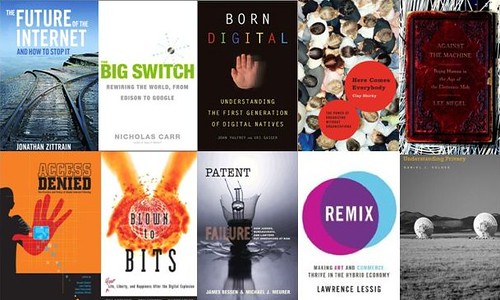
It’s been a big year for tech policy books. Several important titles were released in 2008 that offer interesting perspectives about the future of the Internet and the impact digital technologies are having on our lives, culture, and economy. Back in September, I compared some of the most popular technology policy books of the past five years and tried to group them into two camps: “Internet optimists” vs. “Internet pessimists.” That post generated a great deal of discussion and I plan on expanding it into a longer article soon. In this post, however, I will merely list what I regard as the most important technology policy books of the past year. Best Tech Books of 2008 (covers)

What qualifies as an “important” tech policy book? Basically, it’s a title that many people in this field are currently discussing and that we will likely be talking about for many years to come. I want to make it clear, however, that merely because a book appears on this list it does not necessarily mean I agree with everything said in it. In fact, I found much with which to disagree in my picks for the two most important books of 2008, as well as many of the other books on the list. [Moreover, after reading all these books, I am more convinced than ever that libertarians are badly losing the intellectual battle of ideas over Internet issues and digital technology policy. There’s just very few people defending a “Hands-Off-the-Net” approach anymore. But that’s a subject for another day!]

Another caveat: Narrowly focused titles lose a few points on my list. For example, as was the case in past years, a number of important IP-related books have come out this year. If a book deals exclusively with copyright or patent issues, it does not exactly qualify as the same sort of “tech policy book” as other titles found on this list since it is a narrow exploration of just one set of issues that have a bearing on digital technology policy. The same could be said of a book that deals exclusively with privacy policy, like Solove’s Understanding Privacy. It’s an important book with implications for the future of tech policy, but I demoted it a bit because of its narrow focus.

With those caveats in mind, here are my Top 10 Most Important Tech Policy Books of 2008 (and please let me know about your picks for book of the year):

Continue reading →

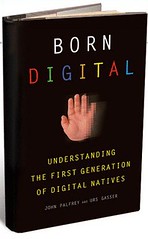
Born Digital coverEarlier this year, I mentioned an outstanding book that John Palfrey of the Berkman Center for Internet & Society at Harvard Law School co-edited entitled Access Denied: The Practice and Policy of Global Internet Filtering.  It’s an excellent resource for anyone studying the methods governments are (unfortunately) using to stifle online expression across the globe.  It’s one of the most important technology policy books of the year.

Well, it looks like John Palfrey will have a second title on this year’s “Best Tech Books” list.  I’ve just finished his new book with his Berkman Center colleague Urs Gasser, Born Digital: Understanding the First Generation of Digital Natives, and it is definitely worthy of your attention. In my book review posted today on the City Journal’s website, I argue that “Palfrey and Gasser’s fine early history of this generation serves as a starting point for any conversation about how to mentor the children of the Web.”  It’s a comprehensive and very even-handed discussion about a variety of concerns or Internet pathologies, including: online safety, personal privacy, copyright piracy, offensive content, classroom learning, and much more.

My City Journal review is down below, but in coming weeks I will be posting some additional thoughts about some specific things in the book worthy of more attention (including a few things I disagreed with).  Overall, I’d say Born Digital is a close runner-up in the race for “Tech Book of the Year,” closely trailing Jonathan Zittrain’s Future of the Internet and How to Stop It (which I have reviewed multiple times) and Nick Carr’s The Big Switch.  But I found far more to agree with in Born Digital than I did in those two books.  Highly recommended.

Continue reading →