President Biden began his 2023 State of the Union remarks by saying America is defined by possibilities. Correct! Unfortunately, his tech-bashing will undermine those possibilities by discouraging technological innovation & online freedom in the United States.
America became THE global leader on digital tech because we rejected heavy-handed controls on innovators & speech. We shouldn’t return to the broken model of the past by layering on red tape, economic controls & speech restrictions.
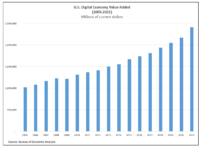
What has the tech economy done for us lately? Here is a look at the value added to the U.S. economy by the digital sector from 2005-2021. That’s $2.4 TRILLION (with a T) added in 2021. These are astonishing numbers.
FACT: According to the BEA, in 2021, “the U.S. digital economy accounted for $3.70 trillion of gross output, $2.41 trillion of value added (translating to 10.3 % of U.S. GDP), $1.24 trillion of compensation + 8.0 million jobs.”
In 2021…
$3.70 trillion of gross output
$2.41 trillion of value added (=10.3% percent GDP)
$1.24 trillion of compensation
8.0 million jobs
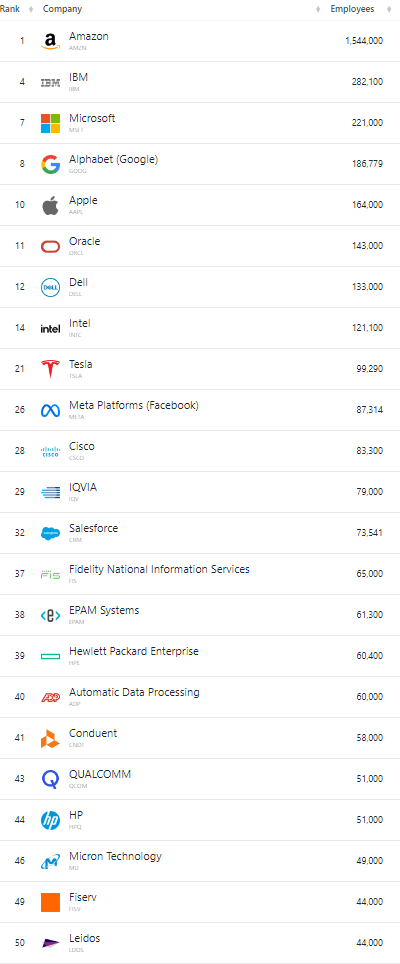
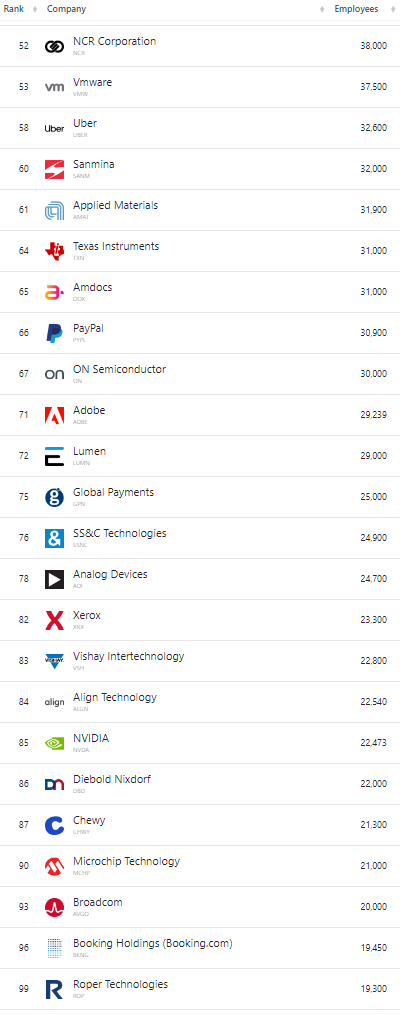
FACT: globally, 49 of the top 100 digital tech firms with most employees are US companies. Here they are. Smart public policy made this list possible.
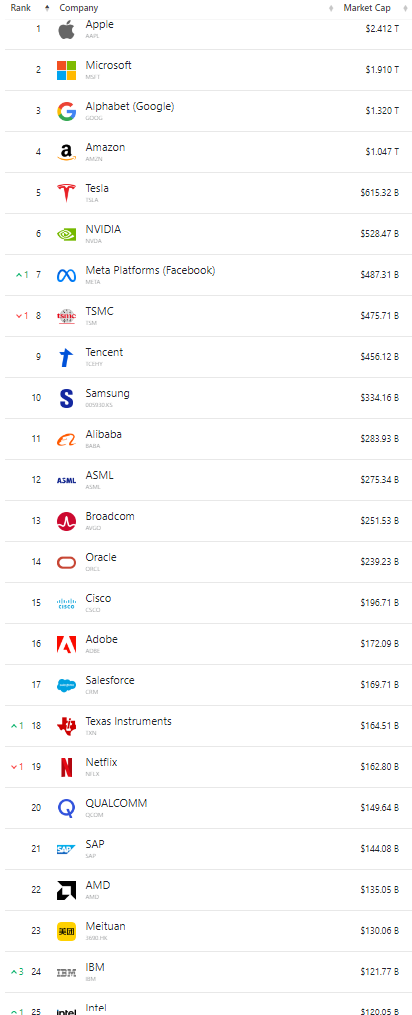
FACT: 18 of the world’s Top 25 tech companies by Market Cap are US-based firms.
It’d be a huge mistake to adopt Europe’s approach to tech regulation. As I noted recently in the Wall Street Journal, “The only thing Europe exports now on the digital-technology front is regulation.” Yet, Biden would have us import the EU model to our shores.
My R Street colleague Josh Withrow has also noted how, “the EU’s approach appears to be, in sum, ‘If you can’t innovate, regulate.’” America should not be following the disastrous regulatory path of the European Union on digital technology policy.
On antitrust regulation, here is a study by my R Street colleague Wayne Brough on the dangerous approach that the Biden administration wants, which would swing a wrecking ball through the tech economy. We have to avoid this.
It is particularly important that the US not follow the EU’s lead on artificial intelligence regulation at a time when we are in heated competition w China on the AI front as I noted here.
American tech innovators flourished thanks to a positive innovation culture rooted in permissionless innovation & policies like Section 230, which allowed American firms to become global powerhouses. And we’ve moved from a world of information scarcity to one of information abundance. Let’s keep it that way.
“The only thing Europe exports now on the digital-technology front is regulation,” I noted in my response, and that makes it all the more mind-boggling that Biden and Barr want to go down that same path. “[T]he EU’s big-government regulatory crusade against digital tech: Stagnant markets, limited innovation and a dearth of major players. Overregulation by EU bureaucrats led Europe’s best entrepreneurs and investors to flee to the U.S. or elsewhere in search of the freedom to innovate.”
Thus, the Biden and Barr plans for importing European-style tech mandates, “would be a stake through the heart of the ‘permissionless innovation’ that made America’s info-tech economy a global powerhouse.” In a longer response to the Biden oped that I published on the R Street blog, I note that:
“It is remarkable to think that after years of everyone complaining about the lack of bipartisanship in Washington, we might get the one type of bipartisanship America absolutely does not need: the single most destructive technological suicide in U.S. history, with mandates being substituted for markets, and permission slips for entrepreneurial freedom.”
What makes all this even more remarkable is that they calls for hyper-regulation come at a time when China is challenging America’s dominance in technology and AI. Thus, “new mandates could compromise America’s lead,” I conclude. “Shackling our tech sectors with regulatory chains will hobble our nation’s ability to meet global competition and undermine innovation and consumer choice domestically.”
This a running list of all the essays and reports I’ve already rolled out on the governance of artificial intelligence (AI), machine learning (ML), and robotics. Why have I decided to spend so much time on this issue? Because this will become the most important technological revolution of our lifetimes. Every segment of the economy will be touched in some fashion by AI, ML, robotics, and the power of computational science. It should be equally clear that public policy will be radically transformed along the way.
Eventually, all policy will involve AI policy and computational considerations. As AI “eats the world,” it eats the world of public policy along with it. The stakes here are profound for individuals, economies, and nations. As a result, AI policy will be the most important technology policy fight of the next decade, and perhaps next quarter century. Those who are passionate about the freedom to innovate need to prepare to meet the challenge as proposals to regulate AI proliferate.
There are many socio-technical concerns surrounding algorithmic systems that deserve serious consideration and appropriate governance steps to ensure that these systems are beneficial to society. However,
there is an equally compelling public interest in ensuring that AI innovations are developed and made widely available to help improve human well-being across many dimensions. And that’s the case that I’ll be dedicating my life to making in coming years.
Here’s the list of what I’ve done so far. I will continue to update this as new material is released: Continue reading →
On December 13th, I will be participating in an Atlas Network panel on, “Big Tech, Free Speech, and Censorship: The Classical Liberal Approach.” In anticipation of that event, I have also just published a new op-ed for The Hill entitled, “Left and right take aim at Big Tech — and the First Amendment.” In this essay, I expand upon that op-ed and discuss the growing calls from both the Left and the Right for a variety of new content regulations. I then outline the classical liberal approach to concerns about free speech platforms more generally, which ultimately comes down to the proposition that innovation and competition are always superior to government regulation when it comes to content policy.
In the current debates, I am particularly concerned with calls by many conservatives for more comprehensive governmental controls on speech policies enforced by various private platforms, so I will zero in on those efforts in this essay. First, here’s what both the Left and the Right share in common in these debates: Many on both sides of the aisle desire more government control over the editorial decisions made by private platforms. They both advocate more political meddling with the way private firms make decisions about what types of content and communications are allowed on their platforms. In today’s hyper-partisan world,” I argue in my
Hill column, “tech platforms have become just another plaything to be dominated by politics and regulation. When the ends justify the means, principles that transcend the battles of the day — like property rights, free speech and editorial independence — become disposable. These are things we take for granted until they’ve been chipped away at and lost.”
Despite a shared objective for greater politicization of media markets, the Left and the Right part ways quickly when it comes to the underlying objectives of expanded government control. As I noted in my
Hill op-ed:
there is considerable confusion in the complaints both parties make about “Big Tech.” Democrats want tech companies doing more to limit content they claim is hate speech, misinformation, or that incites violence. Republicans want online operators to do less, because many conservatives believe tech platforms already take down too much of their content.
This makes life very lonely for free speech defenders and classical liberals. Usually in the past, we could count on the Left to be with us in some free speech battles (such as putting an end to “indecency” regulations for broadcast radio and television), while the Right would be with us on others (such as opposition to the “Fairness Doctrine,” or similar mandates). Today, however, it is more common for classical liberals to be fighting with both sides about free speech issues.
My focus is primarily on the Right because, with the rise of Donald Trump and “national conservatism,” there seems to be a lot of soul-searching going on among conservatives about their stance toward private media platforms, and the editorial rights of digital platforms in particular. Continue reading →
Industrial Policy is a red-hot topic once again with many policymakers and pundits of different ideological leanings lining up to support ambitious new state planning for various sectors — especially 5G, artificial intelligence, and semiconductors. A remarkably bipartisan array of people and organizations are advocating for government to flex its muscle and begin directing more spending and decision-making in various technological areas. They all suggest some sort of big plan is needed, and it is not uncommon for these industrial policy advocates to suggest that hundreds of billions will need to be spent in pursuit of those plans.
Others disagree, however, and I’ll be using this post to catalog some of their concerns on an ongoing basis. Some of the criticisms listed here are portions of longer essays, many of which highlight other types of steps that governments can take to spur innovative activities. Industrial policy is an amorphous term with many definitions of a broad spectrum of possible proposals. Almost everyone believes in
some form of industrial policy if you define the term broadly enough. But, as I argued in a September 2020 essay “On Defining ‘Industrial Policy‘,” I believe it is important to narrow the focus of the term such that we can continue to use the term in a rational way. Toward that end, I believe a proper understanding of industrial policy refers to targeted and directed efforts to plan for specific future industrial outputs and outcomes.
The collection of essays below is merely an attempt to highlight some of the general concerns about the most ambitious calls for expansive industrial policy, many of which harken back to debates I was covering in the late 1980s and early 1990s, when I first started a career in policy analysis. During that time, Japan and South Korea were the primary countries of concern cited by industrial policy advocates. Today, it is China’s growing economic standing that is fueling calls for ambitious state-led targeted investments in “strategic” sectors and technologies. To a lesser extent, grandiose European industrial policy proposals are also prompting new US counter-proposals.
All this activity is what has given rise to many of the critiques listed below. If you have suggestions for other essays I might add to this list, please feel free to pass them along. FYI: There’s no particular order here.
I wanted to bring to your attention this Federalist Society podcast discussion I hosted a few weeks ago on, “Tech Policy Under the Biden Administration and 117th Congress.” I was joined by Jennifer Huddleston, Director of Technology & Innovation Policy at the American Action Forum, and Blake Reid, Clinical Professor at the University of Colorado Law School.
We discussed key policy debates – such as antitrust and “Big Tech,” online speech and Section 230, and the race to 5G – and considered how the new presidential administration and Congress might approach innovation and the tech industry in 2021 and beyond. Note: You might also want to check out this earlier essay by Jennifer on, “5 Tech Policy Topics to Follow in the Biden Administration and 117th Congress.”
The Technology Liberation Front is the tech policy blog dedicated to keeping politicians' hands off the 'net and everything else related to technology. Learn more about TLF →



 The Technology Liberation Front is the tech policy blog dedicated to keeping politicians' hands off the 'net and everything else related to technology.
Running List of My Research on AI, ML & Robotics Policy
by Adam Thierer on July 29, 2022 · 0 comments
[last updated 4/3/2025 – Check my Medium page for latest posts]
This a running list of all the essays and reports I’ve already rolled out on the governance of artificial intelligence (AI), machine learning (ML), and robotics. Why have I decided to spend so much time on this issue? Because this will become the most important technological revolution of our lifetimes. Every segment of the economy will be touched in some fashion by AI, ML, robotics, and the power of computational science. It should be equally clear that public policy will be radically transformed along the way.
Eventually, all policy will involve AI policy and computational considerations. As AI “eats the world,” it eats the world of public policy along with it. The stakes here are profound for individuals, economies, and nations. As a result, AI policy will be the most important technology policy fight of the next decade, and perhaps next quarter century. Those who are passionate about the freedom to innovate need to prepare to meet the challenge as proposals to regulate AI proliferate.
There are many socio-technical concerns surrounding algorithmic systems that deserve serious consideration and appropriate governance steps to ensure that these systems are beneficial to society. However, there is an equally compelling public interest in ensuring that AI innovations are developed and made widely available to help improve human well-being across many dimensions. And that’s the case that I’ll be dedicating my life to making in coming years.
Here’s the list of what I’ve done so far. I will continue to update this as new material is released: Continue reading →