Conversations about how the Internet can be used to increase the openness and accountability of government usually focuses on the Executive and Legislative branches of the Federal government. But on this week’s episode of Technology Policy Weekly, I hosted a discussion of the equally vital issue of public access to court records, joined by:
We discussed a wide range of issues, including:
- Why lay people should care—this is ultimately about reducing the legal profession’s monopoly over access to the courts!
- The philosophical reasons why better access to court records is important – little things like democracy, fairness, consistency, equality, the rule of law, etc.
- The copyrightability of legal records
- The history of the problem & what can be done about it
There are several ways to listen to the TLF Podcast. You can press play on the player below to listen right now, or download the MP3 file. You can also subscribe to the podcast by clicking on the button for your preferred service. And do us a favor, Digg this podcast!
[display_podcast]
I’ve been catching up on Radio Berkman, the podcast produced by our friends at the Berkman Center for Internet & Society and a great companion to the TLF’s own Tech Policy Weekly Podcast. There’s been a lot of talk about government transparency on the TLF lately, including TPW 40: Obama, e-Government & Transparency. But that conversation has been mainly focused on how to make “public” records accessible.
The most recent Radio Berkman episode, “Can you Keep a Secret?” explores the thorny questions about what should be deemed public in the first place, and what should be classified:
The government keeps secrets. We take that for granted. But should we? Some speculate that intelligence agencies and elected officials are a little bit trigger happy with the “Top Secret” stamp, and that society would benefit from greater openness. With the government classifying millions of pages of documents per year – in a recent year the U.S. classified about five times the number of pages added to the Library of Congress – a great deal of useful human knowledge gets put under lock and key. But some argue that secrecy is still crucial to our national security.
Radio Berkman pokes its head into a recent talkback with the directors of the film
Secrecy, Harvard University professors Peter Galison and Robb Moss. They are joined by Harvard Law School professors Jonathan Zittrain, Martha Minow, and Jack Goldsmith.
I look forward to seeing the film (when it comes out on Netflix).
What I found most interesting was the discussion of the essential trade-off in the relationship between the media and the state has always been between the media’s “independence” and its “responsibility” (~33:30 in). Even the staunchest critics of the national security state would probably accept that there are
some stories in the media shouldn’t publish because they’d jeopardize the safety of Americans. But we all want the media to blow the whistle on the bad stuff that goes on behind a veil of secrecy. Drawing that line is a terribly difficult task. But it becomes even more complicated with the decline of traditional professional investigative journalism and the rise of blog/amateur journalism. Continue reading →
Online child safety — especially the fear of predators lurking on social networking sites (SNS) — continues to spur calls by state and federal lawmakers for regulation. At first, some federal lawmakers advocated outright bans on SNS in schools and libraries via the Deleting Online Predators Act (DOPA). Meanwhile, state and local lawmakers — specifically state Attorneys General (AGs) — have been even more vociferous in their calls for regulation in the form of mandatory age verification for social networking sites, which would cover a broad swath of online sites and activities according to their definitions of SNS. But the question that ultimately gets lost in this debate is: Just how much risk do social networking sites really pose for teens? Which risks are real and which are overblown? And what’s the best way to deal with the risks that we find to be legitimate?
 Nancy Willard devotes her life to answering those questions. Willard is one of America’s leading experts on online safety and risk prevention. She runs the Center for Safe and Responsible Internet Use and she is the author of two outstanding books, Cyberbullying and Cyberthreats and Cyber-Safe Kids, Cyber-Savvy Teens. In my opinion, Willard’s general approach to online child safety is the most enlightened, level-headed, and likely to be effective. That’s because Willard focuses on putting fears in perspective, identifying the actual risks that kids face online, and devising sensible strategies to deal with risks and problems as they are discovered. Her approach is holistic and built upon sound data, targeted risk-identification strategies, and time-tested education and mentoring methods. For my money, it’s the most sensible approach to online safety issues. In fact, when other parents ask me for “just one thing” to read on the topic, I usually recommend Willard’s work — especially her amazing book Cyber-Safe Kids, Cyber-Savvy Teens. And her background in early childhood education, special education for “at risk” children with emotional and behavior difficulties, as well as experience in computer law, means she is uniquely suited to be analyzing these issues. In sum, this is woman we should all be closely listening to on these issues.
Recently, Willard has been responding to criticisms that state AGs have leveled against the Internet Safety Technical Task Force (ISTTF) and its final report. [Disclaimer: I was a member of the ISTTF.] I’ve already outlined the ISTTF’s work at length here, but the three key takeaways from the report were that:
- the risk of predation on social network sites has been over-stated; the data suggest that cyber-bullying is the bigger problem on SNS;
- there is no silver-bullet technical solution to online child safety concerns, and mandatory age verification, in particular, would not make kids safer online but could even create bigger problems in the long-run;
- education and empowerment are the real keys to keeping kids safer online.
Continue reading →
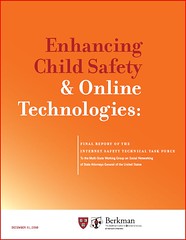 The Internet Safety Technical Task Force (ISTTF), which was formed a year ago to study online safety concerns and technologies, today issued its final report to the U.S. Attorneys General who authorized its creation. It was a great honor for me to serve as a member of the ISTTF and I believe this Task Force and its report represent a major step forward in the discussion about online child safety in this country.
The ISTTF was very ably chaired by John Palfrey, co-director of Harvard University’s Berkman Center for Internet & Society, and I just want to express my profound thanks here to John and his team at Harvard for doing a great job herding cats and overseeing a very challenging process. I encourage everyone to examine the full ISTTF report and all the submissions, presentations, and academic literature that we collected. [It’s all here.] It was a comprehensive undertaking that left no stone unturned.
Importantly, the ISTTF convened (1) a Research Advisory Board (RAB),which brought together some of the best and brightest academic researchers in the field of child safety and child development and (2) a Technical Advisory Board (TAB), which included some of America’s leading technologists, who reviewed child safety technologies submitted to the ISTTF. I strongly recommend you closely examine the RAB literature review and TAB assessment of technologies because those reports provide very detailed assessments of the issues. They both represent amazing achievements in their respective arenas.
There are a couple of key takeaways from the ISTTF’s research and final 278-page report that I want to highlight here. Most importantly, like past blue-ribbon commissions that have studied this issue, the ISTTF has generally concluded
there is no silver-bullet technical solution to online child safety concerns. The better way forward is a “layered approach” to online child protection. Here’s how we put it on page 6 of the final report:
The Task Force remains optimistic about the development of technologies to enhance protections for minors online and to support institutions and individuals involved in protecting minors, but cautions against overreliance on technology in isolation or on a single technological approach. Technology can play a helpful role, but there is no one technological solution or specific combination of technological solutions to the problem of online safety for minors. Instead, a combination of technologies, in concert with parental oversight, education, social services, law enforcement, and sound policies by social network sites and service providers may assist in addressing specific problems that minors face online. All stakeholders must continue to work in a cooperative and collaborative manner, sharing information and ideas to achieve the common goal of making the Internet as safe as possible for minors.
Continue reading →
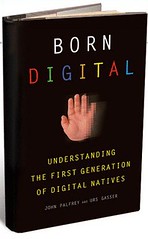 Earlier this year, I mentioned an outstanding book that John Palfrey of the Berkman Center for Internet & Society at Harvard Law School co-edited entitled Access Denied: The Practice and Policy of Global Internet Filtering. It’s an excellent resource for anyone studying the methods governments are (unfortunately) using to stifle online expression across the globe. It’s one of the most important technology policy books of the year.
Well, it looks like John Palfrey will have a second title on this year’s “Best Tech Books” list. I’ve just finished his new book with his Berkman Center colleague Urs Gasser, Born Digital: Understanding the First Generation of Digital Natives, and it is definitely worthy of your attention. In my book review posted today on the City Journal’s website, I argue that “Palfrey and Gasser’s fine early history of this generation serves as a starting point for any conversation about how to mentor the children of the Web.” It’s a comprehensive and very even-handed discussion about a variety of concerns or Internet pathologies, including: online safety, personal privacy, copyright piracy, offensive content, classroom learning, and much more.
My
City Journal review is down below, but in coming weeks I will be posting some additional thoughts about some specific things in the book worthy of more attention (including a few things I disagreed with). Overall, I’d say Born Digital is a close runner-up in the race for “Tech Book of the Year,” closely trailing Jonathan Zittrain’s Future of the Internet and How to Stop It (which I have reviewed multiple times) and Nick Carr’s The Big Switch. But I found far more to agree with in Born Digital than I did in those two books. Highly recommended.
Continue reading →
[Note: You might want to first read my review of Jonathan Zittrain’s book to give this essay some context.]
Jonathan Zittrain must have been smiling as he read Leander Kahney’s excellent Wired cover story this month, “How Apple Got Everything Right By Doing Everything Wrong.” In a sense, the article vindicates Zittrain’s thesis in The Future of the Internet–And How to Stop It.
 Again, in his provocative book, Zittrain argues that, for a variety of reasons, the glorious days of the generative, open Internet and general-purpose PCs are supposedly giving way to closed networks and a world of what he contemptuously calls “sterile, tethered devices.” And Apple products such as the iPhone, the iPod, and iTunes serve as prime examples of the troubling world that await us. And Kahney’s article confirms that Apple is every bit as closed and insular as Zittrain suggests. Kahney nicely contrasts Apple with Google, a company that “embraces openness,” trusts “the wisdom of crowds,” and has its famous “Don’t be evil” philosophy:
It’s ironic, then, that one of the Valley’s most successful companies ignored all of these tenets. Google and Apple may have a friendly relationship — Google CEO Eric Schmidt sits on Apple’s board, after all — but by Google’s definition, Apple is irredeemably evil, behaving more like an old-fashioned industrial titan than a different-thinking business of the future. Apple operates with a level of secrecy that makes Thomas Pynchon look like Paris Hilton. It locks consumers into a proprietary ecosystem. And as for treating employees like gods? Yeah, Apple doesn’t do that either.
Continue reading →
Jonathan Zittrain, who is affiliated with Oxford University and Harvard’s Berkman Center, recently released a provocatively titled book: The Future of the Internet–And How to Stop It. It’s an interesting read and I recommend you pick it up despite what I’ll say about it in a moment. (Incidentally, if you ever have a chance to hear Jonathan speak, I highly recommend you do so. He is, bar none, the most entertaining tech policy geek in the world. Imagine Dennis Miller with a cyberlaw degree.)

Jonathan’s book contrasts two different paradigms that he argues could define the Net’s future: The “generative” Net versus what he refers to as a world of “tethered, sterile appliances.” By “generative” he means technologies or networks that invite or allow tinkering and all sorts of creative uses. Think general-purpose personal computers and the traditional “best efforts” Internet. “Tethered, sterile appliances” by contrast, are technologies or networks that discourage or disallow tinkering. Basically, “take it or leave it” proprietary devices like Apple’s iPhone or the TiVo, or online walled gardens like the old AOL and current cell phone networks.
Jonathan’s thesis is that, for a variety of reasons [viruses, Spam, identify theft, etc], we run the risk of seeing the glorious days of the generative, open Net give way to more tethered devices and closed networks. He states:
Continue reading →

 The Technology Liberation Front is the tech policy blog dedicated to keeping politicians' hands off the 'net and everything else related to technology.