Speaking of transparency… My colleague Barbara Esbin has a great piece on the PFF blog about changes being implemented by Acting Chairman Copps to make the agency less dysfunctional and more open to the public:
the new Acting Chairman has confirmed what FCC insiders, outside practitioners, and the House staff investigating former Chairman Kevin Martin’s management practices have long known: Commission staffers were not permitted to freely communicate either with one another, or with the other Commissioners. The liberation of the staff, together with changes concerning how the Bureaus and Offices work with each other and how the Commission communications with the public, certainly falls under the category of “change we can believe in…”
Acting Chairman Copps has outlined other important changes in how the FCC does business, including establishing a calendar for regular open meetings in advance, and updating the FCC’s website to be more user-friendly, particularly its Digital TV Transition pages. These and other changes and commitments together constitute an extremely promising start for Acting Chairman Copps, and his commitment to transparency and order bode very well for the FCC, its staff, the companies the agency regulates, and the American public.
Great news. Let’s hope the FCC also gets to work
soon on updating its painfully antique website, with its proliferation of databases.
One of the reasons that so many of us here take issue with proposals to expand regulation of communications, broadband, and media markets is because we have studied the horrendous inefficiencies of economic regulation in practice. We oppose regulatory proposals not because of a “blind faith” in free markets, but because we understand that even when markets stumble they correct themselves quicker and more efficiently than regulatory systems do. One can profess the supposed theoretical benefits of enlightened “public interest” regulation all they want, but the facts are the facts. And the facts do not support the proposition that government regulation generally enhances consumer welfare.
In that regard, Tim Lee’s new Net neutrality report for Cato does a nice job of surveying some of the past unintended consequences of regulation. Also, even though it is now 10 years old, I highly recommend “Economic Deregulation and Customer Choice” by Jerry Ellig and Robert Crandall. It’s an outstanding overview of why economic regulation of various industries failed consumers so miserably in the past.
But if you want even more shocking proof of how horrendously inefficient communications regulation can be in practice, then you must read my PFF colleague Barbara Esbin’s two essays this week on the Universal Service Fund (USF): “The High Cost of USF Support,” and “More FCC Support Fund Follies.” In these two essays, Esbin walks the reader through various grim reports and statistics that have been released recently documenting the failures of the USF.
Continue reading →
Last week I discussed Barbara Esbin’s new PFF paper about the FCC’s absurd investigation into how the cable industry is transitioning analog customers over to digital. This is an essential transition is the cable industry is going to free up bandwidth to compete against telco-provided fiber offerings in the future. The faster the cable industry can migrate its old analog TV customers over to the digital platform, the more bandwidth they can re-deploy for high-speed Net access and services. Mark Cuban helps put things in perspective:
1. the only thing that cable companies, and satellite for that matter have to sell is bandwidth and the applications they can run on that bandwith. More bandwidth means more digital everything.
2. For Basic Cable subscribers that get say, 40 analog channels, they are consuming 40 x 38.6mbs or 1.54 Gbs. Let that sink in. 1.54 Gbs of bandwidth. Compare that to how fast your internet access is. That more bandwidth than your entire neighborhood consumes online, by a lot.
Thats also the equivalent of 500 standard def digital channels. If you convert that to revenue per bit for cable companies, or cost per bit for basic cable consumers, the basic cable customers are getting the best deal in town. By a long shot.
Digital cable customers, not so much. Digital customers are paying multiples of analog customers for bandwidth. In reality, analog customers are getting an amazing deal, and the cable companies have been hesitant to convert them only because of the potential FCC backlash.
I’m as cynical as the next guy when it comes to cable rates and motivations, but the reality is that the longer analog remains, the fewer opportunities to leverage the freed up bandwidth to create next generation bandwidth hog applications. Will the cable companies charge us an a lot for that bandwidth, probably. But when we start to see applications built on top of 250mbs per second and more, it will have far more value to society than watching USA Network on your old analog TV. And Net Neutrality? Well if everyone had that 1.54gbs available to them, net neutrality would be a non issue. We wouldn’t be arguing about access or pre-emption, we would be arguing about quality of service.
Once again we are reminded that all regulations have opportunity costs and in this case the FCC’s actions could cost consumers the loss (or at least delay) of higher-speed broadband offerings in the near-term.
I need not remind anyone here about FCC Chairman Kevin Martin’s ongoing “war on cable.” Even if you hate the cable industry or capitalism in general, there’s just no way I can see how anyone who believes in the rule of law and good government can support Martin’s incessant abuse of power in his Moby Dick-like crusade against the cable industry. A crusade, incidentally, which happens to be motivated by Chairman Ahab’s desire to control speech on cable television, as I’ll note below.
Anyway, the latest chapter in this miserable saga of government-gone-mad is Martin’s recent effort to begin a far-ranging data gathering effort concerning cable prices and analog-to-digital channel movements under the guise of individual complaint enforcement. In a new paper entitled “Der Undue Prozess at the FCC: Part Deux,” my PFF colleague Barbara Esbin shows, once again, how the FCC’s regular processes and procedures are being perverted by Martin to achieve ends not within the agency’s delegated authority. And the results, in this case, will be profoundly anti-consumer.
Esbin documents the four flaws in the FCC’s investigation as follows:
Continue reading →
I’ve been trying to catch up after a week-long cruise with my kids down in the Caribbean and as I was doing my best to sort through thousands of e-mails and articles in my RSS reader, I stopped and did a double-take when I saw some headlines from last week about how the Federal Communications Commission is spending $350,000 taxpayer dollars to sponsor a NASCAR team. For that money, NASCAR driver David Gilliland “has agreed to use his No. 38 car as a high-speed billboard promoting the February 2009 national transition to digital television,” according to Multichannel News.
In the annuls of idiotic government spending initiatives this one has to be a potential hall of fame entry. Over on the PFF Blog, my PFF colleague Barbara Esbin has a humorous piece explaining why:
what signal does FCC sponsorship of a stock car racer send to the beleaguered American public in this autumn of our discontent? The FCC Chairman claims that this sponsorship is an “extremely effective way for the FCC to raise DTV awareness among people of all ages and income levels across the United States who loyally follow one of the most popular sports in America.” Well, those loyal sports fans will have to be following No. 38 at the three sponsored races with some pretty high-speed binoculars to catch the DTV message. Although the $350,000 does get the government posting of its informational website URL, www.dtv.gov, along the track — doubtless not the only advertisement to lure spectator eyeballs — it is primarily receiving posting on the car’s sides and on the driver’s helmet and suit. Let’s just hope No. 38 has a large fan base, does exceeding well in the three races, and, more importantly, avoids accidents, injuries, and fleeting expletives.
Maybe this is just another federal government bailout. On the same day that the FCC announced its investment in NASCAR, the Raleigh News & Observer ran an article entitled, “Global crisis threatens NASCAR.” It seems that “motor sport” team sponsorship has been down this year, “with sinking auto showroom sales, declining attendance and rising operating costs.” And let’s not even talk about the carbon footprint of stock car racing.
Of course, what’s even more pathetic about this move is that FCC Chairman Kevin Martin’s likely motivation for doing this is probably political: He probably thinks this is a good way to win blue collar votes with all the NASCAR fans down in North Carolina for a future run for office. [It’s widely rumored that he will seek some office down in his home state after his tenure at the FCC is up.] After all, NASCAR is hugely popular in that state. I don’t know about you, but I’m none too happy subsidizing a get-out-the-NASCAR-vote effort for one of the most regulatory-minded FCC Chairmen in history.
My colleague Barbara Esbin, a Senior Fellow and Director of the Center for Communications and Competition Policy at The Progress & Freedom Foundation, was asked to pen a short history of the net neutrality wars in the U.S. for a French publication, La Lettre de l’Autorité. Her essay provides an excellent, concise overview of where we’ve come from and where we might be heading on this front. I’ve pasted the entire essay down below, or you can download the PDF here.
Net Neutrality Regulation in the United States
by Barbara Esbin
PFF
Progress Snapshot
Release 4.21 October 2008
The United States moved closer to “Net Neutrality” regulation this year when the Federal Communications Commission found that Comcast, a cable broadband Internet service provider, violated a set of Internet policy principles the FCC adopted in 2005 by limiting peer-to-peer (P2P) traffic. The ruling was the culmination of a ten-year effort that began as a call for wholesale “open access” to the cable platform for third-party Internet service providers. Requests for open access first emerged in 1998 when the FCC considered AT&T’s acquisition of cable operator TCI. The FCC rejected open access, but the issue quickly re-emerged in a subsequent proceeding to determine the appropriate regulatory classification of cable Internet service. Depending on how the FCC categorized cable Internet service, it would either be subject to telecommunications “common carrier” requirements, “cable service” requirements, or treated as a then-unregulated “information service.”
In 2002, the FCC classified cable Internet service as an “information service.” This meant that the telecommunications common carrier requirements — that service be provided upon request, without unreasonable discrimination as to rates, terms and conditions of service — would not apply to cable Internet services. The FCC’s decision was upheld by the U.S. Supreme Court in
NCTA v. Brand X. Afterwards, advocates of open access re-directed their efforts away from advocating wholesale access for third-party ISPs, and towards rules aimed at consumer rights to a “neutral network” or “net neutrality.”
Continue reading →
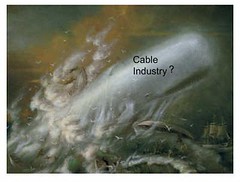 Well, another four months have passed since I last asked this question, but let me pose it again: Where exactly is the FCC’s Video Competition Report and why is it taking so long to get it out the door? It wouldn’t have anything to do with a certain Chairman Ahab still trying to get his cable whale, would it? No, of course not. I’m sure there’s a perfectly rational reason that this 13th Annual report is now something like 18 months past due altogether. Right.
And keep in mind that the data in the 13th report is for a period ending on June 30, 2006, so whenever the report finally comes out the data in it will be well over two years old! That won’t exactly reflect the true state of the video programming market considering the significant changes we have since that time, especially the continued explosive growth of online video, VOD, and DVRs.
The reason that I have been making a big deal out of this issue is because this gets to the question of just how “scientific” and “independent” of an agency the FCC really is. We are talking about facts here. Basic data. This is stuff the FCC should be routinely collecting and reporting on a timely basis — indeed that is what Congress
requires the agency to do in this specific case. And yet the agency can’t do it because its Chairman is on this Moby Dick-like crusade against the cable industry. By the time this 13th annual report finally sees the light of day, the 15th annual report might be due! Outrageous. (And you wonder why many of us here are so skeptical about empowering the FCC regulating the Internet via Net neutrality mandates! If an over-zealous Chairman can politicize this issue, just think what might happen once we give the agency the authority to regulate the Net.)
Anyway, down below you will find the paper that Barbara Esbin and I wrote about the issue four months ago. Perhaps we should place a little ticker somewhere here on the site that counts each day that passes as we wait for the Commission to produce this report. We can take bets on when the agency’s data holdout will end.
Continue reading →
 In a new
PFF
essay, my colleague Barbara Esbin and I address a recent petition filed by the Rural Cellular Association (RCA) asking the FCC to prohibit exclusive arrangements between wireless handset producers and carriers. The RCA petition claims that large wireless companies have an unfair market advantage by giving their customers exclusive access to certain advanced smart phones, such as the Apple/AT&T iPhone—and that this anticompetitive practice is harmful to rural consumers served by RCA members.
In a new
PFF
essay, my colleague Barbara Esbin and I address a recent petition filed by the Rural Cellular Association (RCA) asking the FCC to prohibit exclusive arrangements between wireless handset producers and carriers. The RCA petition claims that large wireless companies have an unfair market advantage by giving their customers exclusive access to certain advanced smart phones, such as the Apple/AT&T iPhone—and that this anticompetitive practice is harmful to rural consumers served by RCA members.
In the piece, we debunk RCA’s arguments premised on a supposed lack of competition in wireless markets. RCA will likely now redouble these arguments by pointing to Verizon’s planned acquisition of Alltel (by far the smallest of the “Big 5” carriers), which was announced the day our piece was published. But even with four large carriers instead of five, the wireless market remains vibrantly competitive—especially as compared to 1992, when the FCC decided that even the two-carrier market was “extremely competitive,” and rejecting arguments that it ban exclusive handset arrangements. Continue reading →

 The Technology Liberation Front is the tech policy blog dedicated to keeping politicians' hands off the 'net and everything else related to technology.