Posts tagged as:

So I say in Politico today. Highlights:

During his first two years in office, the president generated a lot of heat in the transparency area — but little sunlight. House Republicans can quickly outshine Obama and the Democratic Senate. It all depends on how they implement the watch phrase of their amendment package: “publicly available in electronic form.” . . . The House can reach the gold standard for transparency if its new practices make introducing a bill and publishing the bill online the same thing. Moving a bill out of committee and posting the committee-passed version as online data must also be the same thing. Voting on a bill and publishing all data about the vote online must be standard procedure. . . . The transparency community owes it to Congress to say how it wants to get the data.

Of course, I’ve fooled you just a little bit. The whole thing is a highlight! (ahem) Read it.

. . . you’d think that you would follow the “Speeches” link from the home page on Whitehouse.gov. If you do, today you see just four speeches.

I went looking for the text of his national security speech at the National Archives today. The New York Times has it but Whitehouse.gov doesn’t? What’s going on here?

Google recently experienced failures of its core services — a phenomenon that quickly spawned the hashtag “googlefail” on the popular social networking platform Twitter.  These failures show that a company once thought of as the odds-on favorite for dominating the global market in all things web — the monolith of Mountain View — is looking more and more like a search-only player.

Big firms consistently fail to use their “market dominance” to take over adjacent markets, something that should give antitrust warriors in the Obama administration reason for pause.  The renewed call for tough antitrust enforcement comes at a time when Google, a poster-child for market dominance, simply can’t leverage its position at all.

Continue reading →

This morning, Cato put out a TechKnowledge of mine called “The Promise that Keeps on Breaking.” It deals with the policy issues surrounding President Obama’s yet unfulfilled promise to post bills sent to him by Congress online for five days before he signs them.

A Cato@Liberty post last week went through the President’s progress so far on the five-day promise.

. . . or does he?

Friday afternoon, the White House blog announced that the American Recovery and Reinvestment Act of 2009 was posted online for public comment. This is good evidence that the President intends to honor his campaign promise to post legislation online and take public comment for five days before signing it.

But it’s not great evidence of that.

The Whitehouse.gov post went up at 2:05 pm, but the House didn’t vote until 2:24 pm and the Senate voted at 05:29 pm. (Click on the “votes” to see how your representatives did.) As of Saturday afternoon, the Thomas legislative tracking system doesn’t indicate that the bill has been presented to the President yet. And news reports indicate that the President will sign the bill on Monday, three days after it was “pre-“posted.

Regular order, Mr. President. When a bill is presented to you, post it online (at a consistent place on your Web site, not just at ad hoc URLs as you’ve done up to now). Then wait five days, reviewing the comments of the public as you promised to do when you asked the public to elect you.

The steps the White House has taken toward implementing the President’s promise are good steps. (In this Cato daily podcast, I characterized the President’s record on transparency so far as “mixed.”) But the promise is not fulfilled until bills receive five days online airing after they have been presented.

Presentment is a distinct, constitutional step in the legislative process. Until every non-emergency bill is posted online for five days after presentment and before signing, President Obama will look like he’s being driven by events and maneuvered by his elders in Congress.

I’ve been following President Obama’s early moves on government transparency here on Tech Liberation and on the Cato@Liberty blog.

Last week, Obama’s first broken campaign promise was the pledge to post legislation online for five days before signing it.

Well, the White House is working to address that, but it appears to be doing so with a half-measure that comes up short. On Sunday, the White House blog announced that the SCHIP legislation pending in the Senate was up for public comment. And it is, of course, but it hasn’t passed the Senate yet.

It was implicit in the promise to post bills online for five days prior to signing that the bill posted would be the one passed by the House and Senate and presented to the President.

If the White House were to implement the promised practice of leaving bills sitting out there, unsigned, after they pass Congress, that would have significant effects. The practice would threaten to reveal excesses in parochial amendments and earmarks which could bring down otherwise good bills. President Obama’s promised five-day cooling off period would force the House and Senate to act with more circumspection.

Taking comments on a bill as it makes its way through the House and Senate does not have the same salutary effect. If the White House is trying to start the five-day clock on the SCHIP bill with the posting of a comment page on Sunday, that is not consistent with President Obama’s promise.

On the first full day of the new Obama administration, I wrote here, and later followed up, expressing regret that the Obama White House hadn’t ported the “Seat at the Table” program over from the transition. Change.gov published documents submitted to the transition on its Web site for public review and comment. Whitehouse.gov does not.

Now we learn that the White House will not honor an Obama campaign and Whitehouse.gov pledge – not more than nine days old – to post all non-emergency legislation on the White House Web site for five days before the President signs it.

One significant addition to WhiteHouse.gov reflects a campaign promise from the President: we will publish all non-emergency legislation to the website for five days, and allow the public to review and comment before the President signs it.

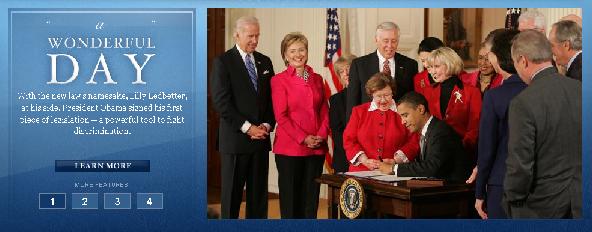
President Obama signed the “Lilly Ledbetter Fair Pay Act of 2009” into law today, one day after Congress delivered it to him. And there’s the bill law, posted on Whitehouse.gov for public review. But it sure hasn’t been up for five days. And it’s not emergency legislation: Bills like it have been floating around in Congress since at least June 2007.

If I was a little demanding about transparency from day one, it was a bit of counterpoint to folks who were going dewy about Obama’s transparency promises. Those were simply words. Judging by the Whitehouse.gov screen cap below, transparency got thrown over the side for a photo op. Welcome to Washington.

obama-photo-op

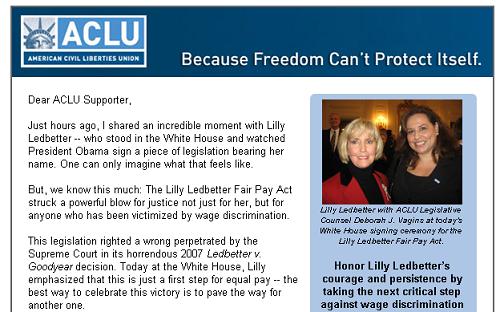
Update: Just got an email that helps illustrate why the sound practices of letting legislation cool and taking public comment would go by the wayside. Getting credit from the ACLU is much more important than pleasing the relatively tiny coterie of transparency fans – and there is almost no expectation among the public that a White House should practice good lawmaking hygiene.

aclu-screencap

I can’t believe we’re actually asking whether Obama—the candidate who promised to bring the Federal government (and perhaps everyone else) into the Web 2.0 era whether they like it or not—will have a “personal computer.”

The “webiness” of Obama’s predecessors is just embarrassing:   

Clinton famously sent only two e-mails while he was president, one to test whether he could push the “send” button and one to John Glenn, sent while the former Ohio senator was aboard the space shuttle… During his presidency, George W. Bush didn’t have a personal log-in to the White House Internet server, nor did he have a personal whitehouse.gov e-mail address. (He gave up his private e-mail account, G94B@aol.com, just before his first inauguration.) When he did go online, there were some things he couldn’t access. During Bush’s tenure, the White House’s IT department blocked sites like Facebook, YouTube, Twitter, and most of MySpace. The ability to comment on blogs was blocked, as was certain content that was deemed offensive. According to David Almacy, who served as Bush’s director for Internet and e-communications from 2005-07, only two people had access to the iTunes store during that period: Almacy, who had to upload speeches to the site, and the president’s personal aide, so that he could download songs for Bush’s iPod.

Pipes and tubes, pipes and tubes, my friends…  

If Obama decides not to implement whatever legal or technical changes would be required for him to do something so simple as having a computer on his desk, I suppose we’ll know that he’s not really all that interested—at least on a personal level—in all his rhetoric about the power of the Internet to make government more transparent and accountable.  Let’s hope that doesn’t happen.

The new Whitehouse.gov went live shortly after Barack Obama became president yesterday. It has much of the look and feel of his transition Web site, Change.gov.

Among the featured items on the homepage today (they will change regularly, of course) is the site itself and the new administration’s commitment to transparency. However, the actual terms of that commitment come up pretty anemic.

In a post on the White House blog, Director of New Media Macon Phillips says:

President Obama has committed to making his administration the most open and transparent in history, and WhiteHouse.gov will play a major role in delivering on that promise. The President’s executive orders and proclamations will be published for everyone to review, and that’s just the beginning of our efforts to provide a window for all Americans into the business of the government. You can also learn about some of the senior leadership in the new administration and about the President’s policy priorities.

Executive orders and proclamations? Information about senior leadership and the President’s priorities? That’s not breaking any new ground on transparency.

The transition’s “Seat at the Table” program required “any documents from official meetings with outside organizations [to] be posted on our website for people to review and comment on.”

The decision to port this practice over to the White House has either not been made, or has been decided against. Given that meetings are already happening, it will be a tough policy to implement if it is not implemented right away.

There is an “Office of Public Liaison” (and intergovernmental affairs) on the Whitehouse.gov site, but it’s nothing more than an email submission form at this point. “More ways for you to interact” are promised.

Words aren’t deeds, and it’s already too late to demonstrate a day-one commitment to transparency. Let’s hope the first steps of the new administration are not steps away from the important transparency precedents set by the transition.

Update: As I wrote this post, news stories were coming out about new executive orders coming out dealing with ethics and transparency. Though I haven’t been able to find them yet – hint hint, Whitehouse.gov – the change to the interpretation of FOIA sound like a welcome, if modest, step in the right direction.

Is $1,200,000,000,000.00.  That’s the expected 2009 Federal budget deficit.  Since the current Federal debt is estimated at a “mere” $10.6 trillion, this means that we’re expected to add nearly 9% in a single year to a debt accumulated over 233 years (since 1774).  This number also amounts to more than 8% of the U.S. economy. 

So what does this have to do with technology policy?  To start with, this figure comes from Congressional Budget Office estimates, which “don’t account for the huge economic stimulus bill Obama is expected to propose soon to try to jolt the economy.”  So, while the Obama team has talked about big “public works” and “infrastructure” spending (which used to be called, variously, “make-work,” “pork barrel” and “corporate welfare”), there’s sure to be huge pressure not to waste more taxpayer money on top of this staggering figure.  Whatever blame Bush deserves, Obama probably doesn’t want to go down in history as the man who finally caused the U.S. government to default on its unmanageable debt burden.

One certainly could make an argument that the kind of technology-related “infrastructure” stimulus Obama has talked about (e.g., broadband subsidies) would be less of a waste of money than, say, simply building more bridges (as Japan did in the 1990s, its “lost decade”) or other reflexively Keynesian responses.  But even so, I suspect that the total amount of funding made available for such projects won’t be anywhere near enough to satisfy the technology policy Left.  

This could result in increased pressure on the Administration to increase regulation of the technology sector in order to implement tech-leftist ideas about “protecting” users’ privacy, promoting media diversity or “fairness”, mandating net “neutrality,” “opening up” spectrum, etc.  Such  proposals might seem attractive precisely because they generally wouldn’t require increased Federal expenditures other than the cost of hiring more bureaucrats (which means more government employee union jobs anyway—hardly a bad thing for Democrats)—while the economic consequences of such proposals for companies and consumers will probably surely be trivialized.  For example, if the advocates of government control at the so-called “Free Press” can’t get universal broadband, they’ll probably press that much harder to cripple online advertising and traffic management by ISPs, just to name two popular bogeymen.obamas-new-new-deal
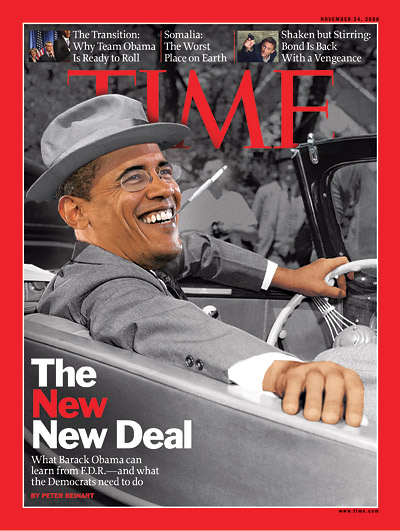
One might think that a sharp economic decline would cause policy-makers to think twice before undermining the business models that have supported IT innovation and real infrastructure investment.  But one has only to look at the policies of FDR’s first two terms to see how even an amiable, soft-spoken president elected on a mantra of change and “uniting” the nation in a time of crisis could consistently choose to place “Reform” (i.e., increased regulation) over “Recovery” (i.e., the health of the economy)—with devastating economic consequences.

Continue reading →