I wanted to follow up on Eli Dourado’s excellent previous post (“Real Talk on Net Neutrality“) to reiterate the importance of a few points he made and add some additional thoughts about the issues raised in that New York Times article on Net neutrality and forced access regulation that lots of people are talking about today.
What Eli’s post makes clear is that there are those of us who think about Net neutrality and infrastructure regulation in economic terms (a rapidly shrinking group, unfortunately) and those who think it about in quasi-religious terms. The problem with the latter ideology of
neutrality uber alles, however, is that at some point it must confront real-world economics. This is Eli’s core point: Something must pay the bills. In this case, something must cover the significant fixed costs associated with broadband investments if you hope to sustain those networks. Unless you are ready to make the plunge and suggest that the government should cover those costs through massive infrastructure expenditures and even potential nationalization or municipalization of broadband networks — and some clearly would be — then you have to get serious about how those costs will be covered by private operators.
Thus, we come back to the importance of business model experimentation and pricing flexibility to this debate. I have been harping on this point for a long time now, going all the way back to this 2005 essay, “The Real Net Neutrality Debate: Pricing Flexibility Versus Pricing Regulation.” And there’s a litany of other things I’ve penned on the same point, many of which I have cited at the end of this essay.
Here are the core points I have tried to get across in those earlier essays: Continue reading →
Of all the shockingly naive and shamelessly self-serving editorials I’ve read by businesspeople in recent years, today’s Wall Street Journal oped by Netflix general counsel David Hyman really takes the cake. It’s an implicit plea to policymakers for broadband price controls. Hyman doesn’t like the idea of broadband operators potentially pricing bandwidth according to usage /demand and he wants action taken to stop it. Of course, why wouldn’t he say that? It’s in Netflix’s best interest to ensure that somebody else besides them picks up the tab for increased broadband consumption!
But Hyman tries to pull a fast one on the reader and suggest that scarcity is an economic illusion and that any effort by broadband operators to migrate to usage-based pricing schemes is simply a nefarious, anti-consumer plot that must be foiled. “Consumers and regulators need to take heed of what is happening and avoid winding up like the proverbial frog in a pot of boiling water,” Hyman warns. “It’s time to jump before it’s too late.”
Rubbish! The only thing policymakers need to do is avoid myopic, misguided advice like Hyman’s, which isn’t based on one iota of economic theory or evidence.
Continue reading →
This morning, the Technology Committee of the New York City Council convened a large hearing on a resolution urging Congress to pass a robust Net Neutrality law. I was supposed to testify, but our narrowband transportation system prevented me from getting to New York. Here, however, is the testimony I prepared. It focuses on investment, innovation, and the impact Net Neutrality would have on both.
“Net Neutrality’s Impact on Internet Innovation” – by Bret Swanson – 11.20.09
Interesting piece here from Slate’s Farhad Manjoo on why AT&T should dump unlimited data plans and end what he calls the “iPhone all-you-can-eat buffet.” He notes that: “The typical smartphone customer consumes about 40 to 80 megabytes of wireless capacity a month. The typical iPhone customer uses 400 MB a month. AT&T’s network is getting crushed by that demand.” Because “some iPhone owners are hogging the network” and causing “a slowed-down wireless network,” Manjoo recommends a congestion pricing model as a method of balancing supply and demand:
How would my plan work? I propose charging $10 a month for each 100 MB you upload or download on your phone, with a maximum of $40 per month. In other words, people who use 400 MB or more per month will pay $40 for their plan, or $10 more than they pay now. Everybody else will pay their current rate—or less, as little as $10 a month. To summarize: If you don’t use your iPhone very much, your current monthly rates will go down; if you use it a lot, your rates will increase. (Of course, only your usage of AT&T’s cellular network would count toward your plan; what you do on Wi-Fi wouldn’t matter.)
To understand the advantages of tiered pricing, let’s look at AT&T’s current strategy of spending billions to build more network space. Why won’t this work? For the same reason building more roads doesn’t reduce traffic—more capacity increases the attractiveness of driving, which brings a lot more cars to the road, which leads to more gridlock.
Congestion pricing and metering is something I’ve written quite a bit about here in the context of wireline broadband (1, 2, 3), but Manjoo is equally correct that it could be applied for wireless data plans. It has the added value of taking pressure off lawmakers to impose Net neutrality regulation since pricing of the pipe becomes an effective substitute for most other forms of network management. In other words, price, don’t block bandwidth-hogging customers and applications. The problem, Manjoo explains: Continue reading →
Those who advocate regulating Internet service providers as common carriers subject to “open access” mandates (a/k/a “Net Neutrality”) want us to believe that their cause is the “Civil Rights” issue of the digital age, with huge popular support and opposed only by self-interested cable companies and their henchmen. In fact, such regulations would actually harm consumers, increase broadband prices, retard the heretofore-explosive growth of bandwidth, and dramatically increase government control over the Internet. Of course, the degree of public interest in a cause doesn’t actually tell us anything about its justice and, fortunately, we live in a democratic oligarchic republic, not a pure democracy. But it’s worth asking whether Americans are really up in arms about the need for “Net Neutrality” regulations. Google Trends suggests not:
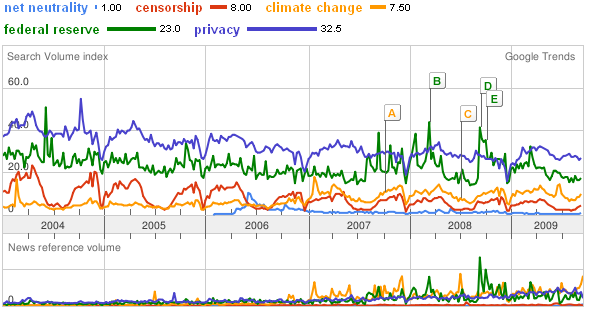 This kind of comparison should dispel once and for all the myth of a popular groundswell for net neutrality regulation—especially since online search volumes heavily over-represent the interests of the digerati, thus over-stating general interest in web-related topics.
In fact, “Net Neutrality” regulation is a
niche cause trumpeted incessantly by the blogosphere with about the same level of broad popular interest online as “housing rights”—a topic about which most of us probably don’t often fall into conversation (unless we happen to live in Bakuninist Berkeley or the Bolivarian Caliphate of Cambridge, MA, ground-zero of American Chavismo). Continue reading →
Make sure to read George Ou’s two recent articles over at the Digital Society blog setting the record straight about broadband usage caps: “Putting American Bandwidth Caps into Context” and “We Need to be Reasonable about Broadband Usage Caps.” George is one sharp cookie. I particularly like the way he takes apart Free Press for their hypocrisy on this issue, something I have commented on here before after George brought it to my attention. See:
… and here’s some older material on the issue…
In several of our previous podcasts (see episodes 34, 35,and 37), we’ve discussed what we’ve called the “Comcast Kerfuffle,” which was the controversy surrounding the steps Comcast took to manage BitTorrent traffic on its networks. Critics called it a violation of Net neutrality principles while Comcast and others called it sensible network management.
This week we saw a new kerfuffle of sorts develop over the revelation in a Monday front-page Wall Street Journal story that Google had approached major cable and phone companies and supposedly proposed to create a fast lane for its own content. What exactly is it that Google is proposing, and does it mean – as the Wall Street Journal and some others have suggested – that Google is somehow going back on their support for Net neutrality principles and regulation? More importantly, what does it all mean for the future of the Internet, network management, and consumers. That’s what we discussed on the TLF’s latest “Tech Policy Weekly” podcast.
Today’s 30-minute discussion featured two of our regular contributors at the TLF, who both wrote about this issue multiple times this week.
Cord Blomquist of the Competitive Enterprise Institute wrote about the issue here and here, and Bret Swanson of the Progress & Freedom Foundation wrote about it here and here. To help us wade through some of the more technical networking issues in play, we were also joined on the podcast by Richard Bennett, a computer scientist and network engineer guru who blogs at Broadband Politics as well as Circle ID and he also pens occasional columns for The Register. Also appearing on the show was Adam Marcus, Research Fellow & Senior Technologist at PFF, who wrote a “nuts and bolts” essay full of excellent technical background on edge caching and net neutrality.
You can download the MP3 file here, or use the online player below to start listening to the show right now.
[display_podcast]
The venerable Economist magazine has made a hash of my research on the growth of the Internet, which examines the rich media technologies now flooding onto the Web and projects Internet traffic over the coming decade. This “exaflood” of new applications and services represents a bounty of new entertainment, education, and business applications that can drive productivity and economic growth across all our industries and the world economy.
But somehow,
The Economist was convinced that my research represents some “gloomy prophesy,” that I am “doom-mongering” about an Internet “overload” that could “crash” the Internet. Where does The Economist find any evidence for these silly charges?
In a series of reports, articles (here and here), and presentations around the globe — and in a long, detailed, nuanced, very pleasant interview with The Economist, in which I thought the reporter grasped the key points — I have consistently said the exaflood is an opportunity, an embarrassment of riches.
Continue reading →
Last week I discussed Barbara Esbin’s new PFF paper about the FCC’s absurd investigation into how the cable industry is transitioning analog customers over to digital. This is an essential transition is the cable industry is going to free up bandwidth to compete against telco-provided fiber offerings in the future. The faster the cable industry can migrate its old analog TV customers over to the digital platform, the more bandwidth they can re-deploy for high-speed Net access and services. Mark Cuban helps put things in perspective:
1. the only thing that cable companies, and satellite for that matter have to sell is bandwidth and the applications they can run on that bandwith. More bandwidth means more digital everything.
2. For Basic Cable subscribers that get say, 40 analog channels, they are consuming 40 x 38.6mbs or 1.54 Gbs. Let that sink in. 1.54 Gbs of bandwidth. Compare that to how fast your internet access is. That more bandwidth than your entire neighborhood consumes online, by a lot.
Thats also the equivalent of 500 standard def digital channels. If you convert that to revenue per bit for cable companies, or cost per bit for basic cable consumers, the basic cable customers are getting the best deal in town. By a long shot.
Digital cable customers, not so much. Digital customers are paying multiples of analog customers for bandwidth. In reality, analog customers are getting an amazing deal, and the cable companies have been hesitant to convert them only because of the potential FCC backlash.
I’m as cynical as the next guy when it comes to cable rates and motivations, but the reality is that the longer analog remains, the fewer opportunities to leverage the freed up bandwidth to create next generation bandwidth hog applications. Will the cable companies charge us an a lot for that bandwidth, probably. But when we start to see applications built on top of 250mbs per second and more, it will have far more value to society than watching USA Network on your old analog TV. And Net Neutrality? Well if everyone had that 1.54gbs available to them, net neutrality would be a non issue. We wouldn’t be arguing about access or pre-emption, we would be arguing about quality of service.
Once again we are reminded that all regulations have opportunity costs and in this case the FCC’s actions could cost consumers the loss (or at least delay) of higher-speed broadband offerings in the near-term.
A new report from TeleGeography finds that bandwidth prices for backbone transit continue to decline rapidly across the globe. In San Francisco, for instance, the price per mbps of Gigabit Ethernet transit has dropped 38 % in the past 12 months. Developing countries are also enjoying substantial price cuts in 15 to 20% range.
But if the Internet’s core is controlled by an oligopolistic cartel—as Tim Wu argued in a recent New York Times essay—then why does bandwidth keep getting cheaper?
Perhaps it’s because the fourteen or so firms which offer backbone IP transit are competing fiercely to win over business from smaller carriers and enterprises. And as businesses of all sizes demand faster connectivity, more dark fiber is being lit, creating an expansion in network capacity. In DC, for instance, a price war has made high-speed commercial data services much more affordable, with one communications provider offering converged 10mbps full-duplex dedicated Ethernet over copper for less than the market price of four bonded T1 lines.
Why are some providers moving towards data transfer caps if bandwidth prices are dropping ? In part, it’s because backbone transit is not the only usage-variable expense that residential ISPs face. Last-mile bandwidth remains a highly contested resource in many neighborhoods, and the cost per megabit of bringing faster speeds to the doorstep far exceeds the cost of adding more wavelengths to a long-distance fiber optic line. As consumers demand greater speeds, providers are investing heavily in network upgrades—these costs are adding up, and there’s a strong case to be made that heavy users ought to shoulder a larger portion of the burden than light users.

 The Technology Liberation Front is the tech policy blog dedicated to keeping politicians' hands off the 'net and everything else related to technology.