PFF today released the fifth installment in our ongoing series on “The Wrong Way to Reinvent Media.” This series of papers explores various tax and regulatory proposals that would have government play an expanded role in supporting the press, journalism, or other media content. In the latest essay, Berin Szoka, Ken Ferree, and I discuss proposals for direct subsidies for failing media outlets and out-of-work journalists.
We argue taxpayer support for failing outlets and unemployed journalists implicates significant First Amendment concerns. On the whole, subsidies can make “journalists and media operators more dependent upon the State; compromise press independence and diminish public trust in the free press; and result in government discrimination in the politically inescapable dilemma of determining eligibility for subsidies.” Such an agenda would also entail huge cost to taxpayers—initially about $35 billion per year according to advocates—and would represent “a massive wealth transfer from one class of speakers to another…”
We warn that calls for seemingly beneficent bailouts “to save” the media and journalism may actually be driven by those who have something more nefarious in mind: a “post-corporate” world shorn of media capitalists, and “such radicalism must be rejected if we hope to sustain a truly free press and uphold America’s proud tradition of keeping a high and tight wall of separation between Press and State.”
The ideas within these and other essays in the series will be worked into a major PFF filing in the Federal Communications Commission’s (FCC) proceeding on the “Future of Media” on May 7. The paper may be viewed online here and I’ve attached it down below in a Scribd reader.
Continue reading →
As I’ve mentioned here previously, PFF has been rolling out a new series of essays examining proposals that would have the government play a greater role in sustaining struggling media enterprises, “saving journalism,” or promoting more “public interest” content. We’re releasing these as we get ready to submit a big filing in the FCC’s “Future of Media” proceeding (deadline is May 7th). Here’s a podcast Berin Szoka and I did providing an overview of the series and what the FCC is doing.
In the first installment of the series, Berin and I critiqued an old idea that’s suddenly gained new currency: taxing media devices or distribution systems to fund media content. In the second installment, I took a hard look at proposals to impose fees on broadcast spectrum licenses and channeling the proceeds to a “public square channel” or some other type of public media or “public interest” content.
In our latest essay, “The Wrong Way to Reinvent Media, Part 3: Media Vouchers,” Berin and I consider whether it is possible to steer citizens toward so-called “hard news” and get them to financially support it through the use of “news vouchers” or “public interest vouchers”? We argue that using the tax code to “nudge” people to support media — while less problematic than direct subsidies for the press — will likely raise serious issues regarding eligibility and be prone to political meddling. Moreover, it’s unlikely the scheme will actually encourage people to direct more resources to hard news but instead just become a method of subsidizing other content they already consume.
I’ve attached the entire essay down below.
Continue reading →
By Adam Thierer & Berin Szoka
As we mentioned yesterday, in a new series of essays, we will be examining proposals being put forward today that would have the government play a greater role in sustaining struggling media enterprises, “saving journalism,” or promoting more “public interest” content. With many traditional media operators struggling, and questions being raised about how journalism in particular will be supported in the future, Washington policymakers are currently considering what role government can and should play in helping media providers reinvent themselves in the face of tumultuous technological change wrought by the Digital Revolution. We will be releasing 6 or 7 essays on this topic leading up to our big filing in the FCC’s “Future of Media” proceeding (deadline is May 7th).
In the first installment of our series, we will critique an old idea that’s suddenly gained new currency: taxing media devices or distribution systems to fund media content. We argue that such media income redistribution is fundamentally inconsistent with American press traditions, highly problematic under the First Amendment, difficult to implement in a world of media abundance and platform convergence, and likely to cause serious negative side effects. Bottom line: Don’t tax our iPhones or broadband to subsidize media!
We’ve attached the entire text of the piece below. (Installment #2, on broadcast spectrum taxes to subsidize public media, will be released next week.)
Continue reading →
By Adam Thierer & Berin Szoka
In a series of upcoming essays, we will be examining proposals being put forward today that would have the government play a greater role in sustaining struggling media enterprises, “saving journalism,” or promoting more “public interest” content. The reason we’re working up this multi-part series is because, with many traditional media operators struggling, and questions being raised about how journalism in particular will be supported in the future, Washington policymakers are currently considering what role government can and should play in helping media providers reinvent themselves in the face of tumultuous technological change wrought by the Digital Revolution.
For example, the Federal Communications Commission (FCC) recently kicked off a new “Future of Media” effort with a workshop on “Serving the Public Interest in the Digital Era.” (The filing deadline for the FCC’s “Future of Media” proceeding is May 7th). Likewise, the Federal Trade Commission (FTC) has hosted two workshops asking “How Will Journalism Survive the Internet Age?” Meanwhile, the Senate has already held hearings about “the future of journalism,” and Senator Benjamin L. Cardin (D-MD) recently introduced the “Newspaper Revitalization Act,” which would allow newspapers to become tax-exempt non-profits in an effort to help them stay afloat.
Thus, in light of Washington’s sudden interest in the future of media and journalism, we will be taking a hard look at several issues and proposals that are being floated today, including:
- Taxes on media devices, mobile phones, or broadband bills to channel money to media enterprises / content;
- Taxes / fees on broadcasters to funnel support to their public sector competitors or to public interest programs;
- “News vouchers” or “public interest vouchers” that would encourage citizens to channel support to media providers;
- Taxes on private advertising to subsidize non-commercial / public media content;
- Expanded postal subsidies for media mail; and
- Targeted welfare programs for out-of-work journalists or corporate welfare in the form of bailouts for failing media enterprises.
You won’t be surprised to hear that we are generally quite skeptical of most of these ideas, but we promise to give each one serious consideration. We’ll kick things off tomorrow with our essay on why taxing media devices or distribution systems to fund media content is not a particularly good idea.
Here’s a brief audio clip that PFF’s new press director Mike Wendy helped me put together in which I outline some of my reservations with the Federal Communications Commission’s (FCC) just-released National Broadband Plan. It’s just 4 minutes. Just click the play button below.
[display_podcast]
It really is amazing how much the audio marketplace has evolved over the past decade. I’ve written about the growing “competition for our ears” here before, but over at the Radio Survivor blog, there’s an outstanding collection of essays about “The Decade’s Most Important Radio Trends” by several long-time industry experts. Dennis Haarsager of National Public Radio has a nice listing of all the entries over on his blog, which I have reproduced down below.
It just blows my mind to think that just 10 years ago I didn’t have satellite radio (now have 3 subscriptions); I didn’t have Pandora (my 8 different personalized channels are playing in the background on my computer non-stop); I had never heard a podcast (and now subscribe to several and have hosted one here on occasion); I didn’t have an MP3 player and had never burned any of my music (now have 3 players and my entire 25-year collection of CDs on all 3 devices); and I had never spent any time listening to music online (and now am quite in love with Lala and LastFM). Meanwhile, I am still listening to the old fashion radio quite a bit, including on a new HD Radio player in my house. You gotta love choice like that!
Anyway, read these essays for a fuller investigation into the state of the audio marketplace. I don’t agree with everything said in each of the entries but still recommend you check out the entire series:
Continue reading →
As anyone who has spent time searching for comments on the FCC’s website can tell you, the agency doesn’t exactly have the most user-friendly website. In the interest of making it easier for others to read the comments that came in last week in the agency’s “Child Safe Viewing Act” Notice of Inquiry, I have compiled all the major comments (those over 3 or 4 pages) and provided links to them below the fold.
Again, this proceeding was required under the “Child Safe Viewing Act of 2007,” which Congress passed last year and President Bush signed last December. The goal of the bill and the FCC’s proceeding (MB 09-26) is to study “advanced blocking technologies” that “may be appropriate across a wide variety of distribution platforms, including wired, wireless, and Internet platforms.” I filed 150+ pages worth of comments in this matter last week, and here’s my analysis of why this bill and the FCC’s proceeding are worth monitoring closely.
Continue reading →
Today I filed comments with the Federal Communications Commission (FCC) in its proceeding examining the marketplace for “advanced blocking technologies.” This proceeding was required under the “Child Safe Viewing Act of 2007,” which Congress passed last year and President Bush signed last December. The goal of the bill and the FCC’s proceeding (MB 09-26) is to study “advanced blocking technologies” that “may be appropriate across a wide variety of distribution platforms, including wired, wireless, and Internet platforms.” My colleagues will no doubt laugh about the fact that I have dropped an absurd 150 pages worth of comments on the FCC in this matter, but I had a lot to say on this topic! Parental controls, child safety, and free speech issues have been the focus of much of my research agenda over the past 10 years.
In my filing, I argue that the FCC should tread carefully in this matter since the agency has no authority over most of the media platforms and technologies described in the Commission’s recent Notice of Inquiry. Moreover, any related mandates or regulatory actions in in this area could diminish future innovation in this field and would violate the First Amendment rights of media creators and consumers alike. The other major conclusions of my filing are as follows:
- There exists an unprecedented abundance of parental control tools to help parents decide what constitutes acceptable media content in their homes and in the lives of their children.
- There is a trade-off between complexity and convenience for both tools and ratings, and no parental control tool is completely foolproof.
- Most homes have no need for parental control technologies because parents rely on other methods or there are no children in the home.
- The role of household media rules and methods is underappreciated and those rules have an important bearing on this debate.
- Parental control technologies work best in combination with educational efforts and parental involvement.
- The search for technological silver-bullets and “universal” solutions represent a quixotic, Holy Grail-like quest and it will destroy innovation in this marketplace.
- Enforcement of “household standards” made possible through use of parental controls and other methods negates the need for “community standards”-based content regulation.
My entire filing can be found here and down below in a Scribd reader. All comments in the matter are due tomorrow and then reply comments are due on May 18th.
Continue reading →
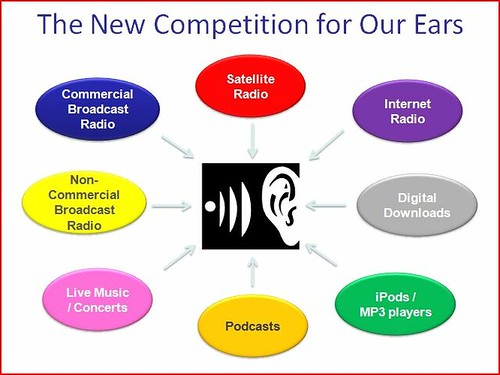
Much ink is spilled over the expanding array of video marketplace choices that are competing for the attention of our eyeballs, but much less is usually written about the competition for our ears. As this excellent new Business Week article by Olga Kharif makes clear, competition and innovation in the audio marketplace has never been more vibrant. It’s something I’ve pointed out here before and here’s a chart I created for my Media Metrics report to highlight all the new competition for our ears. We’ve come a long way since the days of my youth, when transistor radios and vinyl records were the extent of audio competition!
 Faithful readers will recall that, several months ago, I penned a 7-part “Media Metrics” series that took a hard look at the health of the media marketplace. Today, the Progress & Freedom Foundation is releasing a greatly expanded version of these essays that I have put together with my PFF colleague Grant Eskelsen. In this 100-page special report, “Media Metrics: The True State of the Modern Media Marketplace,” we begin by noting that heated debates about the state of the media marketplace continue to rage in Washington, and opinions seem to range from grim to outright apocalyptic. As we note on pg. 1:
Many people—including a large number of legislators and regulators—argue that America’s media marketplace is in a miserable state. Some claim that citizens lack choice in media outlets and that options are just as scarce as ever. Others believe that media “localism” is dead or that many groups or niches go underserved because of a lack of true “diversity” in media. Others argue that the market is hopelessly over-concentrated in the hands of a few evil media barons who are hell-bent on force-feeding us corporate propaganda. And still others say that the quality of news and entertainment in our society has deteriorated because of a combination of all of the above. It all sounds quite troubling, but is any of it true?
After taking an objective look at the true state of America’s media marketplace, we conclude that such pessimism is unwarranted. Indeed, a careful review of the facts reveals that—contrary to what those media critics suggest—we have more media choice, more media competition, and more media diversity than ever before. Indeed, to the extent there was ever a “golden age” of media in America, we are living in it today. The media sky has never been brighter and it is getting brighter with each passing year.
Continue reading →

 The Technology Liberation Front is the tech policy blog dedicated to keeping politicians' hands off the 'net and everything else related to technology.