Posts tagged as:

Corbin Barthold invited me on Tech Freedom’s “Tech Policy Podcast” to discuss the history of antitrust and competition policy over the past half century. We covered a huge range of cases and controversies, including: the DOJ’s mega cases against IBM & AT&T, Blockbuster and Hollywood Video’s derailed merger, the Sirius-XM deal, the hysteria over the AOL-Time Warner merger, the evolution of competition in mobile markets, and how we finally ended that dreaded old MySpace monopoly!

What does the future hold for Google, Facebook, Amazon, and Netflix? Do antitrust regulators at the DOJ or FTC have enough to mount a case against these firms? Which case is most likely to have legs?

Corbin and I also talked about the of progress more generally and the troubling rise of more and more Luddite thinking on both the left and right. I encourage you to give it a listen:

If there is one thing I have learned in almost 23 years of covering communications and media regulation it is this: No matter how well-intentioned, regulation often has unintended consequences that hurt the very consumers the rules are meant to protect. Case in point: “universal service” mandates that require a company to serve an entire area as a condition of offering service at all. The intention is noble: Get service out to everyone in the community, preferably at a very cheap rate. Alas, the result of mandating that result is clear: You get less competition, less investment, less innovation, and less consumer choice. And often you don’t even get everyone served.

Consider this Wall Street Journal article today, “Google Fiber Is Fast, but Is It Fair? The Company Provides Neighborhoods With Faster and Cheaper Service, but Are Some Being Left Behind?” In the story, Alistair Barr notes that:

U.S. policy long favored extending service to all. AT&T touted its “universal service” in advertisements more than a century ago. The concept was codified in a 1934 law requiring nationwide “wire and radio services” to reach everyone at “reasonable charges.” In exchange for wiring a community, telecommunications providers often gained a monopoly. Cities made similar deals with cable-TV providers beginning in the 1960s.

The problem, of course, is that while this model allowed for the slow spread of service to most communities, it came at a very steep cost: Monopoly and plain vanilla service. I documented this in a 1994 essay entitled, “Unnatural Monopoly: Critical Moments in the Development of the Bell System Monopoly.” As well-intentioned regulatory mandates started piling up, competition slowly disappeared. And a devil’s deal was eventually cut between regulators and AT&T to adopt the company’s advertising motto — “One Policy, One System, Universal Service” — as the de facto law of the land. Continue reading →

Call it what you want: a bailout, a thumb on the scales, bidder restrictions–the FCC might conspicuously intervene in the 2015 incentive auctions at the behest of smaller carriers and public interest advocates.

Chairman Wheeler’s recent comments indicate the FCC may devise a way to prevent the largest two carriers–AT&T and Verizon–from purchasing “too much” of the television broadcasters’ spectrum at auction. AT&T likely sees the writing on the wall and argues that if there are auction limits, the restrictions should apply only to the auction, rather than more extreme restrictions that would penalize AT&T and Verizon, the largest carriers, for previously-acquired spectrum. As The Switch’s Brian Fung put it,

the small carriers favor what are called “asymmetric” spectrum caps that affect various carriers differently, while opponents prefer “symmetric” caps that don’t account for existing market positions.

While I wish AT&T put up more of a fight to auction interventions, they (and staff at the FCC) are handicapped in pursuing an unrestricted auction. The blame lies mostly with Congress who gave the FCC vague (thus ripe for abuse) and conflicting mandates spanning decades. The 1993 law authorizing auctions, for instance, requires the FCC to “avoid[] excessive concentration of licenses” and to “disseminat[e] licenses among a wide variety of applicants” among other regulatory carve-outs for smaller competitors. These latter requirements, if implemented as rigorously as smaller carriers would like, directly undermine the purpose of the 2012 American Taxpayer Relief Act that requires the upcoming spectrum auctions raise $7 billion for a public safety broadband network and $20 billion for deficit reduction.

By asymmetrically penalizing AT&T and Verizon, the FCC increases the probability the auction fails to raise the tens of billions of dollars needed (see Fred Campbell’s recent paper). I haven’t heard a policymaker speak about the incentive auction without remarking how extraordinarily complex it is. That complexity–as was made clear in this week’s Senate hearing on the subject–means no one knows how much spectrum will be auctioned off or how much money will be raised. I was doubtful the FCC would secure the called-for 120 MHz for auction in the first place, but the Senate hearing convinced me that they might not get even 60 MHz. If the FCC meddles too much and the broadcasters aren’t assured they’ll get top dollar for their spectrum, the broadcasters might not show up to sell.

For many reasons, the FCC should ignore the pressures to restrict the large carriers in bidding. Smaller carriers argue the large carriers will outbid them only to preclude competition and hoard the spectrum. Every major carrier is spending billions to expand its footprint and capacity rapidly so the hoarding argument is hard to accept (not to mention, carriers face FCC build out requirements). The hoarding argument also confounds me because AT&T and Verizon are at the forefront arguing for more spectrum auctions, particularly spectrum from federal agencies. Would they want the market flooded with new spectrum only so they could spend billions to hoard it?

Asymmetric auction restrictions also resemble a bailout for smaller carriers. T-Mobile and Sprint–who most actively lobby for auction restrictions–are not mom-and-pop establishments. Each is a sophisticated, powerful corporation with access to capital markets and backed by larger international telecoms–Germany’s Deutsche Telekom for T-Mobile and Japan’s SoftBank for Sprint. DT and SoftBank have both pledged to spend billions in the next few years to improve their American carrier’s competitive position. Such carriers do not need an FCC handout.

The bailout resemblance is more apparent when you realize Sprint has been hamstrung for nearly a decade with damaging business decisions. Three come immediately to mind: 1) the dreadful merger with Nextel in 2005; 2) the ill-fated bet in 2008 to forgo LTE rollout in favor of WiMax, a competing 4G standard; and 3) the loss of over one million customers when it discontinued its push-to-talk iDEN service for network upgrades. The losses from the Nextel merger alone approach $30 billion.

To be clear, I don’t second-guess Sprint’s decisions. They did what innovative firms are supposed to do in attempting big, risky investments. However, it should not be the job of the FCC to favor some firms through spectrum auctions because some carriers’ business decisions did not pan out. That is not a competitive wireless auction–that is an FCC-orchestrated bailout. Granted, the FCC has been handed conflicting mandates. The Commission has ample discretion, however, to conduct a competitive auction that both complies with the law and improves chances of reaching the ambitious revenue goals. Intense meddling with auction results could prove disastrous.

Last week, the House held a hearing about the so-called IP Transition. The IP Transition refers to the telephone industry practice of carrying all wire-based consumer services–voice, Internet, and television–via faster, better fiber networks and not on the traditional copper wires that had fewer capabilities. Most consumers have not and will not notice the change. The completed IP Transition, however, has enormous implications for how the FCC regulates. As one telecom watcher said, “What’s at stake? Everything in telecom policy.”

For 100 years or so, phone service has had a special place in regulatory law given its importance in connecting the public. Phone service was almost exclusively over copper wires, a service affectionately called “plain old telephone service” (POTS). AT&T became the government-approved POTS national monopolist in 1913 (which ended with the AT&T antitrust breakup in the 1980s). The deal was: AT&T got to be a protected monopolist while the government got to require AT&T provide various public benefits. The most significant of these is universal service–AT&T had to serve virtually every US household and charge reasonable rates even to remote (that is, expensive) customers.

To create more phone competitors to the Baby Bells–the phone companies spun off from the AT&T break-up in the 1980s–the Congress passed the 1996 Telecom Act and the FCC put burdens on the Baby Bells to allow new phone companies to lease the Baby Bells’ AT&T-created copper wires at regulated rates. The market changed in ways never envisioned in the 1990s however. Today, phone companies face competition–not from the new phone companies leasing the old monopoly infrastructure but from entirely different technologies. You can receive voice service from your cable company (“digital voice”), your “phone” company (POTS), your wireless company, and even Internet-based providers like Vonage and Skype. Increasingly, households are leaving POTS behind in favor of voice service from cable or wireless providers. Yet POTS providers–like Verizon and AT&T (which also offer wireless service)–must abide by monopoly-era regulations that their cable and wireless competitors–Comcast, Sprint, and others–don’t have to abide by.

Understanding the significance of the IP Transition requires (unfortunately) knowing a little bit about Title I and Title II of the Communications Act. “Telecommunications services,” which are the phone companies with copper networks, are heavily regulated by the FCC under Title II. On the other hand, “information services,” which includes Internet service, are lightly regulated under Title I. This division made some sense in the 1990s. It is increasingly under stress now because burdened “telecommunications” companies like AT&T and Verizon are offering “information services” like Internet via DSL, FiOS, and U-Verse. Conversely, lightly-regulated “information services” companies like Comcast, Charter, and Time-Warner Cable are entering the regulated telephone market but face few of the regulatory burdens.

Which brings us to the IP Transition. As Title II phone companies replace their copper wires with fiber and deploy broadband networks to compete with cable companies, their customers’ phone service is being carried via IP packets. Functionally, these new networks act like a heavily-regulated Title II service since they carry voice, but they also act like the Title I broadband networks that cable providers built. So should these new fiber networks be burdened like Title II services or deregulated like Title I services? Or is it possible to achieve some middle ground using existing law? Those are the questions before the FCC and policymakers. Billions of dollars of investment will be accelerated or slowed and many firms will live or die depending on how the FCC and Congress act. Stay tuned.

Over at The Switch, the Washington Post’s excellent new technology policy blog, Brian Fung has an interesting post about tethering and Google Glass, but I think he perpetuates a common misconception:

Carriers have all sorts of rules about tethering, and sorting through them can be like feeling your way down a dark alley. Verizon used to charge $20 a month for tethering before the FCC ruled it had to allow tethering for free. Now, any data you use comes out of your cellular plan’s overall data allowance. AT&T gives you a separate pool of data for tethering plans, but charges up to $50 a month for the right, much as Verizon once did.

Fung claims that due to the likely increase in tethering as devices like Google Glass come to market, “assuming the FCC didn’t require all wireless carriers to make tethering free, it’d be a huge source of potential revenue for companies like AT&T.”

In fact, the cost of tethering on AT&T is not very different from the cost of doing so on Verizon, which means by definition that AT&T is not likely to get a windfall from increased use of tethering. It’s also evidence that the FCC tethering rule for Verizon doesn’t matter very much.

Continue reading →

Jerry Ellig, senior research fellow at the Mercatus Center at George Mason University, discusses the the FCC’s lifeline assistance benefit funded through the Universal Service Fund (USF). The program, created in 1997, subsidizes phone services for low-income households. The USF is not funded through the federal budget, rather via a fee from monthly phone bills — reaching an all-time high of 17% of telecomm companies’ revenues last year. Ellig discusses the similarities between the USF fee and a tax, how the fee fluctuates, how subsidies to the telecomm industry have boomed in recent years, and how to curb the waste, fraud and abuse that comes as a result of the lifeline assistance benefit.

Download

Related Links

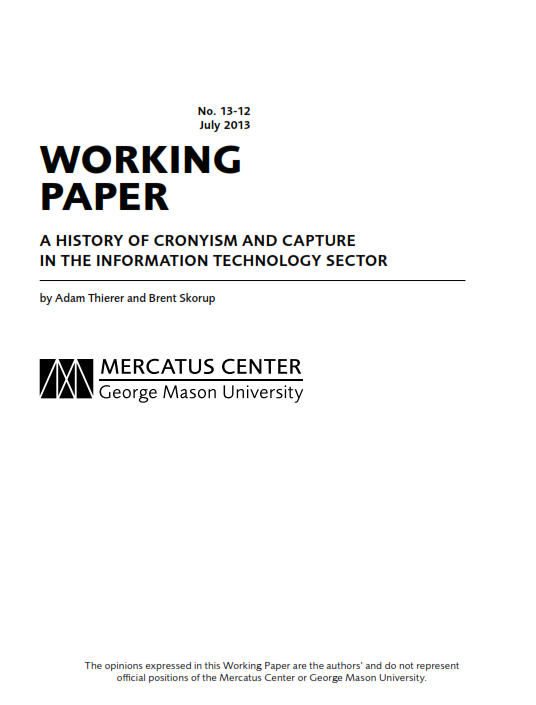
WP coverThe Mercatus Center at George Mason University has just released a new paper by Brent Skorup and me entitled, “A History of Cronyism and Capture in the Information Technology Sector.” In this 73-page working paper, which we hope to place in a law review or political science journal shortly, we document the evolution of government-granted privileges, or “cronyism,” in the information and communications technology marketplace and in the media-producing sectors. Specifically, we offer detailed histories of rent-seeking and regulatory capture in: the early history of the telephony and spectrum licensing in the United States; local cable TV franchising; the universal service system; the digital TV transition in the 1990s; and modern video marketplace regulation (i.e., must-carry and retransmission consent rules, among others.

Our paper also shows how cronyism is slowly creeping into new high-technology sectors.We document how Internet companies and other high-tech giants are among the fastest-growing lobbying shops in Washington these days. According to the Center for Responsive Politics, lobbying spending by information technology sectors has almost doubled since the turn of the century, from roughly $200 million in 2000 to $390 million in 2012.  The computing and Internet sector has been responsible for most of that growth in recent years. Worse yet, we document how many of these high-tech firms are increasingly seeking and receiving government favors, mostly in the form of targeted tax breaks or incentives. Continue reading →

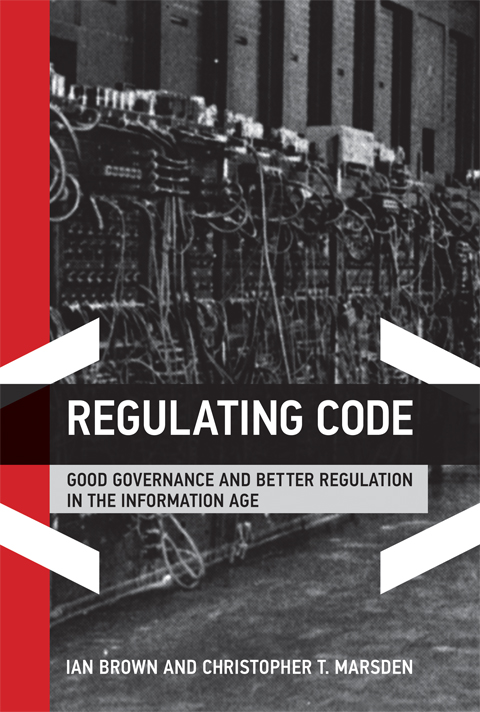
Regulating Code book coverIan Brown and Christopher T. Marsden’s new book, Regulating Code: Good Governance and Better Regulation in the Information Age, will go down as one of the most important Internet policy books of 2013 for two reasons. First, their book offers an excellent overview of how Internet regulation has unfolded on five different fronts: privacy and data protection; copyright; content censorship; social networks and user-generated content issues; and net neutrality regulation. They craft detailed case studies that incorporate important insights about how countries across the globe are dealing with these issues. Second, the authors endorse a specific normative approach to Net governance that they argue is taking hold across these policy arenas. They call their preferred policy paradigm “prosumer law” and it envisions an active role for governments, which they think should pursue “smarter regulation” of code.

In terms of organization, Brown and Marsden’s book follows the same format found in Milton Mueller’s important 2010 book Networks and States: The Global Politics of Internet Governance; both books feature meaty case studies in the middle bookended by chapters that endorse a specific approach to Internet policymaking. (Incidentally, both books were published by MIT Press.) And, also like Mueller’s book, Brown and Marsden’s Regulating Code does a somewhat better job using case studies to explore the forces shaping Internet policy across the globe than it does making the normative case for their preferred approach to these issues. Continue reading →

Declan McCullagh, chief political correspondent for CNET and former Washington bureau chief for Wired News, discusses recent leaks of NSA surveillance programs. What do we know so far, and what more might be unveiled in the coming weeks? McCullagh covers legal challenges to the programs, the Patriot Act, the fourth amendment, email encryption, the media and public response, and broader implications for privacy and reform.

Download

Related Links


Today, AT&T announced they had abandoned their planned acquisition of T-Mobile after the DOJ sued to block the deal and the FCC published a report sharply critical of the deal. The following statement can be attributed to TechFreedom Fellows Larry Downes, Geoffrey Manne and Berin Szoka:

Nearly two years ago, the Obama FCC declared a spectrum crisis. But Congress has refused to authorize the agency to reallocate underused spectrum from television broadcasters and government agencies—which would take years anyway. The AT&T/T-Mobile merger would have eased this crisis and accelerated the deployment of next-generation 4G networks. The government killed the deal based on formalistic and outdated measures of market concentration—even though the FCC’s own data show dynamic competition, falling prices, and new entry. The disconnect is jarring. Those celebrating the deal’s collapse will wake up to a sober reality: There is no Plan B for more spectrum. All the hand-wringing about “preserving” competition has only denied consumers a strong 4G LTE competitor to compete with Verizon—and slammed the brakes on continued growth of the mobile marketplace. Unfortunately, this is just part of a broader pattern of regulators attempting to engineer technology markets they don’t understand. The letter sent today by the Senate Antitrust Subcommittee urging the Department of Justice to investigate Google’s business practices relies on similar contortions of market definition to conclude that the search market is not competitive. In both cases, regulators are applying 1960s economics to 21st century markets. Ultimately, it’s consumers who will lose from such central planning.