Interoperability is a topic that has long been of interest to me. How networks, platforms, and devices work with each other–or sometimes fail to–is an important engineering, business, and policy issue. Back in 2012, I spilled out over 5,000 words on the topic when reviewing John Palfrey and Urs Gasser’s excellent book, Interop: The Promise and Perils of Highly Interconnected Systems.
I’ve always struggled with the interoperability issues, however, and often avoided them became of the sheer complexity of it all. Some interesting recent essays by sci-fi author and digital activist Cory Doctorow remind me that I need to get back on top of the issue. His latest essay is a call-to-arms in favor of what he calls “adversarial interoperability.” “[T]hat’s when you create a new product or service that plugs into the existing ones without the permission of the companies that make them,” he says. “Think of third-party printer ink, alternative app stores, or independent repair shops that use compatible parts from rival manufacturers to fix your car or your phone or your tractor.”
Doctorow is a vociferous defender of expanded digital access rights of many flavors and his latest essays on interoperability expand upon his previous advocacy for open access and a general freedom to tinker. He does much of this work with the Electronic Frontier Foundation (EFF), which shares his commitment to expanded digital access and interoperability rights in various contexts.
I’m in league with Doctorow and EFF on some of these things, but also find myself thinking they go much too far in other ways. At root, their work and advocacy raise a profound question: should there be any general right to exclude on digital platforms? Although he doesn’t always come right out and say it, Doctorow’s work often seems like an outright rejection of any sort of property rights in networks or platforms. Generally speaking, he does not want the law to recognize any right for tech platforms to exclude using digital fences of any sort. Continue reading →
In the latest example of big government run amok, several politicians think they ought to be in charge of which applications you should be able to install on your smartphone.
On March 22, four U.S. Senators sent a letter to Apple, Google, and Research in Motion urging the companies to disable access to mobile device applications that enable users to locate DUI checkpoints in real time. Unsurprisingly, in their zeal to score political points, the Senators—Harry Reid, Chuck Schumer, Frank Lautenberg, and Tom Udall—got it dead wrong.
Had the Senators done some basic fact-checking before firing off their missive, they would have realized that the apps they targeted actually
enhance the effectiveness
of DUI checkpoints while reducing their intrusiveness. And had the Senators glanced at the Constitution – you know, that document they swore an oath to support and defend – they would have seen that sobriety checkpoint apps are almost certainly protected by the First Amendment.

While Apple has stayed mum on the issue so far, Research in Motion quickly yanked the apps in question. This is understandable; perhaps RIM doesn’t wish to incur the wrath of powerful politicians who are notorious for making a public spectacle of going after companies that have the temerity to stand up for what is right.
Google has refused to pull the DUI checkpoint finder apps from the Android app store, reports Digital Trends. Google’s steadfastness on this matter reflects well on its stated commitment to free expression and openness. Not that Google’s track record is perfect on this front – it’s made mistakes from time to time – but it’s certainly a cut above several of its competitors when it comes to defending Internet freedom. Continue reading →
Oh yeah, that was me. And a lot of others. Well, we were wrong. The mobile app store market (Apple, Android, etc) is brimming with a bonanza of micro-business opportunities for producers and consumers alike. I am consistently amazing by the range of offerings available today, the vast majority of which remain free of charge. But what is more impressive is the growing array of applications and games available for mere pennies. Sure, some are more than a buck — but not that much more. I was just looking through the 40+ apps that I’ve got on my Droid right now (not really sure how many I’ve downloaded overall since I’ve deleted a lot) and I would guess that I paid for at least 25% of them–many after being “upsold” by first trying the free versions and then buying. Yes, I know there continues to be a debate about what counts as a “micropayment,” but the fact that so many more people are paying just a couple of bucks or less for content in these mobile app stores suggests that its only going to easier for people to pay even smaller sums for content in coming years.
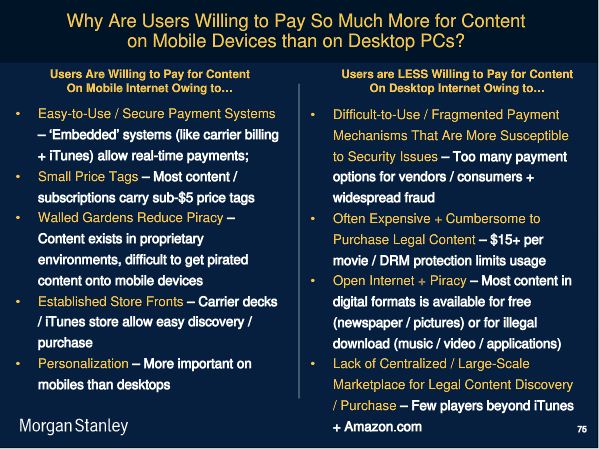
What got me thinking about all this was slide #75 in Mary Meeker’s latest slideshow about Internet trends. The Morgan Stanley web guru notes that users are more willing to pay for content on mobile devices than they are on desktop computers for a number of reasons, but the first of which she listed was: “Easy-to-Use/Secure Payment Systems — embedded systems like carrier billing and iTunes allow real-time payment.” The important point here is that the combination of these slick, well-organized online app stores + secure, super-easy billing systems have combined to overcome the so-called”mental transaction cost problem,” at least to some extent. We’re not nearly as reluctant today to surf away when something says “$0.99” on our screen. Increasingly, we’re hitting the “Buy” button.
 Continue reading →
Oh my, here we go again with bogus accusations of “censorship” flying about a private company’s efforts to self-regulate its own media platform. Yesterday over at Silicon Alley Insider, Nick Saint penned a piece on how, “Apple’s War On Porn Is Just Getting Started.” And then over at TechCrunch, Jason Kincaid wrote about “Why Apple’s New Ban Against Sexy Apps Is Scary.” That yielded a flurry of similarly-titled rants about Apple’s supposedly totalitarian ways for taking away our new-found inalienable human right to unfettered porn and adult entertainment applications via our iPhones. To Mr. Saint, Mr. Kincaid, and the many others who apparently believe Apple is the reincarnation of Big Brother for self-regulating their own Apps Store, all I can say is: Grow up!
Here are a few things they need to consider:
- What Apple decides to do with its application store, and what it chooses to provide in it, is Apple’s own business—quite literally. Like a traditional bricks-and-mortar retailer, they can make policies about what types of content might be deemed too sensitive for the broad community of customers they serve. WalMart, for example, doesn’t carry certain types of music in their stores. If customers don’t like what those retailers are doing, there’s always another place for them to take their business and find what they are looking for.
- When it comes to the Apple controversy, we are generally talking about porn. Note to Mr. Saint and Mr. Kincaid and other whiners… there are plenty of other places to find porn on the Net! Seriously, have you looked?
- A private company’s decision to self-censor by not carrying something in their store is not even in the same universe as the sort of censorship we see government officials engage in, which blocks all content from all platforms. There is no escape from that sort of all-encompassing censorship. Continue reading →
Just when you thought the FCC’s investigation of the wireless industry couldn’t get any stranger, TechCrunch reports that the Commission has sent letters to AT&T, Apple, and Google inquiring about Apple’s recent decision to reject the Google Voice app from the iPhone App Store (as Berin discussed yesterday).
It’s been over two years since the original iPhone was launched, but it seems the FCC still doesn’t get it: the iPhone is very clearly a closed platform — a prototypical walled garden — and Apple has the final say on what applications users can install. When you buy an iPhone, you’re not simply buying a piece of hardware, but actually a package deal that includes software, hardware, and a wireless contract. Is this anti-consumer? 26 million consumers don’t think so. The iPhone 3GS, the latest version of the phone, is selling so fast that Apple’s CFO says they can’t make enough to meet demand!
Of course, the iPhone model isn’t for everyone. I, for one, don’t own one because I’m an obsessive tinkerer and prefer a phone that’s as open as possible. But not everyone shares my preferences. As mentioned above, over 26 million iPhones have been sold since June 2007, so openness clearly isn’t make-or-break for a lot of consumers. Who knows, maybe some people actually trust Apple and like the comfort of knowing that every app they can get comes with a seal of approval from Cupertino.
The FCC’s letter to Apple demands an explanation for why Google Voice was rejected. If Apple’s explanation doesn’t satisfy the FCC’s criteria — which, by the way, are entirely unclear — then what? Will the FCC force Apple to accept Google Voice? Say what you will about Apple’s app store track record, but the prospect of federal regulators having the final word on which applications smartphone owners can install hardly seems pro-consumer. The FCC can’t even figure out how to run its own website!
In some ways, the iPhone has perhaps been too successful for its own good. It’s so popular that many consumers seem to no longer view it as just another product but instead as an item to which they are entitled. Thus, bureaucrats and Congresscritters in search of political points are making a big fuss over the fact that the iPhone isn’t everything to everyone. Why can’t it be wide open? Why isn’t in available on every carrier nationwide? Why is it so expensive to purchase without a service contract?
Continue reading →

 The Technology Liberation Front is the tech policy blog dedicated to keeping politicians' hands off the 'net and everything else related to technology.