Patrick Byrne, CEO of Overstock.com, discusses how Overstock.com became one of the first online retail stores to accept Bitcoin. Byrne provides insight into how Bitcoin lowers transaction costs, making it beneficial to both retailers and consumers, and how governments are attempting to limit access to Bitcoin. Byrne also discusses his project DeepCapture.com, which raises awareness for market manipulation and naked short selling, as well as his philanthropic work and support for education reform.
Download
Related Links
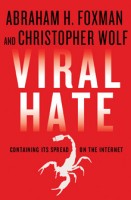 The Internet’s greatest blessing — its general openness to all speech and speakers — is also sometimes its biggest curse. That is, you cannot expect to have the most widely accessible, unrestricted communications platform the world has ever known and not also have some imbeciles who use it to spew insulting, vile, and hateful comments.
It is important to put things in perspective, however. Hate speech is not the norm online. The louts who spew hatred represent a small minority of all online speakers. The vast majority of online speech is of a socially acceptable — even beneficial — nature.
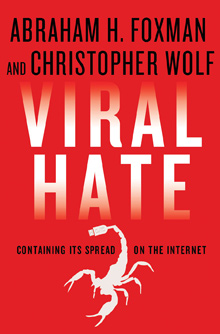
Still, the problem of hate speech remains very real and a diverse array of strategies are needed to deal with it. The sensible path forward in this regard is charted by Abraham H. Foxman and Christopher Wolf in their new book, Viral Hate: Containing Its Spread on the Internet. Their book explains why the best approach to online hate is a combination of education, digital literacy, user empowerment, industry best practices and self-regulation, increased watchdog / press oversight, social pressure and, most importantly, counter-speech. Foxman and Wolf also explain why — no matter how well-intentioned — legal solutions aimed at eradicating online hate will not work and would raise serious unintended consequences if imposed.
In striking this sensible balance, Foxman and Wolf have penned the definitive book on how to constructively combat viral hate in an age of ubiquitous information flows. Continue reading →
Parmy Olson, London Bureau chief for Forbes, discusses her new book We are Anonymous: Inside the Hacker World of Lulzsec, Anonymous and the Global Cyber Insurgency. The book is an inside look at the people behind Anonymous, explaining the movement’s origins as a group of online pranksters, and how they developed into the best known hacktivist organization in the world. Olson discusses the tension that has existed between those that would rather just engage in pranks and those that want to use Annoymous to protest different groups they see as trying to clamp down on internet freedom, as well as some of the group’s most famous campaigns like the attacks against the Church of Scientology and the campaign against Paypal and Mastercard. Olson also describes the development of LulzSec which became famous for a series of attacks in 2011 on high profile websites including Fox, PBS, Sony, and the CIA.
Download
 In a post earlier this week, I discussed Randy Cohen’s “guideline” for anonymous blogging. Specifically, Cohen argued in a recent New York Times piece that, “The effects of anonymous posting have become so baleful that it should be forsworn unless there is a reasonable fear of retribution. By posting openly, we support the conditions in which honest conversation can flourish.” While sympathetic to that guideline, I noted I agreed with it as an ethical principle, not a legal matter. In others words, what might make sense as a “best practice” for the Internet and its users would not make sense as a regulatory standard. I prefer using social norms and public pressure to drive these standards, not regulation that could have an unintended chilling effect on beneficial forms of anonymous online speech.
Dan Gillmor of the Center for Citizen Media of the Harvard Berkman Center has a new column up at the UK Guardian in which he takes a slightly different cut at a new standard or social norm for dealing with some of the more caustic anonymous speech out there:
One of the norms we’d be wise to establish is this: People who don’t stand behind their words deserve, in almost every case, no respect for what they say. In many cases, anonymity is a hiding place that harbours cowardice, not honour. The more we can encourage people to use their real names, the better. But if we try to force this, we’ll create more trouble than we fix. But we don’t want, in the end, to turn everything over to the lawyers. The rest of us — the audience, if you will — need to establish some new norms as well.
Specifically, Gillmor argues that, ” We need to readjust our internal BS meters in a media-saturated age,” because “We are far too prone to accepting what we see and hear.” I think Gillmor has too little faith in most digital denizens; most of us take anonymous comments with a grain of salt and assume that the ugliest of those comments are often untrue. And that’s generally the “principle” he recommends each of us adopt going forward: Continue reading →
 Randy Cohen, who pens “The Ethicist” column for The New York Times Magazine, wrote this week about the “skank case,” or the controversy surrounding the recent legal outing for an anonymous blogger who called fashion model Liskula Cohen a “psychotic, lying, whoring … skank.” Thanks to a recent court decision, we now know that the blogger who uttered those words is Rosemary Port, a 29-year-old Fashion Institute of Technology student. And she now apparently plans to sue Google for revealing her identity to the court. [As a shameful aside, can I just say that there has never been a nerdy Internet legal battle that involved two more smokin’ hot women than this! Sorry, I couldn’t resist pointing out the obvious.]
 Reflecting on this catfight in his NY Times Magazine editorial, “Is It O.K. to Blog About This Woman Anonymously?” Randy Cohen asks:
Has anonymous posting, though generally protected by law, become so toxic that it should be discouraged? It has. To promote the social good of lively conversation and the exchange of ideas, transparency should be the default mode. […]
Here is a guideline. The effects of anonymous posting have become so baleful that it should be forsworn unless there is a reasonable fear of retribution. By posting openly, we support the conditions in which honest conversation can flourish.
But Mr. Cohen never specifies whether he is talking about an
ethical guideline or a legal guideline. There is a world of difference, of course. As a matter of social or personal ethics, I think many of us would agree that anonymity “should be forsworn” and we should encourage people to “post openly.” I always live by that rule myself when blogging or posting comments on other sites, whether they are blogs, discussion boards, or even shopping sites. But that is my choice. I would not want that choice forced by law upon others. Continue reading →
The Wired article (“Great Wall of Facebook: The Social Network’s Plan to Dominate the Internet — and Keep Google Out“) I discussed yesterday touched on another issue near & dear to my heart (besides the importance of smarter advertising): the future of online anonymity. The article lays out Facebook’s “4-Step Plan for Online Domination,” which involves “colonizing” the web though Facebook’s Connect (launched Dec. 2008) and Open Stream API (launched April 2009) initiatives, which:
don’t just allow users to access their Facebook networks from anywhere online. They also help realize Facebook’s longtime vision of giving users a unique, Web-wide online profile. By linking Web activity to Facebook accounts, they begin to replace the largely anonymous “no one knows you’re a dog” version of online identity with one in which every action is tied to who users really are.
To hear Facebook executives tell it, this will make online interactions more meaningful and more personal.
Imagine, for example, if online comments were written by people using their real names rather than by anonymous trolls. “Up until now all the advancements in technology have said information and data are the most important thing,” says Dave Morin, Facebook’s senior platform manager. “The most important thing to us is that there is a person sitting behind that keyboard. We think the Internet is about people.”
The bolded prediction of what I would call “Online Identity Integration” is already happening. To take one tiny example, readers can now post comments on the TLF by logging into Disqus (our Comment Management System) through their Facebook (or Twitter) account, which will also allow them to automatically share those comments on Facebook (or Twitter). This is purely opt-in: Users are free to continue to post anonymous comments. But as more websites and platforms implement such Identity Integration functionality, a growing percentage of online speech will be tied to profiles offered by major social networks.
Some free speech advocates are sure to bemoan Identity Integration as directly undermining online anonymity. Continue reading →
Doug Feaver, a former Washington Post reporter and editor, has published a very interesting editorial today entitled “Listening to the Dot-Commenters.” In the piece, Feaver discusses his personal change of heart about “the anonymous, unmoderated, often appallingly inaccurate, sometimes profane, frequently off point and occasionally racist reader comments that washingtonpost.com allows to be published at the end of articles and blogs.” When he worked at the Post, he fought to keep anonymous and unmoderated comments off the WP.com site entirely because it was too difficult to pre-screen them all and “the bigger problem with The Post’s comment policy, many in the newsroom have told me, is that the comments are anonymous. Anonymity is what gives cover to racists, sexists and others to say inappropriate things without having to say who they are.”
But Feaver now believes those anonymous, unmoderated comment have value because:
I believe that it is useful to be reminded bluntly that the dark forces are out there and that it is too easy to forget that truth by imposing rules that obscure it. As Oscar Wilde wrote in a different context, “Man is least in himself when he talks in his own person. Give him a mask, and he will tell you the truth.” Too many of us like to think that we have made great progress in human relations and that little remains to be done. Unmoderated comments provide an antidote to such ridiculous conclusions. It’s not like the rest of us don’t know those words and hear them occasionally, depending on where we choose to tread, but most of us don’t want to have to confront them.
It seems a bit depressing that the best argument in favor of allowing unmoderated, anonymous comments is that it allows us to see the dark underbelly of mankind, but the good news, Feaver points out, is that:
But I am heartened by the fact that such comments do not go unchallenged by readers. In fact, comment strings are often self-correcting and provide informative exchanges. If somebody says something ridiculous, somebody else will challenge it. And there is wit.
He goes on to provide some good examples. And he also notes how unmoderated comments let readers provide their heartfelt views on the substance of sensitive issues and let journalists and editorialists know how they feel about what is being reported or
how it is being reported. “We journalists need to pay attention to what our readers say, even if we don’t like it,” he argues. “There are things to learn.”
Continue reading →



 The Technology Liberation Front is the tech policy blog dedicated to keeping politicians' hands off the 'net and everything else related to technology.
Anonymity, Reader Comments & Section 230
by Adam Thierer on April 9, 2009 · 18 comments
Doug Feaver, a former Washington Post reporter and editor, has published a very interesting editorial today entitled “Listening to the Dot-Commenters.” In the piece, Feaver discusses his personal change of heart about “the anonymous, unmoderated, often appallingly inaccurate, sometimes profane, frequently off point and occasionally racist reader comments that washingtonpost.com allows to be published at the end of articles and blogs.” When he worked at the Post, he fought to keep anonymous and unmoderated comments off the WP.com site entirely because it was too difficult to pre-screen them all and “the bigger problem with The Post’s comment policy, many in the newsroom have told me, is that the comments are anonymous. Anonymity is what gives cover to racists, sexists and others to say inappropriate things without having to say who they are.”
But Feaver now believes those anonymous, unmoderated comment have value because:
It seems a bit depressing that the best argument in favor of allowing unmoderated, anonymous comments is that it allows us to see the dark underbelly of mankind, but the good news, Feaver points out, is that:
He goes on to provide some good examples. And he also notes how unmoderated comments let readers provide their heartfelt views on the substance of sensitive issues and let journalists and editorialists know how they feel about what is being reported or how it is being reported. “We journalists need to pay attention to what our readers say, even if we don’t like it,” he argues. “There are things to learn.”
Continue reading →