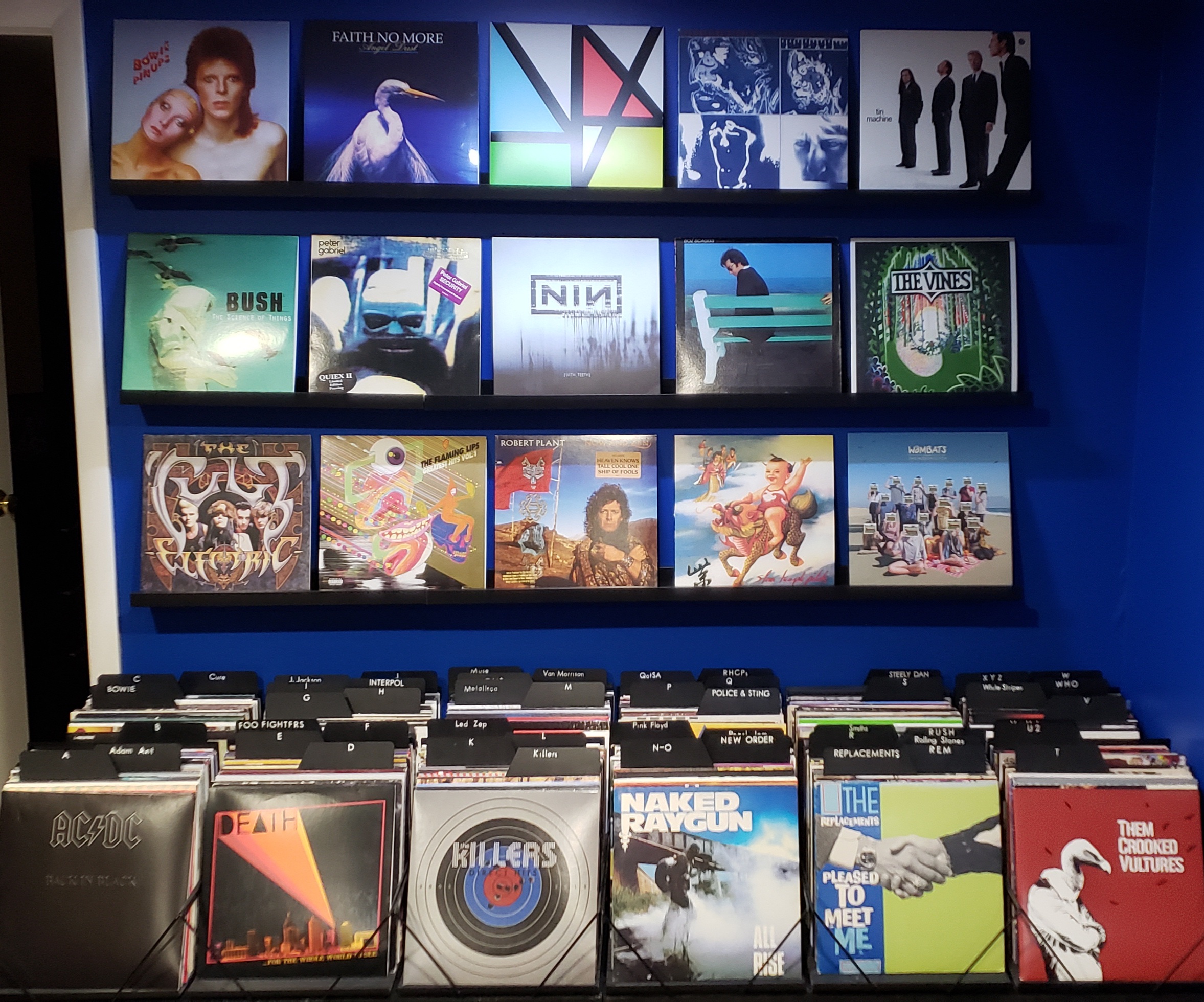
What explains the rebirth of analog era media? Many people (including me!) predicted that vinyl records, turntables, broadcast TV antennas and even printed books seemed destined for the dustbin of technological history. We were so wrong, as I note in this new oped that has gone out through the Tribune Wire Service.
“Many of us threw away our record collections and antennas and began migrating from physical books to digital ones,” I note. “Now, these older technologies are enjoying a revival. What explains their resurgence, and what’s the lesson?”
I offer some data about the rebirth of analog era media as well as some possible explanations for their resurgence. “With vinyl records and printed books, people enjoy making a physical connection with the art they love. They want to hold it in their hands, display it on their wall and show it off to their friends. Digital music or books don’t satisfy that desire, no matter how much more convenient and affordable they might be. The mediums still matter.”
Read more here. Meanwhile, my own personal vinyl collection continues to grow without constraint! …
I cannot in strong enough terms recommend that everyone read Gordon Crovitz’s latest Wall Street Journal column, “Free Speech, Now that Speech is Free.” It perfectly encapsulates everything we stand for here and makes the case that I have made again and again: Speech regulation — of all flavors — makes less and less sense in a world of information abundance and user empowerment, and it is a complete affront to our First Amendment rights. As Crovitz argues:
The Constitution was drafted at a time when there were few media outlets, and few people could be heard. Since then, technology has made it possible for everyone to express their views. The cost of expressing opinions continues to fall. Now that speech is no longer expensive, it’s time to return to the Founders’ intention that speech be free and that Congress not abridge anyone’s right to speak.
Amen brother! In his essay today, Crovitz specifically takes on America’s increasingly insane campaign finance laws, which make a mockery of the First Amendment. In the wake of last week’s Supreme Court arguments in the Citizens United case, Crovitz points out the insulting stupidity and sheer futility of these analog era, scarcity-oriented laws:
Today, it was my great privilege to guest lecture at Princeton University’s Center for Information Technology Policy. Under the leadership of Ed Felten, who also runs the excellent “Freedom to Tinker” blog, the CITP has quickly become one of America’s premier institutions in the field of IT policy matters. David Robinson, who some of you will remember from his days as an editor at The American, serves as associate director of the CITP program and was kind enough to invite me to speak. And our own Tim Lee is currently studying there as well. I wish I was smart enough to get into that program!
The topic of my talk was “The Future of the First Amendment in an Age of Technological Convergence” and I used the opportunity to create a narrated video of this presentation, which I have made to several other groups through the years. In this presentation, I talk about “America’s First Amendment Twilight Zone,” which refers to the fact that identical words and images are being regulated in completely different ways today depending on the mode of transmission. This illogical and unfair situation could eventually threaten the Internet, video games, and all new media with many of the misguided regulations that have long been imposed on broadcast television and radio operators. In my presentation, which you can watch below, I make the case for changing our First Amendment regime to ensure “bit equality”; all speech and media platforms should be accorded the gold standard of First Amendment protection.
Last week I discussed Barbara Esbin’s new PFF paper about the FCC’s absurd investigation into how the cable industry is transitioning analog customers over to digital. This is an essential transition is the cable industry is going to free up bandwidth to compete against telco-provided fiber offerings in the future. The faster the cable industry can migrate its old analog TV customers over to the digital platform, the more bandwidth they can re-deploy for high-speed Net access and services. Mark Cuban helps put things in perspective:
1. the only thing that cable companies, and satellite for that matter have to sell is bandwidth and the applications they can run on that bandwith. More bandwidth means more digital everything.
2. For Basic Cable subscribers that get say, 40 analog channels, they are consuming 40 x 38.6mbs or 1.54 Gbs. Let that sink in. 1.54 Gbs of bandwidth. Compare that to how fast your internet access is. That more bandwidth than your entire neighborhood consumes online, by a lot.
Thats also the equivalent of 500 standard def digital channels. If you convert that to revenue per bit for cable companies, or cost per bit for basic cable consumers, the basic cable customers are getting the best deal in town. By a long shot.
Digital cable customers, not so much. Digital customers are paying multiples of analog customers for bandwidth. In reality, analog customers are getting an amazing deal, and the cable companies have been hesitant to convert them only because of the potential FCC backlash.
I’m as cynical as the next guy when it comes to cable rates and motivations, but the reality is that the longer analog remains, the fewer opportunities to leverage the freed up bandwidth to create next generation bandwidth hog applications. Will the cable companies charge us an a lot for that bandwidth, probably. But when we start to see applications built on top of 250mbs per second and more, it will have far more value to society than watching USA Network on your old analog TV. And Net Neutrality? Well if everyone had that 1.54gbs available to them, net neutrality would be a non issue. We wouldn’t be arguing about access or pre-emption, we would be arguing about quality of service.
Once again we are reminded that all regulations have opportunity costs and in this case the FCC’s actions could cost consumers the loss (or at least delay) of higher-speed broadband offerings in the near-term.
The Technology Liberation Front is the tech policy blog dedicated to keeping politicians' hands off the 'net and everything else related to technology. Learn more about TLF →

 The Technology Liberation Front is the tech policy blog dedicated to keeping politicians' hands off the 'net and everything else related to technology.