It’s been a big year for tech policy books. Several important titles were released in 2008 that offer interesting perspectives about the future of the Internet and the impact digital technologies are having on our lives, culture, and economy. Back in September, I compared some of the most popular technology policy books of the past five years and tried to group them into two camps: “Internet optimists” vs. “Internet pessimists.” That post generated a great deal of discussion and I plan on expanding it into a longer article soon. In this post, however, I will merely list what I regard as the most important technology policy books of the past year.
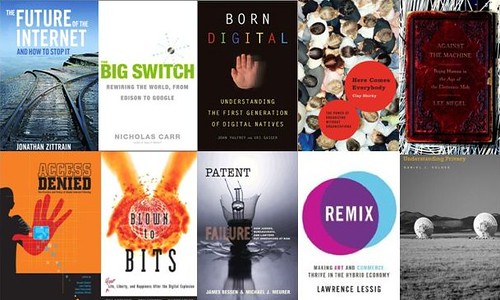
What qualifies as an “important” tech policy book? Basically, it’s a title that many people in this field are currently discussing and that we will likely be talking about for many years to come. I want to make it clear, however, that merely because a book appears on this list it does not necessarily mean I agree with everything said in it. In fact, I found much with which to disagree in my picks for the two most important books of 2008, as well as many of the other books on the list. [Moreover, after reading all these books, I am more convinced than ever that libertarians are badly losing the intellectual battle of ideas over Internet issues and digital technology policy. There’s just very few people defending a “Hands-Off-the-Net” approach anymore. But that’s a subject for another day!]
Another caveat: Narrowly focused titles lose a few points on my list. For example, as was the case in past years, a number of important IP-related books have come out this year. If a book deals exclusively with copyright or patent issues, it does not exactly qualify as the same sort of “tech policy book” as other titles found on this list since it is a narrow exploration of just one set of issues that have a bearing on digital technology policy. The same could be said of a book that deals exclusively with privacy policy, like Solove’s
Understanding Privacy. It’s an important book with implications for the future of tech policy, but I demoted it a bit because of its narrow focus.
With those caveats in mind, here are my Top 10 Most Important Tech Policy Books of 2008 (and please let me know about your picks for book of the year):
Continue reading →
 I just finished reading through The Economist’s new 14-page special report on cloud computing, “Let It Rise” in which Ludwig Siegele provides an outstanding overview of cloud computing and why it is so important:
The rise of the cloud is more than just another platform shift that gets geeks excited. It will undoubtedly transform the information technology (IT) industry, but it will also profoundly change the way people work and companies operate. It will allow digital technology to penetrate every nook and cranny of the economy and of society, creating some tricky political problems along the way.
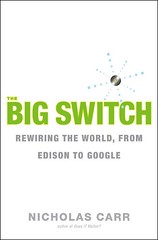
Even if you are very familiar with cloud computing, I recommend you take a look at the article. Anyway, while I was reading it, I was unsurprised to come across some comments from Nicholas Carr, whose new book
The Big Switch: Rewiring the World, from Edison to Google, is essentially an early history of cloud computing and an investigation into its effects on our economy, culture, and society. And that also reminded me that, even though I have mentioned Carr’s book here several times since it was released earlier this year, I have failed to give it a dedicated review. And it certain deserves one because “The Big Switch” is easily one of the most important technology policy books of 2008.
Continue reading →
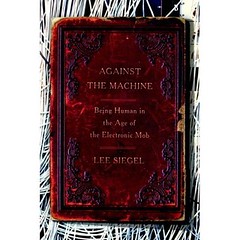 Of the titles I included in a mega-book review about Internet optimists and pessimists that I posted here a few months ago, I mentioned Lee Siegel’s new book, Against the Machine: Being Human in the Age of the Electronic Mob. It is certainly the dourest of the recent books that have adopted a pessimistic view of the impact the Internet is having on our culture, society, and economy. Because Siegel’s book is one of the most important technology policy books of 2008, however, I decided to give it a closer look here.
Siegel’s book essentially picks up where Andrew Keen’s leaves off in
Cult of the Amateur: How Today’s Internet is Killing our Culture (2007). I posted a two-part review of Keen’s book here last year [Part 1, Part 2], but here’s a quick taste of Keen’s take on things. He argues “the moral fabric of our society is being unraveled by Web 2.0” and that “our cultural standards and moral values are not all that are at stake. Gravest of all,” Keen continues, “the very traditional institutions that have helped to foster and create our news, our music, our literature, our television shows, and our movies are under assault as well.”
As I noted in my earlier “Net optimists vs. pessimists” essay, after reading
Cult of the Amateur, I didn’t think anyone else could ever be quite as over-the-top and Chicken Little-ish as Keen. But after working my way through Siegel’s Against the Machine, I realized I was wrong. It made Keen seem downright reasonable and cheery by comparison! Keen and Siegel seem to be in heated competition for the title “High Prophet of Internet Doom,” but Siegel is currently a nose ahead in that race.
Continue reading →
[Note: I updated this discussion and chart in a subsequent essay. See: “Are You An Internet Optimist or Pessimist? The Great Debate over Technology’s Impact on Society.”]
A number of very interesting books have been released over the past year or two which debate how the Internet is reshaping our culture and the economy. I’ve reviewed a couple of them here but I have been waiting to compile a sort of mega-book review once I found a sensible way to conceptually group them together. I’m not going to have time to cover each of them here in the detail they deserve, but I think I have at least found a sensible way to categorize them. For lack of better descriptors, I’ve divided these books and thinkers into two camps: “Internet optimists” versus “Internet Pessimists.” Here’s a list of some of the individuals and books (or other articles and blogs) that I believe epitomize these two camps of thinking:
Adherents & Their Books / Writings
|
Internet Optimists
|
Internet Pessimists
|
|
Yochai Benkler, The Wealth of Networks
|
Andrew Keen, The Cult of the Amateur
|
|
Chris Anderson, The Long Tail and “Free!”
|
Lee Siegel, Against the Machine
|
|
Clay Shirky, Here Comes Everybody
|
Nick Carr, The Big Switch
|
|
Cass Sunstein, Infotopia
|
Cass Sunstein, Republic.com
|
|
Don Tapscott, Wikinomics
|
Todd Gitlin, Media Unlimited
|
|
Kevin Kelly & Wired mag in general
|
Alex Iskold, “The Danger of Free”
|
|
Mike Masnick & TechDirt blog
|
Mark Cuban
|
And here’s a rough sketch of the major beliefs or key themes that separate these two schools of thinking about the impact of the Internet on our culture and economy:
Beliefs / Themes
|
Internet Optimists
|
Internet Pessimists
|
|
Culture / Social
|
|
Net is Participatory
|
Net is Polarizing
|
|
Net yields Personalization
|
Net yields Fragmentation
|
|
a “Global village”
|
Balkanization
|
|
Heterogeneity
/ Diversity of Thought
|
Homogeneity
/ Close-mindedness
|
|
Net breeds pro-democratic tendencies
|
Net breeds anti-democratic tendencies
|
|
Tool of liberation & empowerment
|
Tool of frequent misuse & abuse
|
|
|
|
Economics / Business
|
|
Benefits of “free”
(“Free” = future of media / business)
|
Costs of “free”
(“Free” = end of media / business)
|
|
Increasing importance of “Gift economy”
|
Continuing importance of property rights, profits, firms
|
|
“Wiki” model = wisdom of crowds; power of collective intelligence
|
“Wiki” model = stupidity of crowds; errors of collective intelligence
|
|
Mass collaboration
|
Individual effort
|
So, what to make of this intellectual war? Who’s got the story right?
Continue reading →

 The Technology Liberation Front is the tech policy blog dedicated to keeping politicians' hands off the 'net and everything else related to technology.