Posts tagged as:

What Unites Advocates of Speech Controls & Privacy Regulation? [pdf]

by Adam Thierer & Berin Szoka The Progress & Freedom Foundation, Progress on Point No. 16.19

Anyone who has spent time following debates about speech and privacy regulation comes to recognize the striking parallels between these two policy arenas. In this paper we will highlight the common rhetoric, proposals, and tactics that unite these regulatory movements. Moreover, we will argue that, at root, what often animates calls for regulation of both speech and privacy are two remarkably elitist beliefs:

  1. People are too ignorant (or simply too busy) to be trusted to make wise decisions for themselves (or their children); and/or,
  2. All or most people share essentially the same values or concerns and, therefore, “community standards” should trump household (or individual) standards.

While our use of the term “elitism” may unduly offend some understandably sensitive to populist demagoguery, our aim here is not to launch a broadside against elitism as Time magazine culture critic William H. Henry once defined it: “The willingness to assert unyieldingly that one idea, contribution or attainment is better than another.”[1] Rather, our aim here is to critique that elitism which rises to the level of political condescension and legal sanction. We attack not so much the beliefs of some leaders, activists, or intellectuals that they have a better idea of what it in the public’s best interest than the public itself does, but rather the imposition of those beliefs through coercive, top-down mandates.

That sort of elitism—elitism enforced by law—is often the objective of speech and privacy regulatory advocates. Our goal is to identify the common themes that unite these regulatory movements, explain why such political elitism is unwarranted, and make it clear how it threatens individual liberty as well as the future of free and open Internet. As an alternative to this elitist vision, we advocate an empowerment agenda: fostering an environment in which users have the tools and information they need to make decisions for themselves and their families. Continue reading →

Adam Thierer and I have been trying to drive home a simple message in the ongoing debate about targeted online advertising and privacy:  “There is no Free Lunch!”  We don’t have a lot of friends in this debate, since nearly everyone else seems to assume that online content and services will just continue to fall like manna from heaven if politicians strangle advertising online.  So I was particularly heartened to read the following from Shelly Palmer:

This is the most serious question facing content producers today. Content costs money to produce. Third-party advertising/sponsor support is one model, promoting your own products is another, subscription is a third. At the end of the day, there are only three ways it works: I pay, you pay or someone else pays. Unfortunately, there is no business model called “no one pays.” In the case of MediaBytes, the model is “I pay.” It works for me as stated above. But, apparently, a fairly large number of people in my audience are uninterested in seeing even relevant product offerings. Is advertising over? If so, what’s next?

Amen! Shelly hosts a daily Internet talk show on technology and media called MediaBytes.  He  recently tried inserting a short ad at the beginning of the show to cover the significant costs of production:

The show is produced every business day and requires a research staff, a writer (me), an editor, an encoding/distribution manager and an affiliate relations staff. The reason for the production overview is that, this particular two-minutes may look like a talking head combined with some graphics and clips, but the work flow for any given show takes approximately 6 hour and all of the people involved in the production are on salary here at Advanced Media Ventures Group. And, for the record, MediaBytes, and the associated production materials, takes up approximately 25% of my day.

Unfortunately, Shelly’s audience seemed to feel entitled to receive the fruit of his hard work for free—without suffering the  agony of watching… horror of horrors: advertising!. Continue reading →

by Berin Szoka & Adam Thierer

This morning, the House Energy & Commerce Committee will hold a hearing on “Behavioral Advertising: Industry Practices And Consumers’ Expectations.” If nothing else, it promises to be quite entertaining:  With full-time Google bashers Jeff Chester and Scott Cleland on the agenda, the likelihood that top Google officials will be burned in effigy appears high!

Chester, self-appointed spokesman for what one might call the People for the Ethical Treatment of Data (PETD) movement, is sure to rant and rave about the impending techno-apocalypse that will, like all his other Chicken-Little scenarios, befall us all if online advertisers were permitted to better tailor ads to consumers’ liking. After all, can you imagine the nightmare of less annoying ads that might actually convey more useful information to consumers? Isn’t serving up “untargeted” dumb banner ads for Viagra to young women and Victoria’s Secret ads to Catholic school kids the pinnacle of modern online advertising?  Gods forbid we actually make advertising more relevant and interest-based!  (Those Catholic school boys may appreciate the lingerie ads, but few will likely buy bras.)

Anyway, according to National Journal’s Tech Daily Dose, the hearing lineup also includes:

  • Charles Curran, Executive Director, Network Advertising Initiative
  • Christopher Kelly, Chief Privacy Officer, Facebook
  • Edward Felten, Director, Center for IT Policy, Princeton University
  • Anne Toth, Chief Privacy Officer & Vice President, Policy, Yahoo!
  • Nicole Wong, Deputy General Counsel, Google

That’s an interesting group and we’re sure that they will say interesting things about the issue. Nonetheless, because four of them have a corporate affiliation that fact will inevitably be used by some critics to dismiss what they have to say about the sensibility of more targeted or interest-based forms of online advertising. So, we’d like to offer a few thoughts and pose a few questions to make sure that Committee members understand why, regardless of what it means for any particular online operator, targeting online advertising is very pro-consumer and essential to the future of online content, culture, and competition.  As Wall Street Journal technology columnist Walt Mossberg has noted, “Advertising is the mother’s milk of all the mass media.”  Much of the “free speech” we all cherish isn’t really free, but ad-supported!

Continue reading →

Google has announced that it will soon begin allowing U.S. advertisers to use trademarked keywords in limited circumstances in text ads, much as Yahoo! already does.  Google currently allow advertisers to bid on trademarked terms as keywords that could cause an ad to appear, either next to Google search results or on a third-party publisher’s website.  That policy will not change, and is discussed here by my PFF colleague Sid Rosenzweig.  The new policy is focused on the text seen by users in ads themselves and applies only if the “landing page” (to which the ad links) is used by a reseller, aggregator or parts supplier to sell only products that are relevant to the mark in question, or if the page is used to provide impartial reviews or other information about the trademarked product.  The new policy does not apply to sites/pages that (a) facilitate the sale of counterfeit goods, (b) allow the sale of a competitor’s goods, (c) criticize the trademarked good, or (d) do not provide substantial information or a purchase option.  Despite these limitations and other safeguards, Google has been sharply criticized by some trademark holders and might even be sued (e.g., for contributory infringement).

I’ll defer to the real trademark lawyers to figure out whether Google is correct that its new policy falls within the bounds of trademark law (particularly the “nominative fair use” doctrine).  But since Adam Thierer and I have been involved in an ongoing defense of online advertising against those who would squelch it through regulation in the name of privacy concerns (not at play here), I think it’s important to highlight the potential benefits to users from this seemingly arcane policy change-and to consider what this episode says about online advertising generally.  I see three main benefits to consumers from the policy change that should be considered alongside the vitally important role that trademarks play in our economy in communicating reputational information.

First, Google’s new policy will allow consumers to find products more easily because advertisers will be able to offer more descriptive and therefore informative ads, mentioning what they sell by name. Continue reading →

Google’s new “Interest Based Advertising” (IBA) program represents the company’s first foray into what is generally called “Online Behavioral Advertising” (OBA):  In order to deliver more relevant advertising, Google will begin tailoring ads delivered through AdSense on the Google Content Network (GCN) and YouTube.com (but not Google.com).  This tailoring will be based on a profile of each user’s interests created by tracking their browsing activity across sites that use AdSense-but not search queries or other user information.  Until now, (i) AdSense has delivered essentially “contextual” advertising by choosing which ad to display on a page based on an algorithmic analysis of keywords on that page; and (ii) Google has tracked users’ browsing only for analytics purposes-to limit the number of times a user sees a particular ad (to prevent overexposure) and to allow sequencing of ads in campaigns where one ad must follow another. 

Google is sure to be attacked for crossing a “line in the sand” drawn by some privacy advocates between contextual and behavioral advertising-even though Google’s closest competitor, Yahoo!, already offers a similar program, and the concept in general is hardly new.  Google’s position as the leading search engine and third party ad-delivery network will no doubt cause paroxysms of privacy hysteria among those who consider targeted advertising inherently invasive, unfair or manipulative.

But those whose first priority is advancing consumer privacy, not advancing a political or regulatory agenda, should applaud Google for excluding sensitive categories and for putting the new Ad Preference Manager at the core of the company’s new IBA program.  The Ad Preference Manager sets a new “gold standard” for implementing the principles of Notice and Choice, which have formed the core of both OBA industry self-regulation and the various regulatory proposals made in recent years.  Indeed, Google has done precisely what Adam Thierer and I have called for:  giving consumers more granular control over their own privacy preferences by developing better tools.

Continue reading →

Jerry Yang’s departure as Yahoo! CEO opens the door to a renewed bid by Microsoft to buy Yahoo!’s search business (or Yahoo! itself).  Such a merger could produce a significantly stronger challenger to Google in the search market.  With this possibility in mind, the WSJ just ran a fascinating history of the “paid search” The search marketbusiness—the placement of “contextually targeted” ads next to search engine results based on the search terms that produced those results.
In a nutshell, Microsoft failed to see (back in 1998-2003) the enormous potential of paid search—just as small start-ups (such as Google) were starting to develop the technology and business model that today account for a $12+ billion/year industry, which is  twice the size of the display ad market and which supports a great deal of the online content and services we have all come to take for granted online.  Microsoft first put its toe in the water of paid search with a small-scale partnership with Goto.com in 1999-2000.  But this partnership failed because of internal resistance from the managers of Microsoft’s display-ad program.  In 2000, Google launched Adwords and thus began its transformation from start-up into economic colossus.  By 2002, Microsoft realized that it needed to catchup fast, and approached Goto.com (by then renamed Overture) about a takeover.  But Microsoft ultimately chose in 2003 not to buy the startup because  Bill Gates and Steve Ballmer “balked at Overture’s valuation of $1 billion to $2 billion, arguing that Microsoft could create the same service for less.” 

Microsoft, meanwhile, spent the next 18 months deploying hundreds of programmers to build a search engine and a search-ad service, which it code-named Moonshot. The company launched its search engine in late 2004 and its search-ad system in May 2006.

But Microsoft’s ad system came too late:

Advertisers applauded Moonshot for its technical innovation. But Microsoft had trouble coaxing people to migrate to its search engine from Google; advertisers were unwilling to spend large sums on MSN’s search ads. By building a new system instead of buying Overture, Mr. Mehdi says, “we really delayed our time to market.”

What’s most fascinating about the piece is that it seems to suggest that Microsoft missed its opportunities to get into paid search not because it was “dumb,” “uninnovative” or a “bad” company, but for the same sorts of reasons that big, highly successful and even particularly innovative companies fail.  The reasons companies generally succeed in mastering “adaptive” innovation of the technologies behind their established business models are the very reasons why such great companies struggle to encourage or channel the “disruptive” innovation that renders their core technologies and business models obsolete.   Continue reading →

Today’s USA Today features a debate between the editors and me on the question of the impact media has on children and what should be done about it. Their editorial argues that “Today’s mass media penetrate deeply and quietly, inflicting real damage on young children, an increasing body of research shows.” Specifically, they are referring to a new study commissioned by Common Sense Media (CSM), which claims that a review of 173 studies shows “that a strong correlation exists between greater exposure and adverse health outcomes.”

In my response entitled “Don’t Scapegoat Media,” which appears in its entirety down below the fold, I argue that “Media have long been a convenient scapegoat for the woes of the world,” and that we must be careful not to assume correlation equals causation when surveying the impact of media on kids. After all, I argue, “how do [those studies] account for the other variables that influence youth development, including broken homes, bad parents, socioeconomic status, troubled peer relations, poor schools and so on? And how is media exposure weighted relative to these other influences? Is a beer ad really as much of a negative influence as an alcoholic parent?” Again, read my entire response below. [Of course, even if one assumes some media has an impact on some kids, there are plenty of ways for parents and guardians to take control over the media in their lives, as I have shown in my big book on the subject.]

I was also quoted in this Washington Post article about the new CSM study on Tuesday. Continue reading →

Remember Newspapers?

by on October 27, 2008 · 7 comments

In a City Journal article earlier this year, I wondered “how long some local papers have left when they are barred from restructuring their businesses or partnering with other local media operators to stem the bleeding and reinvent their business models.”  I was responding to the Senate’s smack-down of a half-hearted reform effort that FCC chairman Kevin Martin pushed through in November 2007, which proposed relaxing the FCC’s newspaper/broadcast cross-ownership rule. That rule, unrevised since going into effect in 1975, prohibits a newspaper operator from also owning a radio or television station in the same media market. However, waivers were granted to grandfather in some combined newspaper and broadcast operations that had existed long before the ban took effect. Martin’s proposal was to simply tweak the rule to permit similar combinations in just the nation’s 20 largest media markets.

Martin’s limited liberalization proposal, however, led to howls of disapproval from FCC democrats like Michael Copps and many folks on both side of the aisle in Congress. Supposedly, this was nothing more than a “giveaway” to the newspaper industry, which critics said was doing just fine.  It really makes you wonder if any of those critics even both reading the news about newspapers today.

As I have documented here on many occasions, as well as in my big Media Metrics report, the newspaper industry is in huge trouble with every financial variable of importance rapidly heading south. Alan Mutter does a good job here of summarizing “the secular forces dragging down newspapers: Declining readership, shrinking advertising, high fixed costs and growing online competition that makes it increasingly difficult to charge the premium ad rates that were possible prior to the Internet.”  As a result of these forces, everyday brings another headline like this one today in the New York Times: “The Star-Ledger of Newark Plans 40% Cut,” or this one in the Wall Street Journal: “Some Newspapers Shed Unprofitable Readers.”  The numbers are just miserable, and they just get worse and worse.

Continue reading →

By Adam Thierer & Berin Szoka

The goal of our “Privacy Solution Series,” as we noted in the first installment, is to detail the many “technologies of evasion” (i.e., user-empowerment or user “self-help” tools) that allow web surfers to better protect their privacy online—and especially to defeat tracking for online behavioral advertising purposes.  These tools and methods form an important part of a layered approach that, in our view, provides an effective alternative to government-mandated regulation of online privacy.

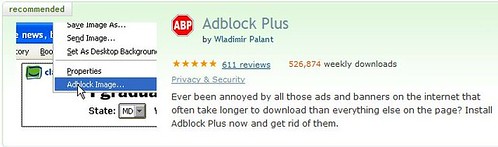
In this second installment in this series, we will highlight Adblock Plus (ABP), a free downloadable extension for the Firefox web browser (as well as for the Flock browser, though we focus on the Firefox version here).

Adblock Plus

Purpose: The primary purpose of Adblock Plus is to block online ads from being downloaded and displayed on a user’s screen as they browse the Web.  In a broad sense, this functionality might be considered a “privacy” tool by those who consider it an intrusion upon, or violation of, their “privacy” to be “subjected” to seeing advertisements as they browse the web.  But if one thinks of privacy in terms of what others know about you, Adblocking is not so much about “privacy” as about user annoyance (measured in terms of distracting images cluttering webpages or simply in terms of long download times for webpages).  In this sense, ABP may not qualify as a “technology of evasion,” strictly speaking.  But, as explained below the fold, ABP does allow its users to “evade” some forms of online tracking by blocking the receipt of some, but not all, tracking cookies.

Cost: Like almost all other Firefox add-ons, both the ABP extensions and the filter subscriptions on which it relies (as described below) are free.

Popularity / Adoption: While there are a wide variety of ad-blocking tools available, Adblock Plus is far and away the leader.  ABP has proven enormously popular since its release in November 2005 as the successor to Adblock, which was first developed in 2002 and reached over 10,000,000 downloads before being abandoned by its developer and even today garners nearly 40,000 downloads a week.  This history of Adblock provides further details.

ABP was named one the 100 best products of 2007 by PC World magazine and is now the #1 most downloaded add-on for Firefox with over 500,000 weekly downloads, up significantly for just a few months.  In a blog post last month, ABP creator Wladimir Palant estimated that “no more than 5% of Firefox users have Adblock Plus installed,” but that percentage is bound to grow larger as more people discover Adblock.  As one indicator of ABP’s popularity, the number of Google searches for “Adblock” has nearly eclipsed the number of searches for “identity theft,” which seems like a far more serious concern than having to look at web ads. Continue reading →

I used to get endless grief from pro-regulatory media activists here in DC when I put forward the argument in days past that Google was a media company and a major player in the battle for eyes, ears and ad dollars in America’s media marketplace. Increasingly, however, more people are coming around to seeing that point, even the crusty old media giants themselves.

In a smart essay over at the Freedom to Tinker blog, David Robinson takes the New York Times to task for an article today again wondering, “Is Google a Media Company?” As David rightly argues: Continue reading →