This is a compendium of readings on “
progress studies
,” or essays and books which generally make the case for technological innovation, dynamism, economic growth, and abundance. I will update this list as additional material of relevance is brought to my attention.
[Last update: 10/11/22]
Recent Essays
- Marc Andreessen, “The Techno-Optimist Manifesto,” a16z.com, October 16, 2023.
- Will Rinehart, “The Abundance Agenda,” The Exformation Newsletter, October 15, 2022.
- Sarah Constantin, “Unblocking Abundance: A Model for Activism,” Rough Diamonds, October 10, 2022.
- Derek Thompson, “The Forgotten Stage of Human Progress,” The Atlantic, May 11, 2022.
- Adam Thierer, “Where is ‘Progress Studies’ Going?” Progress Forum, April 23, 2022.
- Katherine Boyle, “The Case for American Seriousness,” Common Sense, April 18, 2022.
- William Rinehart, “Vetocracy, the Costs of Vetos and Inaction,” Center for Growth & Opportunity at Utah State University, March 24, 2022.
- James Pethokoukis, “Forget about Left Wing and Right Wing. How about an Up Wing America?” Faster Please, March 23, 2022.
- John W. Lettieri & Kenan Fikri, “The Case for Economic Dynamism and Why it Matters for the American Worker,” Economic Innovation Group, March 2022.
- Adam Kovacevich, “Saying YIMBY (Yes In My Back Yard) to “Civic Innovation,” Chamber of Progress, March 21, 2022.
- Eli Dourado, “Remove Barriers to Productivity,” City Journal, March 18, 2022.
- “A Case for Innovation and Optimism,” (A conversation with Jason Crawford), Discourse, March 2, 2022.
- Noah Smith, “A New Industrialist Roundup,” Noahpinion, February 3, 2022.
- James Pethokoukis, “When Will the Next Big Thing Arrive?” Faster Please, February 3, 2022.
- Alec Stapp & Caleb Watney, “
Progress is a Policy Choice
,” Institute for Progress, January 20, 2022.
- Adam Thierer, “
How to Get the Future We Were Promised
,” Discourse, January 18, 2022.
- Katherine Boyle, “
Building American Dynamism
,” Future, January 14, 2022.
- Derek Thompson, “
A Simple Plan to Solve All of America’s Problems
,” The Atlantic, January 12, 2022.
- Jason Crawford, “Progress, Humanism, Agency: An Intellectual Core for the Progress Movement,” Roots of Progress, January 11, 2022.
- Adam Thierer, “Defending Innovation Against Attacks from All Sides,” Discourse, November 9, 2021.
- Matthew Yglesias, “The Case for More Energy,” October 7, 2021.
- Jason Crawford, “
We need a new philosophy of progress
,” The Roots of Progress, August 23, 2021.
- Gale Pooley & Marian L. Tupy, “The Simon Abundance Index 2021,” Human Progress, April 22, 2021.
- Noah Smith, “
Techno-optimism for the 2020s
,” December 3, 2020.
- Ezra Klein, “
Why We Can’t Build
,” Vox, April 22, 2020.
- Marc Andreesen, “
It’s Time to Build
,” Future, April 18, 2020.
- Eli Dourado, “
How do we move the needle on progress
?” September 26, 2019.
- José Luis Ricón, “
About the ‘Progress’ in Progress Studies
” September 6, 2019.
- Will Rinehart, “
Progress Studies: Some Initial Thoughts
,” August 30, 2019.
- Adam Thierer, “
Is There a Science of Progress
?” AIER, August 8, 2019.
- Patrick Collison and Tyler Cowen, “
We Need a New Science of Progress
,” The Atlantic, July 30, 2019.
- Tyler Cowen, “
The Case for the Longer Term
,” Cato Unbound, January 9, 2019.
- Vinod Khosla, “
We Need Large Innovations
,” Medium, January 1, 2018.
- Adam Thierer, “
How Technology Expands the Horizons of Our Humanity
,” Medium, November 19, 2018.
- Chelsea Follett, “Utopianism: One of the Biggest Obstacles to Progress,” Human Progress, August15, 2018.
- Eli Dourado, “
How Technological Innovation Can Massively Reduce the Cost of Living
,” PlainText, January 29, 2016.
Continue reading →
Adam Thierer, Senior Research Fellow at the Mercatus Center discusses his recent working paper with coauthor Brent Skorup, A History of Cronyism and Capture in the Information Technology Sector. Thierer takes a look at how cronyism has manifested itself in technology and media markets — whether it be in the form of regulatory favoritism or tax privileges. Which tech companies are the worst offenders? What are the consequences for consumers? And, how does cronyism affect entrepreneurship over the long term?
Download
Related Links
Former TLF blogger Tim Lee returns with this guest post. Find him most of the time at the Bottom-Up blog.
Thanks to Jim Harper for inviting me to return to TLF to offer some thoughts on the recent Adam Thierer–Tim Wu smackdown. I’ve recently finished finished reading The Master Switch, and I didn’t have have my friend Adam’s viscerally negative reactions.
To be clear, on the policy questions raised by
The Master Switch, Adam and I are largely on the same page. Wu exaggerates the extent to which traditional media has become more “closed” since 1980, he is too pessimistic about the future of the Internet, and the policy agenda he sketches in his final chapter is likely to do more harm than good. I plan to say more about these issues in future writings; for now I’d like to comment on the shape of the discussion that’s taken place so far here at TLF, and to point out what I think Adam is missing about The Master Switch.
Here’s the thing: my copy of the book is 319 pages long. Adam’s critique focuses almost entirely on the final third of the book, (pages 205-319) in which Wu tells the history of the last 30 years and makes some tentative policy suggestions. If Wu had published pages 205-319 as a stand-alone monograph, I would have been cheering along with Adam’s response to it.
But what about the first 200-some pages of the book? A reader of Adam’s epic 6-part critique is mostly left in the dark about their contents. And that’s a shame, because in my view those pages not only contain the best part of the book, but they’re also the most libertarian-friendly parts.
Those pages tell the history of the American communications industries—telephone, cinema, radio, television, and cable—between 1876 and 1980. Adam only discusses this history in one of his six posts. There, he characterizes Wu as blaming market forces for the monopolization of the telephone industry. That’s not how I read the chapter in question. Continue reading →
As he noted, Adam Thierer’s lead article in the most recent Cato Policy Report is called “The Sad State of Cyber-Politics.” It goes through so many ways tech and telecom companies are playing the Washington game to win or keep competitive advantage.
It’s a nice set-up to a Washington Post opinion piece from this weekend in which TownFlier CEO Morris Panner talks about the growing riches accruing to Washington influencers:
We are creating so much regulation – over tax policy, health care, financial activity – that smart people have figured out that they can get rich faster and more easily by manipulating rules on behalf of existing corporations than by creating net new activity and wealth. Gamesmanship pays better than entrepreneurship.
Thierer sees some hope for the tech sector, for a few reasons:
Smaller tech companies have thus far largely resisted the urge [to engage with Washington]. Hopefully that’s for principled reasons, not just due to a shortage of lobbying resources. Second, the esoteric nature of many Internet and digital technology policy discussions frustrates many lawmakers and often forces them to lose interest in these topics. Third, the breakneck pace of technological change makes it difficult for regulators to bottle up innovation and entrepreneurialism.
Panner’s broader piece calls for “a national campaign to create transparency in our legislation and a national moratorium on the creation of commissions, regulators and czars. It is time for Congress to do the hard job of saying what lawmakers mean in clear and easy-to-understand language.” He continues, “We should reject bills that are thousands of pages or that delegate vast authority to unelected regulators.”
That would be a start.
The Comcast-NBC deal has the traditional media world all atwitter—well, better call it aflutter. “Atwitter” is losing its old media connotations.
So the
New York Times rounded up a foursome of advocates to air their views, among them Adam Thierer and yours truly.
Huzzahs and rotten fruit in the comments, please.
(And you can see from comparing our posts which of us believes in economy in the use of words.)
by Berin Szoka & Adam Thierer, Progress Snapshot 5.11 (PDF)
Ten years ago, Nobel Prize-winning economist Milton Friedman lamented the “Business Community’s Suicidal Impulse:” the persistent propensity to persecute one’s competitors through regulation or the threat thereof. Friedman asked: “Is it really in the self-interest of Silicon Valley to set the government on Microsoft?” After yesterday’s FCC vote’s to open a formal “Net Neutrality” rule-making, we must ask whether the high-tech industry—or consumers—will benefit from inviting government regulation of the Internet under the mantra of “neutrality.”
The hatred directed at Microsoft in the 1990s has more recently been focused on the industry that has brought broadband to Americans’ homes (Internet Service Providers) and the company that has done more than any other to make the web useful (Google). Both have been attacked for exercising supposed “gatekeeper” control over the Internet in one fashion or another. They are now turning their guns on each other—the first strikes in what threatens to become an all-out, thermonuclear war in the tech industry over increasingly broad neutrality mandates. Unless we find a way to achieve “Digital Détente,” the consequences of this increasing regulatory brinkmanship will be “mutually assured destruction” (MAD) for industry and consumers.
New Fronts in the Neutrality Wars
The FCC’s proposed rules would apply to all broadband providers, including wireless, but not to Google or many other players operating in other layers of the Net who favor such broadband-specific rules. With this rulemaking looming, AT&T came after Google with letters to the FCC in late September and then another last week accusing the company of violating neutrality principles in their business practices and arguing that any neutrality rules that apply to ISPs should apply equally to Google’s panoply of popular services. In particular, AT&T accused Google of “search engine bias,” suggesting that only government-enforced neutrality mandates could protect consumers from Google’s supposed “monopolist” control.
The promise made yesterday by the FCC—to only apply neutrality principles to the infrastructure layer of the Net—is hollow and will ultimately prove unenforceable. Continue reading →
Adam Thierer has been named the new president of the Progress & Freedom Foundation.
TLF readers don’t need to be told that he’s a tireless advocate for technology policies that preserve freedom and innovation. He was the driving force behind creation of this blog, for example, and he is a prodigious writer and commentator.
Adam will do even more to advance those goals and protect the Internet from stifling regulation from his new perch. Congratulations, Adam!
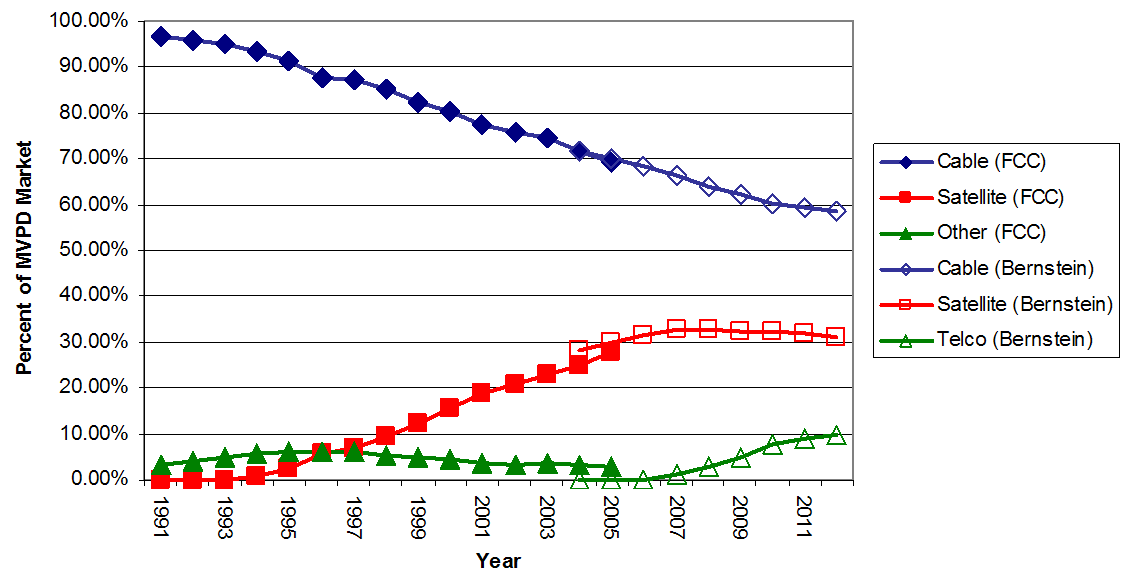
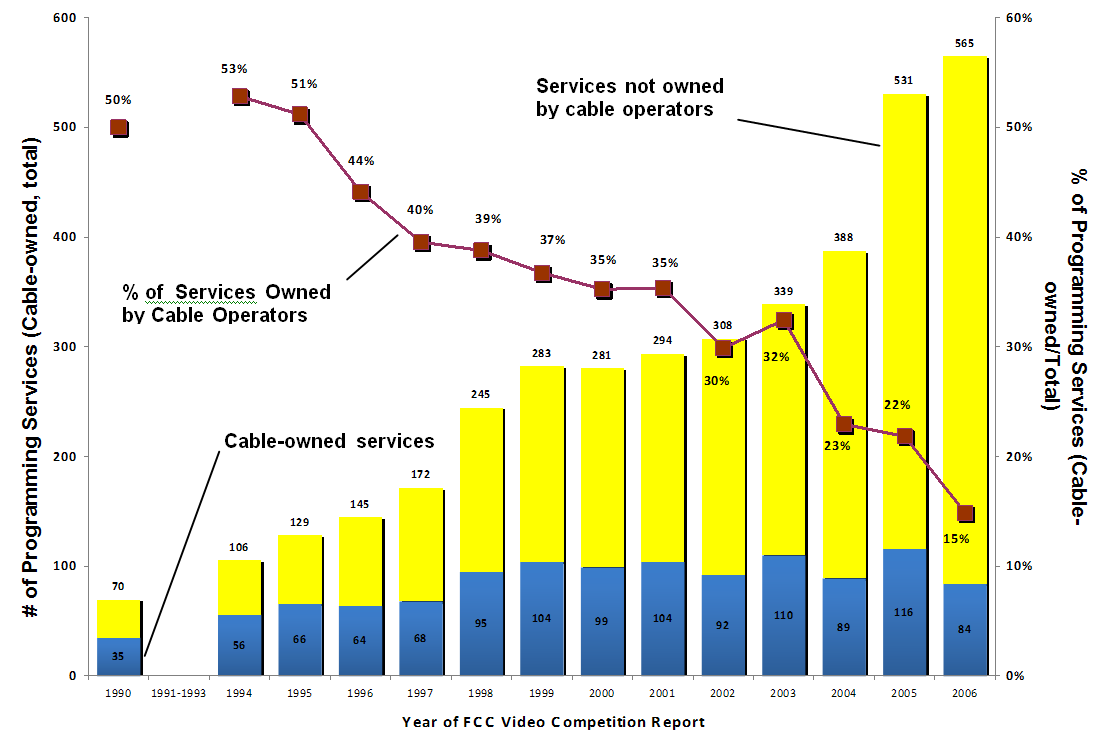
The D.C. Circuit has struck down as arbitrary and capricious the FCC’s “cable cap.” The cap prevented a single cable operator from serving more than 30% of U.S. homes—precisely the same percentage limit struck down by the court in 2001. The court ruled that the FCC had failed to demonstrate that “allowing a cable operator to serve more than 30% of all cable subscribers would threaten to reduce either competition or diversity in programming.”
The court’s decision rested on the two critical charts (both generated by my PFF colleague Adam Thierer in his excellent
Media Metrics special report) at the heart of the PFF amicus brief I wrote with our president, Ken Ferree:
First, the record is replete with evidence of ever increasing competition among video providers: Satellite and fiber optic video providers have entered the market and grown in market share since the Congress passed the 1992 Act, and particularly in recent years. Cable operators, therefore, no longer have the bottleneck power over programming that concerned the Congress in 1992.
Second, over the same period there has been a dramatic increase both in the number of cable networks and in the programming available to subscribers.
Our chart shows the explosion in the number of programmers (though not the total amount of programming), as well as the falling rate of affiliation between cable operators and programmers, which was among the prime factors motivating Congress when it authorized a cable cap in the 1992 Cable Act:
Continue reading →
On July 27th, The Progress & Freedom Foundation hosted a Capitol Hill panel discussion entitled “Online Child Safety, Privacy, and Free Speech: An Overview of Challenges in Congress & the States.” The event featured remarks from:
- Parry Aftab, Executive Director, WiredSafety.org
- Todd Haiken, Senior Manager of Policy, Common Sense Media
- Jim Halpert, Partner, DLA Piper
- Berin Szoka, Senior Fellow, The Progress & Freedom Foundation
We’ve just released the transcript of the event, which I have also pasted down below the fold in a Scribd document reader. Also, the audio for this event can be heard by clicking below:
Download mp3
Here is the full event description: Continue reading →
 Five years ago today the Technology Liberation Front (the “TLF”) got underway with this post. The idea for the TLF came about after I asked some tech policy wonks whether it was worth put together a blog dedicated to covering Internet-related issues from a cyber-libertarian perspective. The model I had in mind was a “Volokh Conspiracy
for Tech Issues,” if you will. I wanted to bring together a collection of sharp, liberty-loving wonks (most of whom worked in the think tank world) to talk about their research on this front and to give them a place to post their views on breaking tech policy developments. It was to be a sort of central clearinghouse for libertarian-oriented tech policy analysis and advocacy.
Five years ago today the Technology Liberation Front (the “TLF”) got underway with this post. The idea for the TLF came about after I asked some tech policy wonks whether it was worth put together a blog dedicated to covering Internet-related issues from a cyber-libertarian perspective. The model I had in mind was a “Volokh Conspiracy
for Tech Issues,” if you will. I wanted to bring together a collection of sharp, liberty-loving wonks (most of whom worked in the think tank world) to talk about their research on this front and to give them a place to post their views on breaking tech policy developments. It was to be a sort of central clearinghouse for libertarian-oriented tech policy analysis and advocacy.
At first, Tim Lee and I debated whether it even made sense to have that sort of narrow focus, but I think the passage of time and the rise of plenty of competition on this front shows that it was worthwhile. And I’ve been very pleased with the tag-team effort of all our TLF contributors and the way—without anyone planning it, in true libertarian fashion—we’ve sort of developed a nice division of labor on various tech policy issues.
Perhaps a few stats are in order on this occasion to mark our progress 5 years in. The best indication of our success is the fact that our Pagerank (Google’s logarithmic scale of website importance based on links to that site) has reached 7/10—the same score shared by the Volokh Conspiracy (our model), as well as Techmeme (the leading tech news aggregator), the Cato Institute, CDT, etc. (For comparison: ArsTechnica and EFF are 8s.) Unfortunately, we’ve only been using Google Analytics for three of the past five years, so it’s impossible to get a authoritative accounting of traffic growth since Day 1. But here are few markers:
- 4,450+ posts
- 29,000+ comments
- 2,698 RSS subscribers
- 15,763 unique visitors per month
- 1,000,000 pageviews since Nov. 2006 when we started using Google Analytics
- Besides organic search and direct links, we get the bulk of our traffic from other tech-oriented sites (in order of hits) TechDirt, Freedom to Tinker, Ars Technica, GamePolitics.com, TechMeme, Slate, etc., and aggregators such as reddit, Fark, and StumbleUpon
So, what’s our #1 post of all-time? Continue reading →

 The Technology Liberation Front is the tech policy blog dedicated to keeping politicians' hands off the 'net and everything else related to technology.