Posts tagged as:

On December 13th, I will be participating in an Atlas Network panel on, “Big Tech, Free Speech, and Censorship: The Classical Liberal Approach.” In anticipation of that event, I have also just published a new op-ed for The Hill entitled, “Left and right take aim at Big Tech — and the First Amendment.” In this essay, I expand upon that op-ed and discuss the growing calls from both the Left and the Right for a variety of new content regulations. I then outline the classical liberal approach to concerns about free speech platforms more generally, which ultimately comes down to the proposition that innovation and competition are always superior to government regulation when it comes to content policy.

In the current debates, I am particularly concerned with calls by many conservatives for more comprehensive governmental controls on speech policies enforced by various private platforms, so I will zero in on those efforts in this essay. First, here’s what both the Left and the Right share in common in these debates: Many on both sides of the aisle desire more government control over the editorial decisions made by private platforms. They both advocate more political meddling with the way private firms make decisions about what types of content and communications are allowed on their platforms. In today’s hyper-partisan world,” I argue in my Hill column, “tech platforms have become just another plaything to be dominated by politics and regulation. When the ends justify the means, principles that transcend the battles of the day — like property rights, free speech and editorial independence — become disposable. These are things we take for granted until they’ve been chipped away at and lost.”

Despite a shared objective for greater politicization of media markets, the Left and the Right part ways quickly when it comes to the underlying objectives of expanded government control. As I noted in my Hill op-ed:

there is considerable confusion in the complaints both parties make about “Big Tech.” Democrats want tech companies doing more to limit content they claim is hate speech, misinformation, or that incites violence. Republicans want online operators to do less, because many conservatives believe tech platforms already take down too much of their content.

This makes life very lonely for free speech defenders and classical liberals. Usually in the past, we could count on the Left to be with us in some free speech battles (such as putting an end to “indecency” regulations for broadcast radio and television), while the Right would be with us on others (such as opposition to the “Fairness Doctrine,” or similar mandates). Today, however, it is more common for classical liberals to be fighting with both sides about free speech issues.

My focus is primarily on the Right because, with the rise of Donald Trump and “national conservatism,” there seems to be a lot of soul-searching going on among conservatives about their stance toward private media platforms, and the editorial rights of digital platforms in particular. Continue reading →

Interoperability is a topic that has long been of interest to me. How networks, platforms, and devices work with each other–or sometimes fail to–is an important engineering, business, and policy issue. Back in 2012, I spilled out over 5,000 words on the topic when reviewing John Palfrey and Urs Gasser’s excellent book, Interop: The Promise and Perils of Highly Interconnected Systems.

I’ve always struggled with the interoperability issues, however, and often avoided them became of the sheer complexity of it all. Some interesting recent essays by sci-fi author and digital activist Cory Doctorow remind me that I need to get back on top of the issue. His latest essay is a call-to-arms in favor of what he calls “adversarial interoperability.” “[T]hat’s when you create a new product or service that plugs into the existing ones without the permission of the companies that make them,” he says. “Think of third-party printer ink, alternative app stores, or independent repair shops that use compatible parts from rival manufacturers to fix your car or your phone or your tractor.”

Doctorow is a vociferous defender of expanded digital access rights of many flavors and his latest essays on interoperability expand upon his previous advocacy for open access and a general freedom to tinker. He does much of this work with the Electronic Frontier Foundation (EFF), which shares his commitment to expanded digital access and interoperability rights in various contexts.

I’m in league with Doctorow and EFF on some of these things, but also find myself thinking they go much too far in other ways. At root, their work and advocacy raise a profound question: should there be any general right to exclude on digital platforms? Although he doesn’t always come right out and say it, Doctorow’s work often seems like an outright rejection of any sort of property rights in networks or platforms. Generally speaking, he does not want the law to recognize any right for tech platforms to exclude using digital fences of any sort. Continue reading →

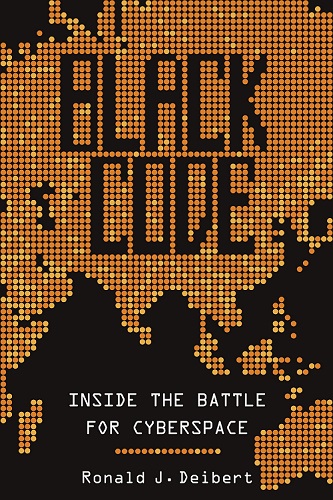
Black Code coverRonald J. Deibert is the director of The Citizen Lab at the University of Toronto’s Munk School of Global Affairs and the author of an important new book, Black Code: Inside the Battle for Cyberspace, an in-depth look at the growing insecurity of the Internet. Specifically, Deibert’s book is a meticulous examination of the “malicious threats that are growing from the inside out” and which “threaten to destroy the fragile ecosystem we have come to take for granted.” (p. 14) It is also a remarkably timely book in light of the recent revelations about NSA surveillance and how it is being facilitated with the assistance of various tech and telecom giants.

The clear and colloquial tone that Deibert employs in the text helps make arcane Internet security issues interesting and accessible. Indeed, some chapters of the book almost feel like they were pulled from the pages of techno-thriller, complete with villainous characters, unexpected plot twists, and shocking conclusions. “Cyber crime has become one of the world’s largest growth businesses,” Deibert notes (p. 144) and his chapters focus on many prominent recent examples, including cyber-crime syndicates like Koobface, government cyber-spying schemes like GhostNet, state-sanctioned sabotage like Stuxnet, and the vexing issue of zero-day exploit sales.

Deibert is uniquely qualified to narrate this tale not just because he is a gifted story-teller but also because he has had a front row seat in the unfolding play that we might refer to as “How Cyberspace Grew Less Secure.” Continue reading →

Jane Yakowitz of Brooklyn Law School recently posted an interesting 63-page paper on SSRN entitled, “Tragedy of the Data Commons.” For those following the current privacy debates, it is must reading since it points out a simple truism: increased data privacy regulation could result in the diminution of many beneficial information flows.

Cutting against the grain of modern privacy scholarship, Yakowitz argues that “The stakes for data privacy have reached a new high water mark, but the consequences are not what they seem. We are at great risk not of privacy threats, but of information obstruction.” (p. 58)  Her concern is that “if taken to the extreme, data privacy can also make discourse anemic and shallow by removing from it relevant and readily attainable facts.” (p. 63)  In particular, she worries that “The bulk of privacy scholarship has had the deleterious effect of exacerbating public distrust in research data.”

Yakowitz is right to be concerned. Access to data and broad data sets that include anonymized profiles of individuals is profound importantly for countless sectors and professions: journalism, medicine, economics, law, criminology, political science, environmental sciences, and many, many others. Yakowitz does a brilliant job documenting the many “fruits of the data commons” by showing how “the benefits flowing from the data commons are indirect but bountiful.” (p. 5) This isn’t about those sectors making money. It’s more about how researchers in those fields use information to improve the world around us. In essence, more data = more knowledge. If we want to study and better understand the world around us, researchers need access to broad (and continuously refreshed) data sets. Overly restrictive privacy regulations or forms of liability could slow that flow, diminish or weaken research capabilities and output, and leave society less well off because of the resulting ignorance we face. Continue reading →

Yesterday I engaged in a lively luncheon debate about Net neutrality regulation with Ben Scott of Free Press at a Catholic University Law School event on “Implementing the National Broadband Plan.” To open the debate, I made a very quick 5-Part Case against Net Neutrality Regulation. I argued that the the objections to a Net neutrality regulatory regime can be grouped into 5 major categories: (1) Legal; (2) Economic; (3) Engineering; (4) Practical; and (5) Philosophical / Principled. Down below you will find my working notes to see how I then elaborated on each objection in a bit more detail. And then Ben and I engaged in some spirited banter for the next 45 minutes.

Unfortunately, it doesn’t appear that the video of our debate is online just yet, but once it is I will post it here. However, the folks from NextGenWeb asked me to shoot a short 2 1/2 min video clip after the debate summarizing my remarks. If you can stand the sight of my big fat head in your browser for that long, here ya go:

http://blip.tv/play/gYh4gci5IQI%2Em4v

The 5-Part Case against Net Neutrality Regulation

The objections to a Net neutrality regulatory regime can be grouped into 5 major categories: (1) Legal; (2) Economic; (3) Engineering; (4) Practical; and (5) Philosophical / Principled. Each objection will be briefly summarized below: Continue reading →

by Adam Thierer & Berin Szoka, Progress Snaphot 6.1

Stephanie Clifford of the  New York Times posted a very interesting article this week summarizing a recent “on-the-record chat” the Times staff had with Federal Trade Commission (FTC) chairman Jon Leibowitz and FTC Bureau of Consumer Protection chief David Vladeck.  The interview [discussed by Braden here] is profoundly important in that it reveals an alarming disconnect regarding the relationship between “privacy” regulation and the future of media, which were the subjects of their discussion with Times staff.  Namely, Leibowitz and Vladeck apparently fail to appreciate how the delicate balance between commercial advertising and journalism is at risk precisely because of the sort of regulations they apparently are ready to adopt.  Because the value of online advertising depends on data about its effectiveness and consumers’ likely interests, and because advertising is indispensable to funding media, what’s ultimately at stake here is nothing short of the future of press freedom.

The “Day of Reckoning” Is Upon Us

Leibowitz and Vladeck spend the first half of The Times interview wringing their hands about “privacy policies,” the declarations made by websites and advertising networks about their data collection and use practices (for which the FTC can and must hold them accountable).  But the two feel that privacy policies don’t adequately inform consumers.  Chairman Leibowitz claims that online companies “haven’t given consumers effective notice, so they can make effective choices.”  And Mr. Vladeck states that advise-and-consent models “depended on the fiction that people were meaningfully giving consent.” But he and the FTC seem ready to abandon the notice and choice model because the “literature is clear” that few people read privacy policies, Vladeck told the Times.  He and Leibowitz continue:

“Philosophically, we wonder if we’re moving to a post-disclosure era and what that would look like,” Mr. Vladeck said. “What’s the substitute for it?” He said the commission was still looking into the issue, but it hoped to have an answer by June or July, when it plans to publish a report on the subject. Mr. Leibowitz gave a hint as to what might be included: “I have a sense, and it’s still amorphous, that we might head toward opt-in,” Mr. Leibowitz said.

This clearly foreshadows the regulatory endgame we have long suspected was coming.  When the FTC released its “Self-Regulatory Principles for Online Behavioral Advertising” eleven months ago, we asked: “What’s the Harm & Where Are We Heading?”  Their answers to both questions have become clearer with each new calculated comment—all apparently intended to slowly “turn up the heat” on the advertising industry so that the proverbial frog will stay in the pot until the water finally boils.  Leibowitz’s FTC has simply dodged the “harm” question with a four-part strategy: Continue reading →

I’ve just released a new PFF white paper looking at the hysteria that has often accompanied major media mergers and then taking a look at the marketplace reality years after the fact.  Here‘s the PDF, but I have also pasted the entire thing down below.

_____________________________

A Brief History of Media Merger Hysteria: From AOL-Time Warner to Comcast-NBC

by Adam Thierer

Although the pending union of Comcast and NBC Universal has not yet made it to the altar, Chicken Little-esque wails about the marriage have already begun in earnest. For example, the pro-regulatory media organization Free Press has already set up a website to complain about the deal.[1] And Jeff Chester, executive director of the Center for Digital Democracy, has called it “an unholy marriage.”[2] The fever only promises to spread once the deal is formally announced, and a lengthy fight over the deal is expected at the Federal Communications Commission (FCC) and whichever antitrust agency reviews the deal.[3]

But reality tends to play out somewhat less dramatically than the script penned by the media worrywarts. It’s worth looking back at some of the more prominent examples of media merger hysteria in recent years to understand why such panic is unwarranted, and why a deal between Comcast and NBC Universal is unlikely to lead to the sort of problems that the pessimists suggest.[4] Continue reading →

Last night here on the TLF, Bret Swanson raised a number of objections with this FCC-commissioned report about international broadband comparisons, which was conducted by some folks at Harvard University’s Berkman Center. Meanwhile, over at the Digital Society blog, George Ou also offers a hard-nosed look at the Berkman broadband report and concludes “The underlying data cited by Berkman study is simply too flawed to be of any use.”  I recommend everyone check out both essays.  It will be interesting to hear how the Berkman folks respond.  Some of these international broadband comparisons are really fishy.  [Here’s a podcast we did on that issue two years ago.]

One quick point… Like Bret, I also found it shocking that–even though the report reads like an ode to forced access regulation–the Berkman folks didn’t spend much time discussing the result of America’s previous open-access regime. “The gaping, jaw-dropping irony of the report,” Bret argues, “was its failure even to mention the chief outcome of America’s previous open-access regime: the telecom/tech crash of 2000-02. We tried this before. And it didn’t work!”  Indeed, America’s regulatory experiment with forced access regulation involved a lot of well intentioned laws and regulation, and too many acronyms to count–CLECs, TELRIC, UNE-P, etc– but it did not result in serious, facilities-based competition.  Instead it offered us the fiction of competition through network-sharing, or what Peter Huber once referred to as building “networks out of paper.” The results were disastrous for investment during that period since regulatory uncertainly led to a lot of stunted innovation.

In sum, sharing is not competing.  You can socialize and commoditize old pipes for awhile and get decent results in the short-term, but you’ll sacrifice long-run investment and innovation if you do.  [For more background, see my recent essay on “The Fiction of Forced Access ‘Competition’ Revisited” and this old Cato piece on “UNE-P and the Future of Telecom “Competition” as well as Jeff Eisenach’s PFF white paper, “Broadband Policy: Does the U.S. Have It Right After All?”]

“Liberty upsets patterns.” That was one of the many lessons that the late Harvard philosopher Robert Nozick taught us in his 1974 masterpiece “Anarchy, State, and Utopia.” What Nozick meant was that there is a fundamental tension between liberty and egalitarianism such that when people are left to their own devices, some forms of inequality would be inevitable and persistent throughout society. (Correspondingly, any attempt to force patterns, or outcomes, upon society requires a surrender of liberty.)

No duh, right? Most people understand this today–even if some of them are all too happy to hand their rights over to the government in exchange for momentary security or some other promise.  In the world of media policy, however, many people still labor under the illusion that liberty and patterned equality are somehow reconcilable. That is, some media policy utopians and Internet pollyannas would like us to believe that if you give every man, woman, and child a platform on which to speak, everyone will be equally heard.  Moreover, in pursuit of that goal, some of them argue government should act to “upset patterns” and push to achieve more “balanced” media outcomes. That is the philosophy that has guided the “media access” movement for decades and it what fuels the “media reformista” movement that is led by groups like the (inappropriately named) Free Press, which was founded by neo-Marxist media theorist Robert McChesney.

Alas, perfect media equality remains an illusive pipe dream. As I have pointed out here before, there has never been anything close to “equal outcomes” when it comes to the distribution or relative success of books, magazines, music, movies, book sales, theater tickets, etc.  A small handful of titles have always dominated, usually according to a classic “power law” or “80-20” distribution, with roughly 20% of the titles getting 80% of the traffic / revenue.  And this trend is increasing, not decreasing, for newer and more “democratic” online media.

For example, recent research has revealed that “the top 10% of prolific Twitter users accounted for over 90% of tweets” and  “the top 15% of the most prolific [Wkipedia] editors account for 90% of Wikipedia’s edits.” As Clay Shirky taught us back in 2003 in this classic essay, the same has long held true for blogging, where outcomes are radically inegalitarian, with a tiny number of blogs getting the overwhelming volume of blogosphere attention.  The reason, Shirky pointed out, is that:

Continue reading →

Last week I discussed Barbara Esbin’s new PFF paper about the FCC’s absurd investigation into how the cable industry is transitioning analog customers over to digital. This is an essential transition is the cable industry is going to free up bandwidth to compete against telco-provided fiber offerings in the future. The faster the cable industry can migrate its old analog TV customers over to the digital platform, the more bandwidth they can re-deploy for high-speed Net access and services. Mark Cuban helps put things in perspective:

1. the only thing that cable companies, and satellite for that matter have to sell is bandwidth and the applications they can run on that bandwith. More bandwidth means more digital everything. 2. For Basic Cable subscribers that get say, 40 analog channels, they are consuming 40 x 38.6mbs or 1.54 Gbs. Let that sink in. 1.54 Gbs of bandwidth. Compare that to how fast your internet access is. That more bandwidth than your entire neighborhood consumes online, by a lot. Thats also the equivalent of 500 standard def digital channels. If you convert that to revenue per bit for cable companies, or cost per bit for basic cable consumers, the basic cable customers are getting the best deal in town. By a long shot. Digital cable customers, not so much. Digital customers are paying multiples of analog customers for bandwidth. In reality, analog customers are getting an amazing deal, and the cable companies have been hesitant to convert them only because of the potential FCC backlash. I’m as cynical as the next guy when it comes to cable rates and motivations, but the reality is that the longer analog remains, the fewer opportunities to leverage the freed up bandwidth to create next generation bandwidth hog applications. Will the cable companies charge us an a lot for that bandwidth, probably. But when we start to see applications built on top of 250mbs per second and more, it will have far more value to society than watching USA Network on your old analog TV. And Net Neutrality?  Well if everyone had that 1.54gbs available to them, net neutrality would be a non issue. We wouldn’t be arguing about access or pre-emption, we would be arguing about quality of service.

Once again we are reminded that all regulations have opportunity costs and in this case the FCC’s actions could cost consumers the loss (or at least delay) of higher-speed broadband offerings in the near-term.