This is a compendium of readings on “
progress studies
,” or essays and books which generally make the case for technological innovation, dynamism, economic growth, and abundance. I will update this list as additional material of relevance is brought to my attention.
[Last update: 10/11/22]
Recent Essays
- Marc Andreessen, “The Techno-Optimist Manifesto,” a16z.com, October 16, 2023.
- Will Rinehart, “The Abundance Agenda,” The Exformation Newsletter, October 15, 2022.
- Sarah Constantin, “Unblocking Abundance: A Model for Activism,” Rough Diamonds, October 10, 2022.
- Derek Thompson, “The Forgotten Stage of Human Progress,” The Atlantic, May 11, 2022.
- Adam Thierer, “Where is ‘Progress Studies’ Going?” Progress Forum, April 23, 2022.
- Katherine Boyle, “The Case for American Seriousness,” Common Sense, April 18, 2022.
- William Rinehart, “Vetocracy, the Costs of Vetos and Inaction,” Center for Growth & Opportunity at Utah State University, March 24, 2022.
- James Pethokoukis, “Forget about Left Wing and Right Wing. How about an Up Wing America?” Faster Please, March 23, 2022.
- John W. Lettieri & Kenan Fikri, “The Case for Economic Dynamism and Why it Matters for the American Worker,” Economic Innovation Group, March 2022.
- Adam Kovacevich, “Saying YIMBY (Yes In My Back Yard) to “Civic Innovation,” Chamber of Progress, March 21, 2022.
- Eli Dourado, “Remove Barriers to Productivity,” City Journal, March 18, 2022.
- “A Case for Innovation and Optimism,” (A conversation with Jason Crawford), Discourse, March 2, 2022.
- Noah Smith, “A New Industrialist Roundup,” Noahpinion, February 3, 2022.
- James Pethokoukis, “When Will the Next Big Thing Arrive?” Faster Please, February 3, 2022.
- Alec Stapp & Caleb Watney, “
Progress is a Policy Choice
,” Institute for Progress, January 20, 2022.
- Adam Thierer, “
How to Get the Future We Were Promised
,” Discourse, January 18, 2022.
- Katherine Boyle, “
Building American Dynamism
,” Future, January 14, 2022.
- Derek Thompson, “
A Simple Plan to Solve All of America’s Problems
,” The Atlantic, January 12, 2022.
- Jason Crawford, “Progress, Humanism, Agency: An Intellectual Core for the Progress Movement,” Roots of Progress, January 11, 2022.
- Adam Thierer, “Defending Innovation Against Attacks from All Sides,” Discourse, November 9, 2021.
- Matthew Yglesias, “The Case for More Energy,” October 7, 2021.
- Jason Crawford, “
We need a new philosophy of progress
,” The Roots of Progress, August 23, 2021.
- Gale Pooley & Marian L. Tupy, “The Simon Abundance Index 2021,” Human Progress, April 22, 2021.
- Noah Smith, “
Techno-optimism for the 2020s
,” December 3, 2020.
- Ezra Klein, “
Why We Can’t Build
,” Vox, April 22, 2020.
- Marc Andreesen, “
It’s Time to Build
,” Future, April 18, 2020.
- Eli Dourado, “
How do we move the needle on progress
?” September 26, 2019.
- José Luis Ricón, “
About the ‘Progress’ in Progress Studies
” September 6, 2019.
- Will Rinehart, “
Progress Studies: Some Initial Thoughts
,” August 30, 2019.
- Adam Thierer, “
Is There a Science of Progress
?” AIER, August 8, 2019.
- Patrick Collison and Tyler Cowen, “
We Need a New Science of Progress
,” The Atlantic, July 30, 2019.
- Tyler Cowen, “
The Case for the Longer Term
,” Cato Unbound, January 9, 2019.
- Vinod Khosla, “
We Need Large Innovations
,” Medium, January 1, 2018.
- Adam Thierer, “
How Technology Expands the Horizons of Our Humanity
,” Medium, November 19, 2018.
- Chelsea Follett, “Utopianism: One of the Biggest Obstacles to Progress,” Human Progress, August15, 2018.
- Eli Dourado, “
How Technological Innovation Can Massively Reduce the Cost of Living
,” PlainText, January 29, 2016.
Continue reading →
[I am currently helping Berin Szoka edit a collection of essays from various Internet policy scholars for a new PFF book called “The Next Digital Decade: Essays about the Internet’s Future.” I plan on including two chapters of my own in the book responding to the two distinct flavors of Internet pessimism that I increasingly find are dominating discussions about Internet policy. Below you will see how the first of these two chapters begins. I welcome input as I refine this draft. ]
Surveying the prevailing mood surrounding cyberlaw and Internet policy circa 2010, one is struck by the overwhelming sense of pessimism about our long-term prospects for a better future. “Internet pessimism,” however, comes in two very distinct flavors:
- Net Skeptics, Pessimistic about the Internet Improving the Lot of Mankind: The first variant of Internet pessimism is rooted in general skepticism regarding the supposed benefits of cyberspace, digital technologies, and information abundance. The proponents of this pessimistic view often wax nostalgic about some supposed “good ‘ol days” when life was much better (although they can’t seem to agree when those were). At a minimum, they want us to slow down and think twice about life in the Information Age and how it is personally affecting each of us. Other times, however, their pessimism borders on neo-Ludditism, with proponents recommending steps be taken to curtail what they feel is the destructive impact of the Net or digital technologies on culture or the economy. Leading proponents of this variant of Internet pessimism include: Neil Postman (Technopoly: The Surrender of Culture to Technology), Andrew Keen, (The Cult of the Amateur: How Today’s Internet is Killing our Culture), Lee Siegel, (Against the Machine: Being Human in the Age of the Electronic Mob), Mark Helprin, (Digital Barbarism) and, to a lesser degree, Jaron Lanier (You Are Not a Gadget) and Nicholas Carr (The Big Switch and The Shallows).
- Net Lovers, Pessimistic about the Future of Openness: A different type of Internet pessimism is on display in the work of many leading cyberlaw scholars today. Noted academics such as Lawrence Lessig, (Code and Other Laws of Cyberspace), Jonathan Zittrain (The Future of the Internet & How to Stop It), and Tim Wu (The Master Switch The Rise and Fall of Information Empires), embrace the Internet and digital technologies, but argue that they are “dying” due to a lack of sufficient care or collective oversight. In particular, they fear that the “open” Internet and “generative” digital systems are giving way to closed, proprietary systems, typically run by villainous corporations out to erect walled gardens and quash our digital liberties. Thus, they are pessimistic about the long-term survival of the wondrous Internet that we currently know and love.
Despite their different concerns, two things unite these two schools of techno-pessimism. Continue reading →
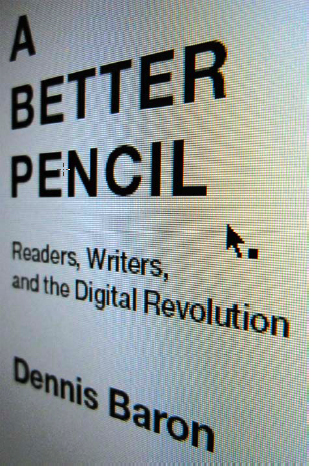 I very much enjoyed Dennis Baron’s new book, A Better Pencil: Readers, Writers, and the Digital Revolution, and highly recommend you pick it up. Baron does a wonderful job exploring the history of techno-pessimism and the endless battles about the impact of new technologies on life and learning, something I have written about here before in my essays on “Internet optimists vs. pessimists” (See: 1, 2, 3).
I have a complete review of Baron’s
A Better Pencil now up on the City Journal‘s website here. I’ve also pasted it down below.
Plato Wrote it Down
by Adam Thierer
a review of A Better Pencil: Readers, Writers, and the Digital Revolution, by Dennis Baron (Oxford University Press, 280 pp., $24.95)
In the beginning, Dennis Baron reminds us in his new book,
A Better Pencil, there was the word—the spoken word, that is. Oral tradition, the passing of knowledge through stories and lectures, was the primary method of instruction and learning throughout early human civilization. But then a few innovative souls decided to start writing everything down on stones and clay. Almost as soon as they did, a great debate began on the impact of new communications technology on culture and education. And it rages on today, with a new generation of optimists and skeptics battling over the impact that computing, the Internet, and digital technologies have on our lives and on how we learn about the world.
Continue reading →
I cannot in strong enough terms recommend that everyone read Gordon Crovitz’s latest Wall Street Journal column, “Free Speech, Now that Speech is Free.” It perfectly encapsulates everything we stand for here and makes the case that I have made again and again: Speech regulation — of all flavors — makes less and less sense in a world of information abundance and user empowerment, and it is a complete affront to our First Amendment rights. As Crovitz argues:
The Constitution was drafted at a time when there were few media outlets, and few people could be heard. Since then, technology has made it possible for everyone to express their views. The cost of expressing opinions continues to fall. Now that speech is no longer expensive, it’s time to return to the Founders’ intention that speech be free and that Congress not abridge anyone’s right to speak.
Amen brother! In his essay today, Crovitz specifically takes on America’s increasingly insane campaign finance laws, which make a mockery of the First Amendment. In the wake of last week’s Supreme Court arguments in the Citizens United case, Crovitz points out the insulting stupidity and sheer futility of these analog era, scarcity-oriented laws:
Continue reading →
Today, it was my great privilege to guest lecture at Princeton University’s Center for Information Technology Policy. Under the leadership of Ed Felten, who also runs the excellent “Freedom to Tinker” blog, the CITP has quickly become one of America’s premier institutions in the field of IT policy matters. David Robinson, who some of you will remember from his days as an editor at The American, serves as associate director of the CITP program and was kind enough to invite me to speak. And our own Tim Lee is currently studying there as well. I wish I was smart enough to get into that program!
The topic of my talk was “The Future of the First Amendment in an Age of Technological Convergence” and I used the opportunity to create a narrated video of this presentation, which I have made to several other groups through the years. In this presentation, I talk about “America’s First Amendment Twilight Zone,” which refers to the fact that identical words and images are being regulated in completely different ways today depending on the mode of transmission. This illogical and unfair situation could eventually threaten the Internet, video games, and all new media with many of the misguided regulations that have long been imposed on broadcast television and radio operators. In my presentation, which you can watch below, I make the case for changing our First Amendment regime to ensure “bit equality”; all speech and media platforms should be accorded the gold standard of First Amendment protection.
http://www.youtube.com/v/xJo3tVMScyI&hl=en&fs=1
Continue reading →
George Will’s weekly Washington Post column focuses on the Fairness Doctrine and calls out those on the Left who would support its reinstatement:
Because liberals have been even less successful in competing with conservatives on talk radio than Detroit has been in competing with its rivals, liberals are seeking intellectual protectionism in the form of regulations that suppress ideological rivals. If liberals advertise their illiberalism by reimposing the fairness doctrine, the Supreme Court might revisit its 1969 ruling that the fairness doctrine is constitutional. The court probably would dismay reactionary liberals by reversing that decision on the ground that the world has changed vastly, pertinently and for the better.
Mr. Will was kind enough to cite my new book with Brian Anderson, A Manifesto for Media Freedom [more info here] on the explosion of media outlets and options since the Supreme Court’s disastrous 1969 Red Lion decision, which blessed the Fairness Doctrine. Some of those stats: today there are about 14,000 radio stations, twice as many as in 1969; 18.9 million subscribers to satellite radio, up 17 percent in 12 months; and that 86 percent of households with either cable or satellite television receive an average of 102 of the 500 available channels.
No need to be putting the “Unfairness Doctrine” back on the books with unprecedented abundance like that.
 Of the titles I included in a mega-book review about Internet optimists and pessimists that I posted here a few months ago, I mentioned Lee Siegel’s new book, Against the Machine: Being Human in the Age of the Electronic Mob. It is certainly the dourest of the recent books that have adopted a pessimistic view of the impact the Internet is having on our culture, society, and economy. Because Siegel’s book is one of the most important technology policy books of 2008, however, I decided to give it a closer look here.
Siegel’s book essentially picks up where Andrew Keen’s leaves off in
Cult of the Amateur: How Today’s Internet is Killing our Culture (2007). I posted a two-part review of Keen’s book here last year [Part 1, Part 2], but here’s a quick taste of Keen’s take on things. He argues “the moral fabric of our society is being unraveled by Web 2.0” and that “our cultural standards and moral values are not all that are at stake. Gravest of all,” Keen continues, “the very traditional institutions that have helped to foster and create our news, our music, our literature, our television shows, and our movies are under assault as well.”
As I noted in my earlier “Net optimists vs. pessimists” essay, after reading
Cult of the Amateur, I didn’t think anyone else could ever be quite as over-the-top and Chicken Little-ish as Keen. But after working my way through Siegel’s Against the Machine, I realized I was wrong. It made Keen seem downright reasonable and cheery by comparison! Keen and Siegel seem to be in heated competition for the title “High Prophet of Internet Doom,” but Siegel is currently a nose ahead in that race.
Continue reading →
Web Pro News’ Jason Lee Miller seems to think he’s hoisted my colleague Bret Swanson, and The Progress & Freedom Foundation in general, on our own collective petard. Bret had responded to Tim Wu’s NYT op-ed by questioning Wu’s argument for developing “alternative supplies of bandwidth” to free us from the tyranny of the OPEC-like broadband cartel:
Unlike natural resources such as oil, which, while abundant, are at some point finite, bandwidth is potentially infinite. The miraculous microcosmic spectrum reuse capabilities of optical fiber and even wireless radiation improve at a rate far faster than any of our macrocosmic machines and minerals. It is far more efficient to move electrons than atoms, and yet more efficient to move photons. Left unfettered, these technologies will continue delivering bandwidth abundance.
Miller suggests that this response to Wu destroys arguments Bret and others at PFF have made against net neutrality regulation–a crusade led by Wu (who taught me Internet law, as it happens):
So what [Swanson is] saying is bandwidth scarcity is a notion invented by internet service providers and wireless providers to jack up prices and provide excuses for interfering with competing services on their networks. Nice. In a weird way, Swanson focuses so hard on disproving Wu’s analogy one way, he misses how the analogy is proved in another: a few organizations (government or not) controlling an important resource and forcing artificial scarcity in order to control the market for that resource is called a cartel.
Miller’s “Gotcha!” rests on the seemingly undeniable premise that broadband can’t be both abundant (as Bret argues)
and scarce (such that ISPs must management traffic on their networks, however non-neutral that may be). But in fact, this seeming contradiction is inherent in the very nature of the Internet–and the way Internet access is currently priced. Continue reading →

 The Technology Liberation Front is the tech policy blog dedicated to keeping politicians' hands off the 'net and everything else related to technology.