Today comes news that Senator Kohl has sent a letter to the DOJ urging “careful review” of the proposed Google/ITA merger. Underlying his concerns (or rather the “concerns raised by a number of industry participants and consumer advocates that I believe warrant careful review”) is this:
Many of ITA’s customers believe that access to ITA’s technology is critical to competition in online air travel search because it cannot be matched by other players in the travel search industry. They claim that ITA’s superior access to information and superior technology enables it to provide faster and better results to consumers. As a result, some of these industry participants and independent experts fear that the current high level of competition among online travel agents and metasearch providers could be undermined if Google were to acquire ITA and start its own OTA or metasearch service. If this were to happen, they argue, consumers would lose the benefits of a robustly competitive online air travel market.
For several reasons, these complaints are without merit and a challenge to the Google/ITA merger would be premature at best—and a costly mistake at worst. Continue reading →
[Cross-posted at Truth on the Market]
Here we go again. The European Commission is after Google more formally than a few months ago (but not yet having issued a Statement of Objections).
For background on the single-firm antitrust issues surrounding Google I modestly recommend my paper with Josh Wright, Google and the Limits of Antitrust: The Case Against the Antitrust Case Against Google (forthcoming soon in the Harvard Journal of Law & Public Policy, by the way).
According to one article on the investigation (from Ars Technica):
The allegations of anticompetitive behavior come as Google has acquired a large array of online services in the last couple of years. Since the company holds around three-quarters of the online search and online advertising markets, it is relatively easy to leverage that dominance to promote its other services over the competition.
(As a not-so-irrelevant aside, I would just point out that I found that article by running a search on Google and clicking on the first item to come up. Somehow I imagine that a real manipulative monopolist Google would do a better job of white-washing the coverage if its ability to tinker with its search results is so complete.)
More to the point, these sorts of leveraging of dominance claims are premature at best and most likely woefully off-base. As I noted in commenting on the Google/Ad-Mob merger investigation and similar claims from such antitrust luminaries as Herb Kohl:
If mobile application advertising competes with other forms of advertising offered by Google, then it represents a small fraction of a larger market and this transaction is competitively insignificant. Moreover, acknowledging that mobile advertising competes with online search advertising does more to expand the size of the relevant market beyond the narrow boundaries it is usually claimed to occupy than it does to increase Google’s share of the combined market (although critics would doubtless argue that the relevant market is still “too concentrated”). If it is a different market, on the other hand, then critics need to make clear how Google’s “dominance” in the “PC-based search advertising market” actually affects the prospects for competition in this one. Merely using the words “leverage” and “dominance” to describe the transaction is hardly sufficient. To the extent that this is just a breathless way of saying Google wants to build its business in a growing market that offers economies of scale and/or scope with its existing business, it’s identifying a feature and not a bug. If instead it’s meant to refer to some sort of anticompetitive tying or “cross-subsidy” (see below), the claim is speculative and unsupported.
The EU press release promotes a version of the “leveraged dominance” story by suggesting that
The Commission will investigate whether Google has abused a dominant market position in online search by allegedly lowering the ranking of unpaid search results of competing services which are specialised in providing users with specific online content such as price comparisons (so-called vertical search services) and by according preferential placement to the results of its own vertical search services in order to shut out competing services.
The biggest problem I see with these claims is that, well, they make no sense. Continue reading →
Congressmen working on national intelligence and homeland security either don’t know how to secure their own home Wi-Fi networks (it’s easy!) or don’t understand why they should bother. If you live outside the Beltway, you might think the response to this problem would be to redouble efforts to educate everyone about the importance of personal responsibility for data security, starting with Congressmen and their staffs. But of course those who live inside the Beltway know that the solution isn’t education or self-help but… you guessed it… to excoriate Google for spying on members of Congress (and bigger government, of course)!
Consumer Watchdog (which doesn’t actually claim any consumers as members) held a press conference this morning about their latest anti-Google stunt, announced last night on their “Inside Google” blog: CWD drove by five Congressmen’s houses in the DC area last week looking for unencrypted Wi-Fi networks. At Jane Harman’s (D-CA) home, they found two unencrypted networks named “Harmanmbr” and “harmantheater” that suggest the networks are Harman’s. So they sent Harman a letter demanding that she hold hearings on Google’s collection of Wi-Fi data, charging Google with “WiSpying.” This is a classic technopanic and the most craven, cynical kind of tech politics—dressed in the “consumer” mantle.
The Wi-Fi/Street View Controversy
Rewind to mid-May, when Google voluntarily disclosed that the cars it used to build a photographic library of what’s visible from public streets for Google Maps Street View had been unintentionally collecting small amounts of information from unencrypted Wi-Fi hotspots like Harman’s. These hotspots can be accessed by anyone who might drive or walk by with a Wi-Fi device—thus potentially exposing data sent over those networks between, say, a laptop in the kitchen, and the wireless router plugged into the cable modem.
Google’s Street View allows you to virtually walk down any public street and check out the neighborhood Continue reading →
I’m a big fan of CNET’s “Buzz Out Loud” podcast and often enjoy co-host Molly Wood’s occasional “Molly Rant” but I’m disappointed to see her jumping on the Google-bashing bandwagon with her latest rant: “Google Buzz: Privacy nightmare.” Instead of appreciating the “privacy by design” features of Buzz, she seems to be rushing to privacy paternalism—just as I feared many would when I blogged about the Buzz launch.
Molly’s primary complaint, repeated several times, is that “you automatically follow everyone in your Gmail contact list, and that information is publicly available in your profile, by default, to everyone who visits your profile.” Actually, while Buzz does automatically follow some users your contact list, it does so only for the ones you chat with most using Gmail (which I believe means only other Gmail users). After that, Buzz simply tells you when other users follow you, and makes it easy to follow them.
So what’s the big deal? Molly’s concern, shared by a number of other bloggers, is that, before a user can start Buzzing, they have to set up Google Profile (another Google product launched last August, which typically appears on the bottom of the first page of Google search results for that name) and the default setting for Google profiles is to “Display the list of people I’m following and people following me.” In this respect, your Google Profile is a lot like your Facebook profile, except that users can decide to hide their followers/followees on their Google profile. (On Facebook, that information is part of the limited bucket of “publicly available information” and can’t be hidden by the user from their profile, but users can opt-out of having their profile accessible at all through search engines or Facebook search.)
There are essentially three ways of dealing with this concern about inadvertent sharing of sensitive contacts: Continue reading →
It’s been a busy week in the Googlesphere. Google made headlines earlier this week when it aired a televised ad for the first time in the company’s history, and again yesterday when it unveiled Buzz, its new social networking platform. Today, Google announced bold plans to build an experimental fiber-to-the-home broadband network that’s slated to eventually deliver a whopping gigabit per second of Internet connectivity to 500,000 U.S. homes.
Google’s ambitious broadband announcement comes as welcome news for anybody who pines for greater broadband competition and, more broadly, infrastructure wealth creation in America. To date, Google has dabbled in broadband in the form of metro Wi-Fi, but hasn’t embarked on anything of this scale. Laying fiber to residences is not cheap or easy, as Verizon has learned the hard way, and Google will undoubtedly have to devote some serious resources to this experiment if it is to realize its lofty goals.
It’s important to remember, however, that Google is first and foremost a content company, not an infrastructure company. Google’s generally awesome products, from search to video to email, attract masses of loyal users. In turn, advertisers flock to Google, spending billions in hopes of reaching its gigantic, precisely-targetable audience. This business model enables Google to invest in developing a steady stream of free services, like Google Voice, Google Apps, and Google Maps Navigation.
So it won’t be too surprising if Google’s broadband experiment doesn’t initially generate enough revenue to cover its costs. In fact, I’m skeptical that Google even anticipates its network will ever become a profit center. Rather, chances are Google won’t be at all concerned if its broadband service doesn’t break even as long as it bolsters the Google brand and spurs larger telecom companies to get more aggressive in upgrading their broadband speeds (which, indirectly, benefits Google).
Google’s broadband agenda is great news for consumers, of course. Who can complain if Google is willing to invest in building a fiber-to-the-home broadband network and is willing to charge below-cost prices? Not me!
Continue reading →
There’s been a lot of hand-wringing lately about Google’s recent acquisitions of Teracent (ad-personalization) and AdMob (mobile ads), as well as Apple’s response, buying AdMob’s rival Quattro Wireless. Jeff Chester, true To form, quickly fired off an angry letter to FTC Chairman Jon Leibowitz, ranting about how the Google/AdMob deal would harm consumer privacy with the same vague fulminations as ever:
Google amasses a goldmine of data by tracking consumers’ behavior as they use its search engine and other online services. Combining this information with information collected by AdMob would give Google a massive amount of consumer data to exploit for its benefit.
Yup, that’s right, it’s all part of Google’s grand conspiracy to exploit (and eventually enslave) us all—and Apple is just a latecomer to this dastardly game. It’s not as if that data about users’ likely interests might, oh, I don’t know… actually help make advertising more relevant—and thus increase advertising revenues for the mobile applications/websites that depend on advertising revenues to make their business models work. No, of course not! Greedy capitalist scum like Google and Apple don’t care about anyone but themselves, and just want to extract every last drop of “surplus value” (as Marx taught us) from The Worker. (Never mind that in 4Q2009 Google generated $1.47 billion for website owners who use Google AdSense to sell ads on their sites—up 17% over 4Q2008—or that Apple has a strong incentive to maximize revenues for its iPhone app developers.) Internet users of the world, unite! You have nothing to lose but all those “free” content and services thrown at your feet! Continue reading →
As early as 1990, telecom industry observers speculated about the shift away from traditional circuit-switched telephony to “Voice Over IP” (VoIP). By the late 1990s, Internet industry observers began using the term “Everything Over IP” (VoIP) to describe the ongoing and seemingly inevitable shift towards Internet distribution of not just voice, but all forms of, audio, text and multi-media content. Today, term has become a victim of its own success: “Of course, ‘everything’ is delivered over IP. How else would you do it?”
While this capitalist success story is among the greatest technological triumphs of our time, a similar rhetorical pattern is, unfortunately, playing out in very different arena of Regulatory Creep. The crusade for “net neutrality” is metastasizing before our very eyes into a broader holy war for regulating “Everything” (EoIP) in the name of “protecting neutrality.” The next target is clear: search engines Google—as an op-ed in today’s New York Times makes crystal clear. Adam Thierer and I warned about this escalation of efforts to get government more involved in regulating Internet back in October in a PFF paper entitled Net Neutrality, Slippery Slopes & High-Tech Mutually Assured Destruction:
If Internet regulation follows the same course as other industries, the FCC and/or lawmakers will eventually indulge calls by all sides to bring more providers and technologies “into the regulatory fold.” Clearly, this process has already begun. Even before rules are on the books, the companies that have made America the leader in the Digital Revolution are turning on each other in a dangerous game of brinksmanship, escalating demands for regulation and playing right into the hands of those who want to bring the entire high-tech sector under the thumb of government—under an Orwellian conception of “Internet Freedom” that makes corporations the real Big Brother, and government, our savior.
Today’s editorial is only small dose of what’s to come. The floodgates will really open and let forth a great gushing rage of demands for sweeping regulation of the entire Internet under the banner of neutrality when the deadlines pass in the FCC’s “net neutrality” NPRM (comments due January 14, 2010; reply comments due March 5). Continue reading →
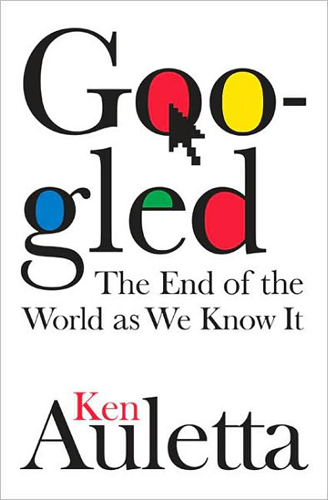 I just finished Ken Auletta’s latest book, Googled: The End of the World As We Know It, and I highly recommend it. Auletta is an amazingly gifted journalist and knows how put together a hell of good story. It helps in this case that he was granted unprecedented access to the Google team and their day-to-day workings at the Googleplex. I’m really shocked by the level of access he was granted to important meetings and officials–over 150 interviews with Googlers, including 11 with CEO Eric Schmidt and several with founders Sergey Brin and Larry Page. That’s impressive.
The book shares much in common with Randall Stross’s excellent Planet Google: One Company’s Audacious Plan to Organize Everything We Know, which I reviewed here earlier this year. Both books recount the history of Google from its early origins to present. And both survey a great deal of ground in terms of the challenges that Google faces as it matures and the policy issues that are relevant to the company (privacy, free speech, copyright law, etc).
What makes Auletta’s book unique is the way we taps his extensive “old media” world contacts and integrates such a diverse cast of characters into the narrative — Mel Karmazin (former Viacom, now Sirius XM), Bob Iger (Disney), Howard Stringer (Sony), Martin Sorrrell (WPP), Irwin Gotlieb (Group M), and even the Internet’s “inventor”–Al Gore! Auletta interviews them or recounts stories about their interactions with Google to show the growing tensions being created by this disruptive company and its highly disruptive technologies. There are some terrifically entertaining anecdotes in the book, but the bottom line is clear: Google has made a lot of enemies in a very short time.
Indeed, the book is as much about the decline of old media as it is about Google’s ascendancy. What Auletta has done so brilliantly here is to tell their stories together and ask how much old media’s recent woes can be blamed on Google and digital disintermediation in general. “If Google is destroying or weakening old business models,” Auletta argues, “it is because the Internet inevitably destroys old ways of doing things, spurs ‘creative destruction.’ This does not mean that Google is not ambitious to grow, and will not grow at the expense of others. But the rewards, and the pain, are unavoidable,” he concludes. Continue reading →
My colleague (and boss) Adam Thierer had a great post last week about how “fart apps” are a great example of the generative nature of the mobile phone application marketplace. But Fart apps are just one type of “soundboard” application. A typical soundboard app has a bunch of buttons, and each time you press a button a sound is played. Most soundboards play catchphrases from popular movies and TV shows. According to AndroidZoom.com, there are 319 applications in the Android Market with “soundboard” in the title or description. Most (280) of them are free.
Almost all the free soundboards I tried include advertising from Google. The three main developers of soundboard apps for Android are Androidz , aspidoff, and Raz Corp. Androidz has ads from DoubleClick and aspidoff and Raz Corp (who’s apps seem exactly the same) both have ads from AdMob (which Google recently acquired). I’m all in favor of ad-supported content, but I suspect that the sound clips used in these soundboards are not licensed.
Continue reading →
My PFF colleagues Berin Szoka and Adam Thierer have written many times about the quid pro quo by which advertising supports free online content and services: somebody must pay for all the supposedly “free” content on the Internet. There is no free lunch!
Here are two two recent examples I came across of the quid pro quo being made very apparent to users.

Hulu. Traditionally, broadcast media has been a “two-sided” market: Broadcasters give away content to attract audiences, and broadcasters “sell” that audience to advertisers. The same is true for Internet video. But watching Hulu over the weekend, I noticed something interesting: Adblock Plus blocked the occasional Hulu ad but every time it did so, I was treated to 30 seconds of a black screen (instead of the normal 15 second ad) showing a message from Hulu reminding me that “Hulu’s advertising partners allow [them] to provide a free viewing experience” and suggesting that I “Confirm all ad-blocking software has been fully disabled.”
Although I use AdBlock on many newspaper websites (because I just can’t focus on the articles with flashing ads next to the text), I would much rather watch a 15-second ad than wait 30 seconds for my show to resume. I think most users would feel the same way. We get annoyed by TV ads because they take up so much of our time. If Wikipedia is to be believed, there’s now an average of 9 minutes of advertisements per half-hour of television. That’s double the amount of advertising that was shown in the 1960s.
But online services such as Hulu show an average of just 37 seconds of advertising per episode. Amazingly, some shows garner ad rates 2-3 times higher than on prime-time television. Why might ad rates for online shows be higher? Because:
Continue reading →


 The Technology Liberation Front is the tech policy blog dedicated to keeping politicians' hands off the 'net and everything else related to technology.