As I previously reported, the DC Circuit recently upheld a decision by the FCC to forbid customer retention practices used by Verizon to incentivize its customers to stay with the carrier rather than leaving for a VOIP provider. In the earlier post, I analyzed the bad economics of the FCC’s ban. In this post, as promised, I go into greater detail on the court’s decision affirming the FCC.
The latest issue of the Center for Internet and Society’s publication, Packets, has arrived and with it my summary of the case. The Packets piece provides a more neutral (but detailed) summary of the DC Circuit’s decision, without much analysis.
The big question before the court was whether what the FCC did was really pursuant to the Telecommunications Act, which forbids a telco “that receives or obtains proprietary information from another carrier for purposes of providing any telecommunications service” from using the information for a marketing purpose. If not, then essentially the FCC just went AWOL; instead of enforcing the law, as it is supposed to, it simply made its own law.
Indeed, that is exactly what happened here. The natural reading of the language, as the court admits, is contrary to the FCC’s ruling. To use an example employed by the court, when one says “Joe received information from Mary for purposes of drafting a brief,” the court reasoned, “it is overwhelmingly likely that the speaker expects Joe to do the drafting.” But Verizon is getting the information from other telcos not in order to provide their customers with phone service, but to cut off service. It is the competitors who are using the information to provide phone service. Mary is drafting the brief, so the statute doesn’t apply! The court never fully explains why it refuses to limit the statutory language to its natural meaning – saying only that one could grammatically read it the other way. Continue reading →
I’ve already laid out my own reactions to Google’s roll-out of an “interest based advertising” (IBA) program here. In a nutshell, I applauded Google setting a new “gold standard” in user empowerment by providing:
Notice in their IBA-targeted ads of who’s paying for the ad and the fact that Google is serving it; and
See and modify the “digital dossier” (to use the fearmonger’s term) of interests associated with the cookie on their computer; and
Opt-out of tracking for IBA purposes.
But as I predicted, despite these pro-privacy features (and despite the fact that other major companies such as Yahoo! and Microsoft already have IBA programs), a number of privacy advocacy organizations are attacking Google for daring to enter the IBA (or “online behavioral advertising”) business at all. I’ll have much more to say about the criticism of Google’s new Ad Preference Manager soon, especially coming from Marc Rotenberg of EPIC (a “disaster“) and Jeff Chester of CDD—precisely the sort of the “paroxysms of privacy hysteria” I predicted.
But first, the criticism from Ari Schwartz of the Center for Democracy & Technology requires a response today. At its best, CDT plays a vital role in calling corporations to continually raise the bar on privacy. My own think tank, the Progress & Freedom Foundation, works closely with CDT on many issues, such as advocating user empowerment through technological means as a constitutionally “less restrictive” way of protecting children than government censorship.
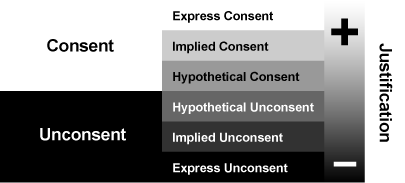
Theories constitute the technology of academia. They give us eggheads the tools we need to get our work done, just as computers serve programmers and DNA sequencing serves bioengineers. I trust that TLF’s readers won’t think me too far off-topic, then, if I cite a new approach to consent theory, something that should interest anyone who cares about the fundamental reasons for valuing of liberty. Here’s a snapshot of the theory:
To get the full story, please see that figure’s source: Graduated Consent Theory, Explained and Applied, Chapman University School of Law, Legal Studies Research Paper Series, Paper No. 09-13 (March 2009) [PDF]. The paper reviews the importance of consent in legal, moral, and economic reasoning, and develops a model of the relationship between consent and justification. It concludes by applying that model to a number of practical problems. Most notably, in contrast to both originalism and “living constitutionism,” the paper promotes interpreting the Constitution according to the plain, present, public meaning of its text and resolving ambiguities in favor of individual liberty.
One hopes not. But the White House’s 60-day review of cyber security, ongoing now, could set the stage for it.
In a TechKnowledge piece out today, I argue against federal responsibility for private cyber security. A common law liability regime is the best route to discovering and patching security flaws in all the implements of our information economy and society.
Today, it was my great privilege to guest lecture at Princeton University’s Center for Information Technology Policy. Under the leadership of Ed Felten, who also runs the excellent “Freedom to Tinker” blog, the CITP has quickly become one of America’s premier institutions in the field of IT policy matters. David Robinson, who some of you will remember from his days as an editor at The American, serves as associate director of the CITP program and was kind enough to invite me to speak. And our own Tim Lee is currently studying there as well. I wish I was smart enough to get into that program!
The topic of my talk was “The Future of the First Amendment in an Age of Technological Convergence” and I used the opportunity to create a narrated video of this presentation, which I have made to several other groups through the years. In this presentation, I talk about “America’s First Amendment Twilight Zone,” which refers to the fact that identical words and images are being regulated in completely different ways today depending on the mode of transmission. This illogical and unfair situation could eventually threaten the Internet, video games, and all new media with many of the misguided regulations that have long been imposed on broadcast television and radio operators. In my presentation, which you can watch below, I make the case for changing our First Amendment regime to ensure “bit equality”; all speech and media platforms should be accorded the gold standard of First Amendment protection.
Google’s new “Interest Based Advertising” (IBA) program represents the company’s first foray into what is generally called “Online Behavioral Advertising” (OBA): In order to deliver more relevant advertising, Google will begin tailoring ads delivered through AdSense on the Google Content Network (GCN) and YouTube.com (but not Google.com). This tailoring will be based on a profile of each user’s interests created by tracking their browsing activity across sites that use AdSense-but not search queries or other user information. Until now, (i) AdSense has delivered essentially “contextual” advertising by choosing which ad to display on a page based on an algorithmic analysis of keywords on that page; and (ii) Google has tracked users’ browsing only for analytics purposes-to limit the number of times a user sees a particular ad (to prevent overexposure) and to allow sequencing of ads in campaigns where one ad must follow another.
Google is sure to be attacked for crossing a “line in the sand” drawn by some privacy advocates between contextual and behavioral advertising-even though Google’s closest competitor, Yahoo!, already offers a similar program, and the concept in general is hardly new. Google’s position as the leading search engine and third party ad-delivery network will no doubt cause paroxysms of privacy hysteria among those who consider targeted advertising inherently invasive, unfair or manipulative.
But those whose first priority is advancing consumer privacy, not advancing a political or regulatory agenda, should applaud Google for excluding sensitive categories and for putting the new Ad Preference Manager at the core of the company’s new IBA program. The Ad Preference Manager sets a new “gold standard” for implementing the principles of Notice and Choice, which have formed the core of both OBA industry self-regulation and the various regulatory proposals made in recent years. Indeed, Google has done precisely what Adam Thierer and I have called for: giving consumers more granular control over their own privacy preferences by developing better tools.
I recently wrote on Cato@Liberty that we should not mourn the passing of business models. Tim Lee extolled the virtues of creative destruction here, in response to a Jim DeLong piece in The American preparing the obituary for the news business and predicting its replacement by government-sponsored news.
Conversations about how the Internet can be used to increase the openness and accountability of government usually focuses on the Executive and Legislative branches of the Federal government. But on this week’s episode of Technology Policy Weekly, I hosted a discussion of the equally vital issue of public access to court records, joined by:
The TLF’s own Tim Lee, who’s written about the problems with PACER , the arcane and expensive system by which court documents are currently made publicly available—with a separate system for each of the 100+ Federal courts!
Why lay people should care—this is ultimately about reducing the legal profession’s monopoly over access to the courts!
The philosophical reasons why better access to court records is important – little things like democracy, fairness, consistency, equality, the rule of law, etc.
The copyrightability of legal records
The history of the problem & what can be done about it
There are several ways to listen to the TLF Podcast. You can press play on the player below to listen right now, or download the MP3 file. You can also subscribe to the podcast by clicking on the button for your preferred service. And do us a favor, Digg this podcast!
As noted in the first installment of our “Privacy Solution Series,” we are outlining various user-empowerment or user “self-help” tools that allow Internet users to better protect their privacy online-and especially to defeat tracking for online behavioral advertising purposes. These tools and methods form an important part of a layered approach that we believe offers an effective alternative to government-mandated regulation of online privacy.
In some of the upcoming installments we will be exploring the privacy controls embedded in the major web browsers consumers use today: Microsoft’s Internet Explorer (IE) 8, the Mozilla Foundation’s Firefox 3, Google’s Chrome 1.0, and Apple’s Safari 4. In evaluating these browsers, we will examine three types of privacy features:
(1) cookie management controls;
(2) private browsing; and
(3) other privacy features
We will first be focusing on the default features and functions embedded in the browsers. We plan to do subsequent installments on the various downloadable “add-ons” available for browsers, as we already did for AdBlock Plus in the second installment of this series. Continue reading →
The Technology Liberation Front is the tech policy blog dedicated to keeping politicians' hands off the 'net and everything else related to technology. Learn more about TLF →



 The Technology Liberation Front is the tech policy blog dedicated to keeping politicians' hands off the 'net and everything else related to technology.