What Do We Think of “Deep Packet Inspection”?
The concept of deep packet inspection has come up a couple of times here at the Progress & Freedom Foundation’s Aspen Summit. And I’ve been interested to find people in other fora talking about deep packet inspection in the way they used to talk about cookies: “You’ll get to like once you understand what it is.”
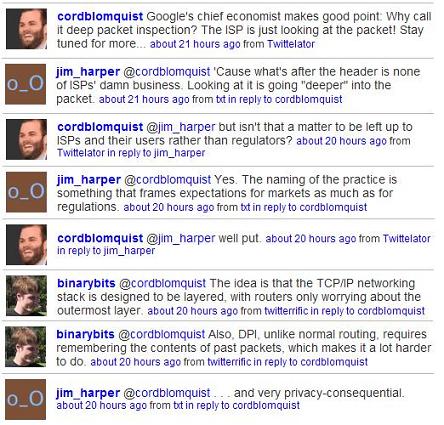
I’m not so sure. Here’s a sample discussion of the issue among us TLFers, conducted on Twitter yesterday. (I’ve reorganized the tweets, so you can read from top to bottom.)
blog comments powered by Disqus

Add New Comment
Viewing 11 Comments
Thanks. Your comment is awaiting approval by a moderator.
Do you already have an account? Log in and claim this comment.
Also, I think you need a better Twitter picture.
Do you already have an account? Log in and claim this comment.
DPI is inherently opt-out because you can always encrypt the payload of your packets if you don't want anybody inspecting them except the computer at the other end.
Do you already have an account? Log in and claim this comment.
Prioritizing VoIP is fine (if it is documented and the customer wants it), but today's DPI boxes are total overkill for that task and I suspect ISPs will always be tempted to use them against their customers' wishes.
Do you already have an account? Log in and claim this comment.
Besides, DPI is inherently opt-out because you can always encrypt the payload of your packets if you don't want anybody peeking inside except for the computer at the other end of the connection.
Do you already have an account? Log in and claim this comment.
I am not a huge fan of DPI, but I defend it because of its clear potential for creating wealth in ways that can benefit consumers. What's so bad about ISPs tracking keywords in unencrypted HTTP packets and using those keywords to deliver better targeted ads? As long as the user can trust that information about their browsing habits won't be turned over to a third party, and assuming there's a way to avoid having your packets inspected, there is a very strong case for allowing the market to develop DPI-based advertising technologies. Of course, with Phorm and NebuAd, there are serious concerns regarding the safety and trustworthiness of the third parties with access to potentially sensitive information. But once you resolve these trust issues, the case for DPI becomes much stronger.
I, for one, am more paranoid than most when it comes to privacy, so I would probably opt out of a DPI scheme or encrypt my data whenever feasible. Fortunately, it's already possible to do Google searches, browse Usenet, conduct financial transactions, and even login to Facebook under the protection of robust encryption.
Do you already have an account? Log in and claim this comment.
Second, DPI—unlike user-determined prioritization—will set off an arms race. If Skype, say, is given high-priority treatment, you'll soon find utilities that allow you to camouflage all of your traffic as Skype traffic. (And Skype traffic is encrypted and highly variable, so it's not going to be easy to distinguish) So ISPs are going to have to be constantly tweaking their prioritization rules in response to new attempts to game the system. IMHO, these long-run costs dwarf the short-term costs of re-designing end-user applications (or operating systems) to mark their packets by priority.
Finally, and most fundamentally, the proliferation of DPI would mean a massive increase in Internet complexity. Right now, you write an application for vanilla TCP/IP and you can be reasonably sure your packets will get "most favored nation" treatment on every network they encounter. In a future world of ubiquitous DPI, every ISP would have slightly different rules for getting your application qualified for prioritization. Developing a latency-sensitive application would require reading the specs of dozens of different ISPs and possibly negotiating with dozens of telecom bureaucracies for favorable treatment. The result will be that launching a new application will be far more complicated and expensive than it is now, and the success of an application would be based on the developer's ability to negotiate favorable DPI treatment, not the application's intrinsic value.
I should emphasize that I think this is a sufficiently awful idea that regulation isn't necessary to prevent it from happening. ISPs will abandon it relatively quickly once they discover what a headache it is. I think ISPs should be allowed to try it if they want to, but I plan to criticize any that do.
Do you already have an account? Log in and claim this comment.
I still don't the idea that the 1986 federal wiretap law might prohibit many forms of deep packet inspection. DPI may well be a bad idea, but I'd rather it be allowed to live or die on its own merits.
Add New Comment
Trackbacks