IP: An Odd Monopoly
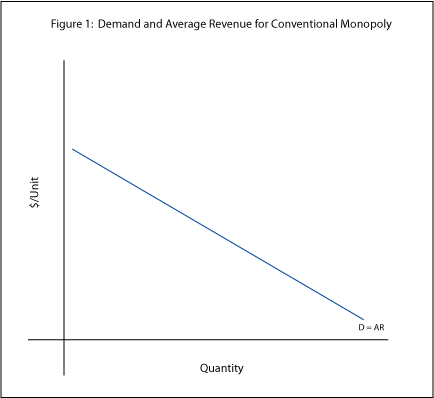
When economists draw graphs to describe monopolies, they typically represent both average revenue (i.e., price) and aggregate demand with a single line. Why? Because they assume that, by dint of revealed preference theory, sales of a good reveal the demand for it, and that a monopolist, by definition, alone satisfies the demand for a particular good. See figure one, below.
I question, though, whether that sort of graph does an adequate job of describing the sorts of monopolies protected by copyrights and patents. Because the law does not protect them perfectly, those sorts of “intellectual privilege” (the term I advocate in lieu of “intellectual property”) suffer unremunerated uses. Some such uses happen through infringement, such as street corner sales of pirated DVDs. Others happen by dint of special legislative exceptions, such as the unlicensed public performances of musical works allowed to certain small commercial retail establishments.
Conventional monopolies, dealing in conventional goods, don’t typically suffer a material gap between price and demand. The law does a pretty good job of preventing the theft and resale of electrical power, for instance. Physics makes that and most other goods fairly easy to protect from trespass. IP (which, recall, stands for “intellectual privilege”) proves rather more difficult to bottle up, however. The law often fails to ensure that all the price—in time, effort, and sometimes cash—that consumers pay to use copyrights and patents ends up in the hands of IP owners. Figure 2, below, offers a picture of that phenomenon.

Even though it offers twice the lines of figure one, I grant that figure two remains rather sparse. Interesting things start to happen, though, when you use figure two as a foundation for more complicated pictures of the supply and demand for IP. You may note, too, that if figure 2 describes IP, it should likewise describe monopolies in other public goods—most notably, in the supply of government services. I’ll hold off on exploring those ideas for now, though, as you readers may convince me to nip this particular experiment in the bud.
[NB: In the original version of figure two, the gap between AR and D held constant regardless of quantity. After some reflection, I edited it to instead show the two in constant proportion. That makes more sense as a matter of theory, since we would expect less recourse to unremunerated uses of a copyright work if it were licensed at a very cheap rate. Casual observation suggests the same result. Nobody, for instance, bothers trying to pirate the daily newspaper.]
[Crossposted to Agoraphilia.]
blog comments powered by Disqus

Add New Comment
Viewing 5 Comments
Thanks. Your comment is awaiting approval by a moderator.
Do you already have an account? Log in and claim this comment.
First (to address the question of explaining the distance between lines AR and D in Figure 2) the distance between these lines is created by the availability of "free" content (legal and illegal).
To explain, as you correctly note, the demand line is an "aggregate" line. As an aggregate line it is the sum of alternate, substitute, and similar demand. Furthermore, demand is not necessarily for a discrete physical product. For example, buying a book is not the "demand" of line D. The demand of line D is more appropriately "three hours of recreational time" since the book buyer could have gone fishing (alternate), could have bought a DVD (substitute), or could have bought a book of a different title (similar).
Now if you consider the time spent on the TLF as recreational (in competition with buying a book), this "free" non-monetized time pushes line AR to the left away from line D. We could also say that going to the library and checking the book out would have the same effect of pushing line AR away from line D.
------------------------------------------------
Second, the implicit assumption that IP owners are somehow being victimized needs to be questioned and tested. My viewpoint is that we are dealing in shades of gray. Tim in "Good Fences Make Good Neighbors" (TLF, 8/24/200) reiterates that we need clear property lines to establish ownership. Artistic content, in many cases, lacks clear property lines because of its subjective nature.
Furthermore, many content producers are now asserting so-called rights, that I believe they do not possess, to take away the rights of the consumer. In a sense, we can say that the content producers, in some cases, are "stealing" from the consumer. So when I read statements such as "Some such uses happen through infringement, such as street corner sales of pirated DVDs. my red-herring detector goes bonkers.
------------------------------------------------
You raised the issue of "government services". Again I wonder if this is a precursor for somehow concluding that the government should not be involved in the free market system. My belief is that the government services have a right to participate and if private industry can't compete too bad. Private industry has no intrinsic right to a profit.
Do you already have an account? Log in and claim this comment.
Personally, my biggest issue with the IP market is the goal of copyright itself. It's designed to encourage innovation, but due to increasingly lock-down approaches to enforcing it, the borrowing and reshaping that drives artistic innovation is being cut off.
...At least in my opinion.
Do you already have an account? Log in and claim this comment.
Of course, the sale of goods in the secondary market is still an economic benefit and can still provide subsequent revenue to the original producer through ancillary sales.
Do you already have an account? Log in and claim this comment.
Steve R.: I'm just trying to figure out how copyright works, right now. I won't pretend that I'm not predisposed to favor certain outcomes--my advocacy of "intellectual privilege" should show that much--but you shouldn't read too much into the present post.
David: I'm worried about the over-extension of copyright, too. Hence my effort in trying to get a firm grip on how to evaluate it as a matter of policy.
Steve R. (again): The price of the first sale should include the value of the future uses--including resales. For an excellent explanation of that idea, see Easterbrook's opinion in Lee v. A.R.T. Co., 125 F.3d 580 (7th Cir. 1997).